Salzburg Festival 2026 Review: Così fan tutte
By Karlo Radečić(Photos: © Monika Rittershaus, Salzburger Festspiele)
In 2020, the Salzburg Festival’s centenary program was reorganized due to restrictions concerning the coronavirus pandemic. As a result, Mozart’s opera “Così fan tutte” – which was not initially planned for that summer – had to be shortened and performed without an intermission. Conductor Joana Mallwitz and director Christof Loy had very little time to decide which cuts to make to the score, a process Mallwitz described as “painful” and undertaken with a “heavy heart.” There were indeed numerous cuts to the recitatives and within many musical numbers, and some of the arias and ensembles were removed completely.
Too Many Cuts in the Score
When it was announced that this year there would be an extended revival of that production (which was also seen in 2021), offering the opportunity to “reveal an even more precise, more detailed web of relationships” between the characters by means of reinstating “the cuts that were forced on” the conductor and the director, it seemed that a more or less complete opera would be presented in the same staging. However, as the opening night approached, the announced runtime was shortened and the word “extended” was dropped; in the end, it was billed simply as a “revival” (“Neuinstudierung” instead of the earlier “erweiterte Wiederaufnahme” in German terminology).
Of the several musical numbers completely cut in 2020, only Despina’s Act one aria, “In uomini! In soldati,” and Ferrando’s Act two aria, “Tradito, schernito,” were reinstated this year. Consequently, the second of the three trios for Ferrando, Guglielmo, and Don Alfonso at the beginning of the opera,“È la fede delle femmine,” the first appearance of the “Bella vita militar!” chorus, the Act two ensemble “La mano a me date,” and even Guglielmo’s aria from the same act,“Donne mie, la fate a tanti,” were still missing. To add to that, there were still some very questionable cuts within other numbers – for example, the one after the orchestral introduction of the Act two finale, skipping the finale’s opening verses so that everything starts straight with Despina’s and Don Alfonso’s “La più bella commediola.” What was done out of necessity during the pandemic, now seemed even more painful and – in the case of some cuts – simply unacceptable.
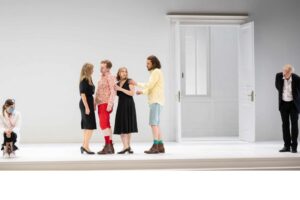
As Christof Loy’s production is minimalistic, stage designer Johannes Leiacker provides, for most of the time, only a white wall with two double doors on the huge stage of the Grosses Festspielhaus, filling the gaps in the score could have been easily done, as in the case of the reinstatement of Despina’s and Ferrando’s arias. Keeping many of the cuts from the original production distorted the structure of the opera and prevented the audience from experiencing full portraits of some of the characters. In the second Act, between the two duets of seduction – “Il core vi dono,” in which a disguised Guglielmo seduces Dorabella, but we are certain that only she has fallen in love, and “Fra gli amplessi,” in which Mozart’s music unmistakably suggests that Fiordiligi and a disguised Ferrando are kindred spirits, and that they have both fallen in love with each other – the composer placed an aria for each participant in Don Alfonso’s “school for lovers” (the alternative title of the opera – and the original title of Lorenzo da Ponte’s libretto – is “La scuola degli amanti”). This year, the Act two arias of Fiordiligi, Ferrando, and Dorabella were all performed, but poor Guglielmo was deprived of singing his “Donne mie, la fate a tanti.”
Surprisingly, in the first act, he was now assigned the elaborate and rarely performed aria “Rivolgete a lui lo sguardo,” which Mozart – deeming it dramatically inappropriate – had replaced before the first performance with the shorter and musically superior “Non siate ritrosi,” also heard in the original 2020 production.
Christof Loy’s Minimalism
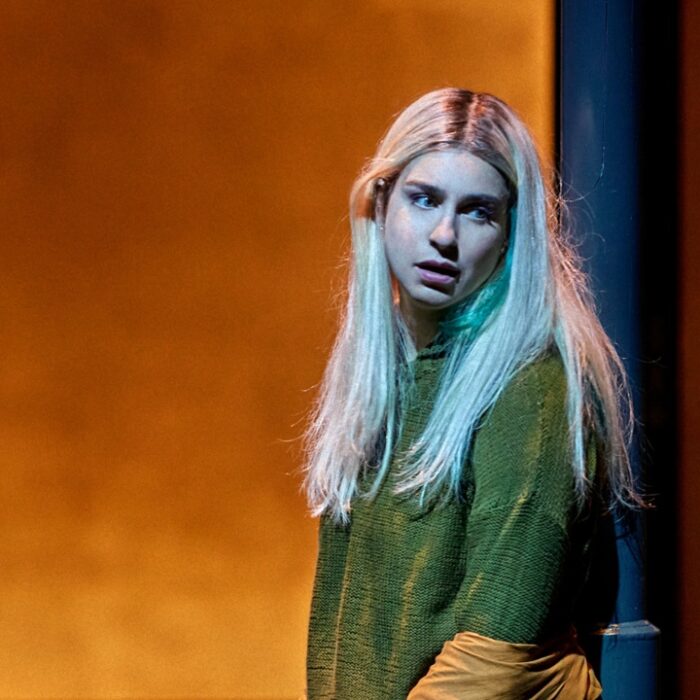
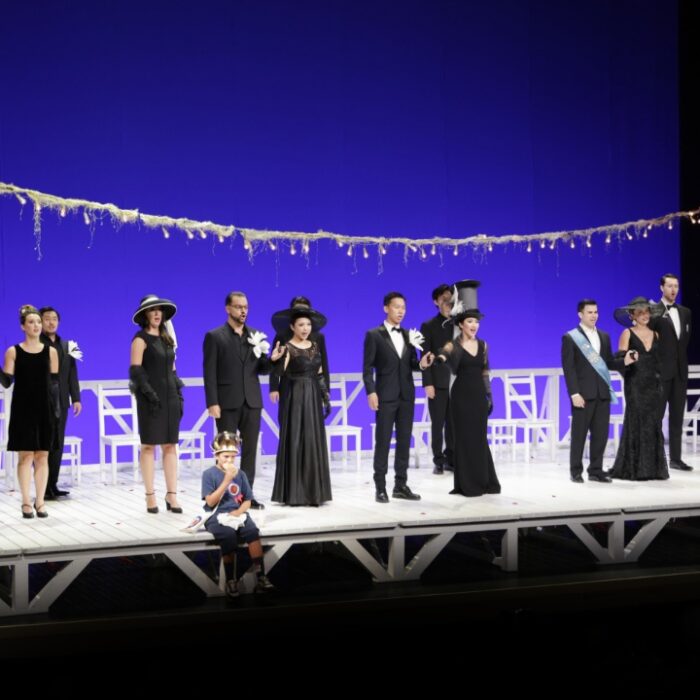
In his own words, the director Christof Loy wanted “to release the characters from any concrete context so that one can perceive them as human beings, not historical figures from 18th century Naples.” The staging therefore dispenses with all stage props, and all six characters initially wear contemporary black-and-white clothes, with the disguised Ferrando and Guglielmo later appearing in bright colors and shorts with costumes designed by Barbara Drosihn. There is, of course, nothing wrong with setting the opera in a coastal city in southern Italy, but Loy’s approach works. Everything concentrates on the characters and their emotions, and all six soloists proved to be good actors – of the original 2020 cast, only Marianne Crebassa, in the role of Dorabella, did not return.
The director successfully investigates the psychology of the characters who inhabit Mozart’s unsettling “dramma giocoso” and does not try to outsmart the composer. He takes the four lovers seriously and shows that loving someone can be both fulfilling and painful, but does not deprive the production of comedy. In the two finales, Despina still masquerades as a doctor, here a female one, with a “pietra mesmerica” and as a notary who reads the marriage contract in “clara voce,” and the audience laughs a lot during the performance.
When a scene in which Ferrando and Guglielmo sing the duet “Secondate, aurette amiche” calls for a garden on a seashore, in Loy’s production, the two parts of the huge white wall move apart to reveal a big plane tree against a black background, at that moment Guglielmo and Ferrando can be seen in new costumes, and when Fiordiligi, in the recitative preceding the “Fra gli amplessi” duet, decides to go to the battlefield in a soldier’s uniform to seek her beloved (who is still Guglielmo), she does put on Ferrando’s suit. Less convincing were some long pauses in the recitatives, for example in Despina’s “Che vita maledetta è il far la cameriera!” – sung while she whipped the chocolate for Dorabella and Fiordiligi.
Committed, Yet Uneven Conducting
The Vienna Philharmonic gave an excellent performance of Mozart’s score, highlighted by admirably executed woodwind solos – most notably the delicate phrasing of a solo oboe accompanying Fiordiligi’s surrender to Ferrando in “Fra gli amplessi” – as well as the prominent solos of the two horns in Fiordiligi’s Act two aria “Per pietà, ben mio, perdona.”
Conductor Joana Mallwitz built a coherent web of tempo relations across the score and paid close attention to phrasing details, including the two bars of violin accompaniment when Fiordiligi addresses Ferrando with “Taci… ahimè!” in their duet. Although one could distinctly sense her love for “Così fan tutte” – as was evident when she beautifully shaped the farewell quintet “Di scrivermi ogni giorno” and the trio “Soave sia il vento” – Mallwitz’s conducting in general felt uneven (as heard on August 11).
Due to an excessive focus on details, the sense of a satisfying whole was occasionally lost, as was the case in the aforementioned duet “Fra gli amplessi,” which is composed of several sections with different tempos and time signatures, and was here performed without cuts. There was also more than one moment when the singers and the orchestra were clearly out of sync. The chorus, deprived of some of its music, sang offstage throughout the evening.
At the fortepiano – which could often be heard outside the recitatives – Pedro Beriso was playful, perhaps even too playful at times. There were interesting examples of playing lead-ins to musical numbers, such as in the exquisite trio “Soave sia il vento,” as well as some colorful conversation between the fortepiano and the orchestra; however, the instrument was occasionally too prominent. In Ferrando’s “Un’aura amorosa,” one of the most beautiful tenor arias ever written, it is the singer who should shine, without the fortepiano trying to steal the show, however briefly, with its interventions.
The Highlight of the Cast: Fiordiligi
When it comes to the quartet of lovers who are taking part in Don Alfonso’s experiment, the singing of the sisters was more convincing than that of the officers. Elsa Dreisig’s soprano and Victoria Karkacheva’s mezzo blended very pleasantly, making the duet “Ah guarda, sorella” and the trio “Soave sia il vento” in Act one particularly beautifully rendered.
The strongest link in the cast was Elsa Dreisig’s Fiordiligi. In the well-known Act one aria “Come scoglio” – where Fiordiligi tries hard, perhaps too hard, to demonstrate her constancy – Dreisig’s full lyric soprano, whose vibrato sounded healthy and natural throughout the evening, easily delivered both precise high notes and well-projected low notes, although the latter were not always sung in the juicy chest register. There were some interesting melodic embellishments, too. Her rendition of the Act two rondò “Per pietà, ben mio, perdona” – a model for Leonore’s aria in Beethoven’s “Fidelio” – was also executed at a high technical level, featuring precise melodic leaps and, for the most part, a convincing low register. Dreisig’s portrayal of Fiordiligi was always believable, from the light-hearted admiration of Guglielmo in “Ah guarda, sorella” to being overpowered by emotion in “Fra gli amplessi.”
Victoria Karkacheva showed considerable technical control in Dorabella’s demanding Act one aria, “Smanie implacabili.” Her musical portrait of the character was distinguished by a richness of tone and an appealingly dark vocal timbre, heard to her best advantage in the Act two aria “È amore un ladroncello.” Her diction, however, was not particularly clear.
Tenor Bogdan Volkov, one of the most sought-after Ferrandos in recent years, demonstrated both vocally and through his acting the delicate lyrical nature that characterizes the role. Regarding the passages composed in a more brilliant or dramatic style, he was more successful in the Act two aria, “Tradito, schernito,” than in “Una bella serenata,” the last of the introductory trios in Act one, where his opening phrases lacked ease. Volkov was at his most vocally convincing during moments of tender phrasing and piano singing, as in the “Volgi a me” section in the marvellous duet with Fiordiligi. However, in Ferrando’s first aria, “Un’aura amorosa,” perhaps the most famous number in the opera, his voice did not sound entirely fresh and – despite elegant legato singing – left something to be desired in terms of purity and nobility of tone.
André Schuen’s macho-type Guglielmo was distinguished by the singer’s dedication to word coloring, as is to be expected from a musician active both in opera and Lied. This was clear in his performance of the duet “Il core vi dono,” where he easily seduced Dorabella, though one might have wished for a more mellifluous interpretation. As already stated, Schuen was unfortunately deprived of Guglielmo’s Act two aria, while opting for the “Rivolgete” aria in the first Act was not particularly fortunate, as it demands a more powerful baritone voice.
As a well-sung and lovable Despina, Lea Desandre offered some tasteful melodic variations in her Act two aria, “Una donna a quindici anni,” and charmed the audience during her disguises in both finales. Johannes Martin Kränzle demonstrated musical and stage intelligence in his interpretation of Don Alfonso. He was also vocally reliable; his expressive phrasing significantly contributed to the overall enjoyment of “Soave sia il vento.”
Despite some shortcomings in conducting and singing, there was much to enjoy in this “Così fan tutte.” One can only hope for a new revival of this production that will present Mozart’s masterpiece in its completeness. The audience of the Salzburg Festival deserves nothing less.