Rossini Opera Festival 2026 Review: Il viaggio a Reims
By Bernardo Gaitan(Photo: Rossini Opera Festival)
“The Journey to Reims” occupies a singular place in Gioachino Rossini’s catalogue today: few could have imagined that a work conceived as a circumstantial celebration of the coronation of Charles X would, two centuries later, become one of the most emblematic titles of the Rossini Opera Festival (ROF) in Pesaro and a veritable testing ground for new generations of bel canto singers.
Composed in 1825 to a libretto by Luigi Balocchi, the opera was conceived as a dramma giocoso intended to celebrate the coronation of Charles X in Paris. Its plot brings together, at a spa in Plombières, an improbable group of aristocrats, artists, and travelers from different European nations, all eager to reach Reims to attend the ceremony. The journey, however, never takes place, and they end up organizing their own grand celebration at the hotel.
Its modern revival was one of the major events of the so-called Rossini Renaissance. In 1984, the ROF returned the work to the stage through a scholarly reconstruction conducted by Claudio Abbado and staged by Luca Ronconi. Since then, the title has received numerous international productions and has progressively approached one hundred stagings and nearly one thousand performances.
In Pesaro, moreover, it acquired a particularly significant role: for approximately a quarter of a century, it has been one of the principal vehicles for presenting the young singers of the Accademia Rossiniana “Alberto Zedda,” as part of the Festival Giovane. Its ensemble structure, abundance of characters, and virtuosic demands make the work a genuine challenge for performers seeking to master the Rossinian language.
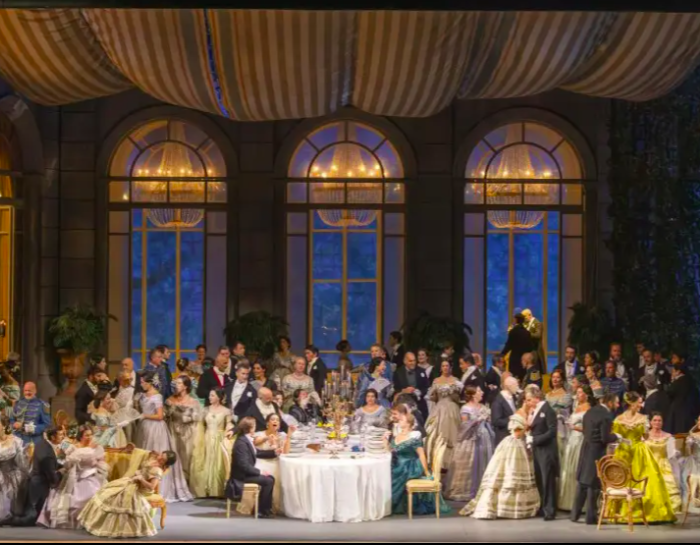
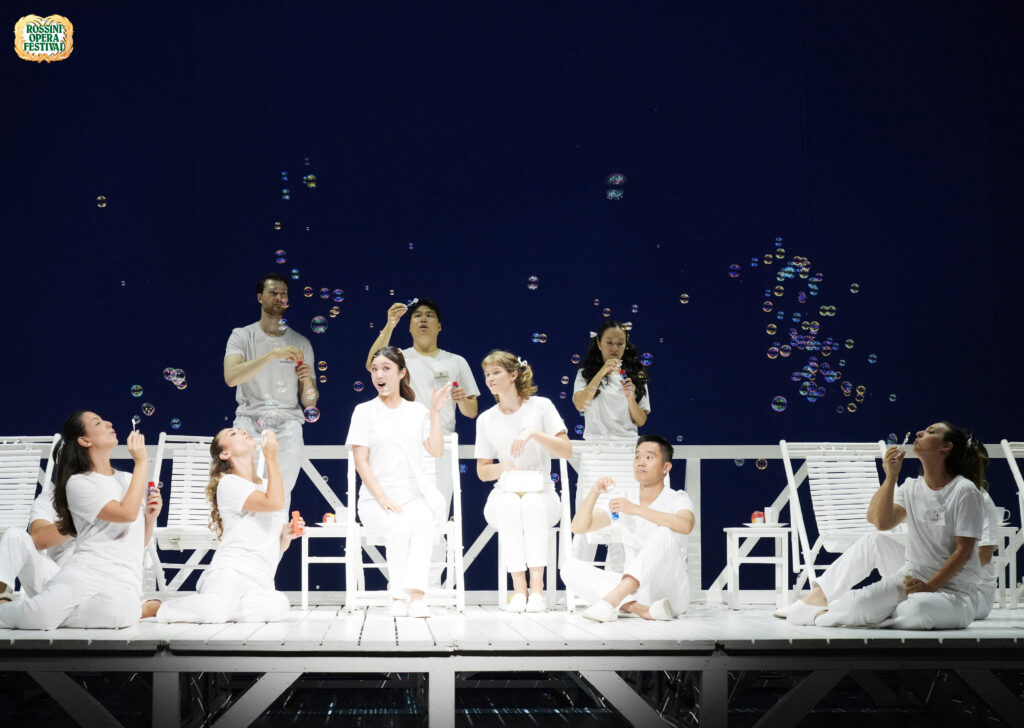
This is where the now-historic production by Emilio Sagi, created in 2001 with sets and costumes by Pepa Ojanguren, comes in, with its revival curated annually by Matteo Anselmi. Over the years, the production has accompanied the development of several generations of young performers and has become, more than a simple revival, one of the rituals of the Rossinian summer in Pesaro.
Musical & Vocal Performance Details
In this edition, leading the Orchestra Filarmonica Gioachino Rossini, the young conductor Sieva Borzak opted for an agile and meticulous reading, particularly attentive to timbral detail, with fluid strings and finely shaped winds. The orchestra responded with cohesion and clarity, confirming a solid stylistic command of the bel canto repertoire. Overall, the result was a vibrant and rhythmic performance, in which the Italian-Russian conductor balanced dynamics and expressive contrasts with considerable skill. Supported by broad and energetic gestures, Borzak’s conducting stood out for its vitality in the final ensembles, sensitively highlighting the different dynamics of the score.
On stage, the first cast of young singers demonstrated an exceptionally high level as a whole, confirming that youth and tremendous talent can go hand in hand. Despite the large number of extra-EU performers, the vocal and acting standards of the singers were very high.
Kanako Tominaga portrayed the proprietor of Il Giglio d’Oro with excellent high notes and agility in the rapid-fire passages. Her Madama Cortese displayed a very strong command of the stage during her aria, “Di vaghi raggi adorno,” although she was at her best in the sillabato and the speed of the final section, “Or state attenti, badate bene.” For her part, Martina Saviano’s voice as Corinna, the Roman improvisatrice, demonstrated an excellent command of legato, both in the angelic “Arpa gentil,” accompanied from the royal box, and in the final improvisation, “All’ombra amena,” where she distinguished herself as a true bel canto poetess.
The fashion-loving Contessa di Folleville, always concerned about her ruined wardrobe, was portrayed by Aziza Omarova who was clear, musical, and well suited to the role in her aria “Partir, o ciel! desio.”
The pairing of Count Libenskof, sung by Enrico Basso and his beloved Marchesa Melibea, portrayed by Martina Myskohlid, was solid both vocally and dramatically. The tenor’s voice was elegant and refined, particularly in the upper register, while the mezzo-soprano’s was velvety and generous. Both displayed exceptional stage presence in the duet “Di che son reo? D’alma celeste.”
For his part, the seductive Cavalier Belfiore, portrayed by Yukang Zheng, was uninhibited on stage and possesses the classic light-tenor voice ideally suited to this repertoire. His duet “Nel suo divin sembiante” with Corinna was amusing and well executed, as was his Italian pronunciation. Equally convincing and engaging was Davor Nekjak as Don Profondo, who also demonstrated excellent Italian diction and was particularly well received for the traditional imitation of accents from other languages in his aria “Medaglie incomparabili.”
Edoardo Di Cecco as the Barone di Trombonok, demonstrated a genuine command of stage interpretation, supported by solid vocalism. It is a pity that he did not have a solo aria. As Lord Sidney, William Meinert displayed a notably fine timbre, particularly in the lower register, as well as a good stage presence during his aria, beautifully accompanied by the flute.
Don Prudenzio, the hotel doctor, portrayed by Kairui Liu; as well as Don Alvaro sung by Taiyo Abe, both possessed good timbre, vocal homogeneity, and articulation. Nor should the consistently correct and stylistically appropriate contributions of Jiahui Mo (Luigino), Hana Ilcic (Delia), Hope Nelson (Maddalena), Madina Abildina (Modestina), Dongjae Son (Zefirino/Gelsomino), and Keisuke Onoda (Antonio) be overlooked.
Long may this now-traditional production in white coats of this extraordinary Rossinian title continue. For those who follow it year after year, it offers the opportunity to witness the remarkable number of outstanding singers who pass through the Pesaro Academy. It is a production that allows audiences to enjoy these young talents who, in all likelihood, we will see in the future pursuing professional careers in opera houses and in the bel canto repertoire.