Arena di Verona 2026 Review: Nabucco
Nabucco at the Arena di Verona: Spectacle Without Babylon
By Ossama el Naggar(Photo: Arena di Verona)
There are few operas more congenial to the Arena di Verona than Verdi’s “Nabucco.” Its massed choruses, martial confrontations, religious fervor and rhetoric of tyranny and liberation seem almost purpose-built for the world’s most imposing open-air amphitheater. Yet the Arena’s colossal scale presents an equally formidable challenge: what magnifies spectacle can just as readily obliterate intimacy, and what fills the stage can distract from the drama. Stefano Poda’s “Nabucco,” revived at the Arena after its 2025 première, exemplifies both possibilities. It is an entertaining and visually arresting evening, but it is scarcely a convincing staging of Verdi’s opera.
Early Verdi is uneven territory. “Oberto” (1839), “Un giorno di regno” (1840) and “Alzira” (1845) have largely disappeared from the standard repertoire for good reason, while “Ernani” (1844) and “Macbeth” (1847) are indisputable masterpieces. “Nabucco”(1842), Verdi’s third opera and first major success, occupies the middle ground. Its continued prominence owes no small debt to the Hebrew slaves’ celebrated “Va, pensiero,” though the score contains several passages of considerably greater dramatic potency than its status as a choral warhorse might suggest, notably Abigaille’s “Anch’io dischiuso un giorno,” Nabucco’s “Dio di Giuda!” and the Act three confrontation between Nabucco and Abigaille.
Production Details
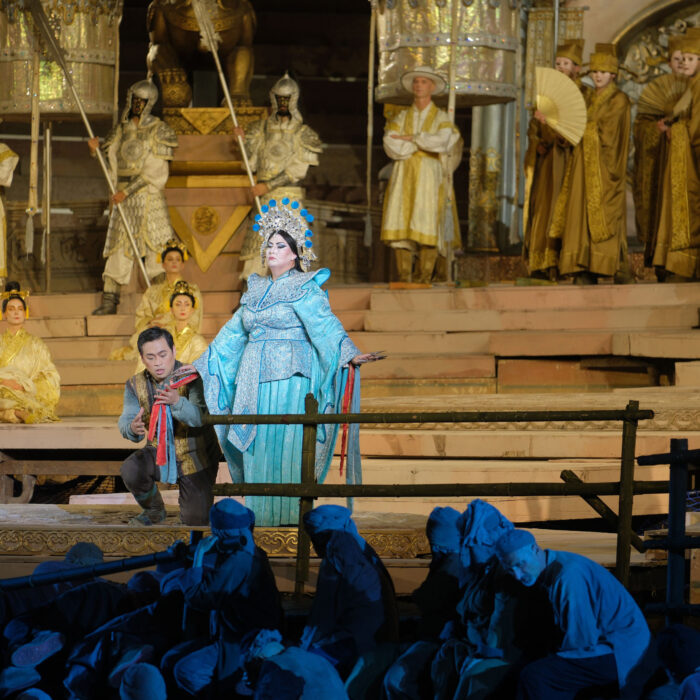
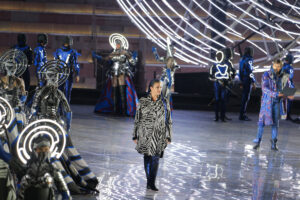
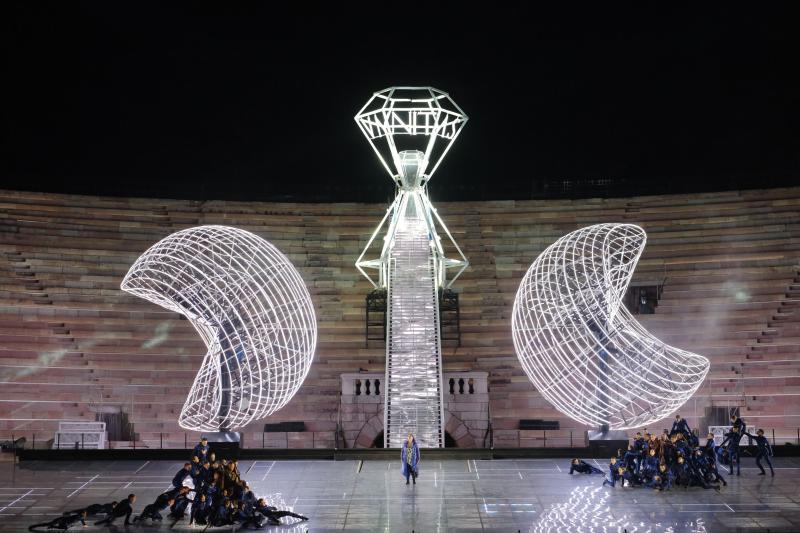
Poda’s production (seen August 8) is spectacular on a scale bordering on the delirious. As director, set and costume designer, lighting designer and choreographer, he has created an entirely self-contained visual universe in which historical Babylon has been replaced by a dystopian realm of monumental geometry, metallic surfaces, luminous costumes and ritualized movement. Two enormous hemispheres dominate the stage, repeatedly separating and converging; a gigantic transparent hourglass inscribed with VANITAS hangs over the proceedings like an elaborate memento mori, while a long staircase descends towards the stage bearing the Latin inscription “Forsan et haec olim meminisse iuvabit.”
It is undeniably arresting. It is also, increasingly, exasperating. Poda’s imagery inhabits a universe somewhere between science fiction, fantasy and an especially lavish Cirque du Soleil spectacular, with occasional visual echoes of “Star Wars” or “Krull.” The fluorescent tubes, illuminated costumes, geometric structures and Eighties-style dance vocabulary are difficult to reconcile with Verdi’s starkly direct drama. One has the uncomfortable impression that “Nabucco” has been displaced by a very expensive visual meditation on “Nabucco.”
The fundamental problem is not that Poda has rejected archaeological realism. No one requires a dusty reconstruction of ancient Babylon, and opera has no obligation to reproduce historical reality literally. The problem is that the production establishes no convincing alternative dramatic reality. At no point does one feel transported to ancient Jerusalem or Babylon; nor does the staging offer a sufficiently coherent futuristic world to replace them. If this is supposed to be a remote dystopia, then the religious and political dimensions of the drama have been stripped away with them. And if there is no Jerusalem, no Babylon and no convincing sense of antiquity, one eventually has to ask: where, precisely, is “Nabucco?”
Poda’s greatest virtue is nevertheless his extraordinary command of the Arena’s immense stage. He understands that such a space cannot simply be left vacant, and his solution is to populate it with seemingly inexhaustible ranks of singers, dancers, soldiers and extras. Bodies are deployed with almost military precision, forming constantly shifting geometric patterns. The prison-like cubes enclosing the Hebrews are striking, as are the austere symmetrical formations of the enslaved population. The first Act concertato is particularly effective: Nabucco stands at the centre of a vast human triangle, transforming the arrangement of bodies into a succinct image of political power.
Yet the staging repeatedly confuses movement with drama. Masses march, turn, kneel, assemble and disperse with such relentless regularity that one begins to admire the choreography while wondering whether anyone has remembered to direct the opera. The principals can become tiny components of a monumental machine, their relationships obscured by the elaborate formations surrounding them. At several points it was genuinely difficult to distinguish the protagonists from the identically costumed Hebrews (all in brown) and Babylonians (all in blue).
The fencing sequences are a case in point. Visually sleek, they have little to do with either Verdi’s world or the supposed futuristic one. The warriors move with balletic discipline, swords describing geometrical trajectories rather than threatening actual bodies. The effect is handsome but dramatically inert. Had the evening been an acrobatic spectacular for Cirque du Soleil, these tableaux might have been cause for unreserved admiration. As “Nabucco,” they are simply perplexing.
Poda’s compulsion to keep everything in motion becomes particularly wearing. The visual apparatus rarely permits Verdi’s music to breathe without an accompanying display of bodies, lights or machinery. Even the persistent clatter of footsteps on the stage structures becomes intrusive. There are moments when one longs for the stage to stop moving and allow the singers to inhabit the drama.
The irony is that Poda plainly possesses the imagination and technical discipline to make the Arena’s gigantic dimensions theatrically meaningful. His finest tableaux transform scale into dramatic language; his weaker ones merely demonstrate scale. The distinction is crucial. This is a production one can admire visually while remaining stubbornly unconvinced by it as theatre.
Arena di Verona
Musical Details
Fortunately, the musical performance provided a considerably firmer centre. Michele Spotti conducted with an assured command of early Verdi, maintaining a productive equilibrium between the score’s youthful theatricality and its often underestimated lyricism. His approach was energetic without being crude and dramatic without succumbing to the inflated bombast to which “Nabucco” can so easily succumb in an amphitheater. Climaxes were carefully graded rather than treated as invitations to unleash maximum decibels, and his phrasing gave the score welcome flexibility.
The Orchestra of the Fondazione Arena responded with precision and cohesion, while the chorus, prepared by Roberto Gabbiani, remained indispensable. Indeed, the chorus was the production’s most natural protagonist. When the Hebrews sing “Va, pensiero,” no elaborate visual apparatus is required to explain the emotion. The Arena chorus delivered it with concentration, sonority and commendable verbal clarity. The famous number emerged not merely as an obligatory crowd-pleaser but as the emotional distillation of an entire people’s yearning for freedom.
Marta Torbidoni as Abigaille
The vocal laurels, however, belonged unequivocally to Marta Torbidoni. After her impressive Lady Macbeth in Macerata’s “Macbeth” last summer and Leonora in “Il Trovatore” this summer, Torbidoni confirmed herself as a formidable interpreter of the more strenuous corners of the early Verdi repertoire. Abigaille is a notorious vocal minefield, demanding amplitude, agility, a secure lower register, rapid dynamic transitions and the stamina to sustain a part that seems almost deliberately designed to exhaust its soprano. Torbidoni met those demands with admirable professionalism and, more importantly, with genuine dramatic involvement.
Her “Anch’io dischiuso un giorno” was particularly telling. Rather than simply assaulting the Arena with sound, she allowed the pianissimo to reveal the wounded woman behind Abigaille’s pathological thirst for power. The contrast between vulnerability and fury gave the character dimensions that Poda’s staging conspicuously failed to provide. Elsewhere, the lower register occasionally betrayed fatigue, and the voice did not always possess the elemental ferocity that can make Abigaille genuinely terrifying. Nevertheless, Torbidoni was the evening’s most compelling stage presence and by some distance its outstanding vocal achievement.
Illuminating Cast
Francesco Meli brought comparable distinction to Ismaele. The part may lack a conventional showpiece aria, but Meli made every recitative, ensemble and confrontation count. His warm, focused lyric tenor and immaculate sense of line endowed Ismaele with emotional specificity, while his phrasing captured the character’s predicament as a man whose love has placed him between antagonistic peoples. There was ardor without sentimentality and desperation without vulgarity. Occasional signs of weariness in the upper register did little to diminish what was otherwise a performance of considerable elegance.
Youngjun Park in the title role possessed a pleasant, well-projected voice, but vocal amplitude alone cannot create a king. Nabucco requires something more imposing than agreeable sonority: he must initially dominate the stage as a figure of almost terrifying authority before the opera progressively strips him of his power, pride and certainty. Here, the voice remained oddly avuncular. At no point did the singer seem genuinely regal, imperious or dangerous. One could hear the baritone perfectly well; one rarely felt the presence of the Babylonian king.
This matters particularly in the final Act, when Nabucco’s transformation becomes the dramatic hinge of the opera. “Son pur queste mie membra!”and “Dio di Giuda” should reveal the human being beneath the conqueror’s armor. The singer was at his most effective when he reduced the scale of his delivery and allowed bewilderment and vulnerability to emerge, but the fundamental dramatic progression remained insufficiently defined. There was simply too little majesty at the beginning for its collapse to register as a genuinely consequential transformation.
Alexander Vinogradov offered a resonant, rounded bass as Zaccaria, with an authoritative manner of delivery and ample sonority. Unfortunately, his diction was inadequate and at times positively incomprehensible. In a work whose dramaturgy depends so heavily on rhetoric, declamation and the articulation of political and religious authority, indistinct verbal delivery is not a minor inconvenience. Anna Werle gave Fenena a warm, burnished mezzo and elegant legato, while Gabriele Sagona was an appropriately severe Grand Priest of Belo. The remaining supporting cast contributed efficiently.
A Spectacle Without Babylon
In the end, this “Nabucco” was an entertaining evening, and there is no denying its visual appeal. Poda has mastered the mechanics of the Arena with extraordinary sophistication; the massed bodies, monumental structures and constantly shifting tableaux frequently produce images of impressive grandeur. But spectacle is not synonymous with drama, and visual ingenuity is not a substitute for theatrical coherence.
The production’s central failure is that one is almost never persuaded that this is “Nabucco.” One sees a futuristic pageant, an elaborate choreography of bodies and machines, a succession of tableaux of considerable technical accomplishment. What one does not consistently see is Babylon, Jerusalem, a people in captivity, a conquering king, a religious struggle or the terrifyingly personal conflict between Abigaille and Nabucco. Poda has taken an opera already overflowing with grandeur and added yet more grandeur, without sufficiently asking what the grandeur is supposed to mean. The result is rather like an exquisitely engineered frame in search of a picture.
The musical performance ultimately rescued the evening. Spotti’s disciplined and theatrically alert conducting, the excellent Arena Orchestra and Chorus, and above all the outstanding Torbidoni and distinguished Meli restored much of the human dimension that the staging so frequently obscured. When the machinery receded and Verdi’s music occupied the foreground, the reason for “Nabucco’s” longevity became unmistakable.
For all its hemispheres, hourglasses, fluorescent costumes, marching bodies and monumental choreography, Verdi’s opera does not actually require much assistance in becoming spectacular. Its spectacle is already in the music. Its drama is already in the characters. Its political and religious conflicts are already in the libretto. The Arena merely supplies an enormous frame.
Poda’s finest moments demonstrate how magnificent that frame can be. His less successful ones demonstrate the danger of making the frame the subject. Visually sumptuous, vocally rewarding in parts and unquestionably entertaining, this “Nabucco” nevertheless remained, at its core, an elaborate spectacle in search of an opera.