Smetana Festival Litomyšl 2026 Review: The Devil’s Wall
Smetana’s Final Opera Proves to be a Revelatory Experience
By Alan Neilson(Photo: František Renzaj)
The Devil’s Wall is a large granite outcrop that overlooks the Vltava River in southern Bohemia. Below its jagged rock faces, a boulder field flows down the steep-sided valley to the river. It is a magical and mysterious place which today is part of a national park. Unsurprisingly, it is also a place of myth and legend. It is said that the Devil himself was responsible for this weird and strange-looking rocky feature, which he had constructed in a failed battle with God to control the world. Equally unsurprising is that Bedrich Smetana, the ‘father of the Czech national music’ whose love for his country’s landscape, culture, history and folklore was the inspiration for much of his music, used the Devil’s Wall as the basis for his eighth and final opera.
The librettist’s, Eliška Krásnohorská, original vision was to create a serious drama centered on the struggle between the Devil and the Church, but Smetana, who wanted a lighter, comic drama, intervened to create a romantic comedy with a strong love interest involving Lord Vok’s search for a bride that played alongside the Devil and the Church’s battle over the building of a monastery. The effect was to create a work that shifts radically between amusing, light scenes, with the aging, shy Vok struggling to find a wife, and acting very much like an adolescent, to scenes in which a demon, named Rarach, terrorizes the abbott, Beneš, and the other monks, in which his malevolant presence casts a heavy shadow over the whole narrative. Although certainly possible, works that combine comedy with serious drama can be very tricky to stage successfully. Often, their success boils down to the ability of the director to integrate conflicting or unrelated emotional situations.
Heřman Takes the Comedy Too Far in an Otherwise Excellent Production
The thought-provoking director, Jiří Heřman, attacked the problem with his usual flair and imagination to create a presentation that brilliantly played up the horror and threat posed by the demon and his legions, who masquerading as skeletons, terrorized the monks. The romantic interludes in which Vok courted Hedvika and Katuška flirted with the local men were playfully and sentimentally portrayed, and every opportunity for comedy was exploited to the full, including its darker aspects. Each scene was expertly designed to draw in the audience, causing it to laugh out loud at Vok’s initial arrival on stage, dressed in an ill-fitting suit of armor, to sigh at Vok and Hedvika’s slow-moving courtship or to recoil in horror as Rarach, hanging above the stage, berated those below. It was an emotional roller-coaster and a thoroughly absorbing interpretation.
Indeed, it is Heřman’s success in developing the potential of each scene that is a characteristic of his work. Each is given a full consideration. He does not skimp on the less interesting scenes to concentrate on the more dramatically gripping crowd scenes or pleasing climaxes. It is an approach that has served him well.
However, in this case, for all its merits, it was not wholly successful. If one stepped back and took an overview of the opera as a whole, rather than engaging on a scene by scene basis, then it was less convincing; the fast changing shifts from fun and laughter to terror and vice-versa undermined its dramatic cohesion.
Partly, this is a structural problem with the libretto, which lacks the subtelty and nuance to bind the comedy and horror together in a wholly convincing manner, but Heřman must also take his share of the blame. He took the comedy too far on occasions. Having a model of fish singing in the final scene was absurd and, although the audience laughed, it completely compromised the finale. The comedy also undermined the characters themselves: often he had Vok appear as a ridiculous individual, such as when, so enamored was he with Hedvika, that he had to hide from her, trembling, which made him appear like a 13-year-old child, instead of a man of advanced years. It was difficult to accept that his aria “Jen jediná mě ženy krásná tvář” in which, he reflects deeply upon his complex feelings, came from the mouth of the same man.
By contrast, his treatment of Rarach was powerfully rendered. His strongly defined characterization meant that he dominated the stage, as he threatened, mocked and inflicted terror on anyone who crossed his path, particularly Beneš. And the absence of a successfully developed, serious counterbalancing figure, meant that the interpretation became a little one-sided and further impacted upon the work’s dramatic cohesion.
The presentation took place in the castle’s courtyard. Its raked seating provided excellent sightlines to the large stage that ran for its whole width. It also had substantial depth. All of which gave Heřman and his set designer, Dragan Stojčevski, plenty of space to create imaginative, colorful and, at times, busy tableaux, in which the dance troupe, playing the role of Rarach’s minions and the substantial chorus of monks and peasants were able to move freely and with purpose. The scenery, for the most part had a monastic feel, with confessional boxes, pews and a library of large tomes, which successfully added to the religious nature of the conflict. It was also an adaptable set that could be quickly altered from large open spaces to smaller, more intimate areas, allowing the focus to remain centered on the drama and ensure that the soloists were never dwarfed by the scenery, lost in the large spaces or hidden in the crowd of monks, peasants and dancers. There was, however, no attempt to represent the Devil’s Wall itself or, in fact, the Vltava river or any other physical features of the landscape.
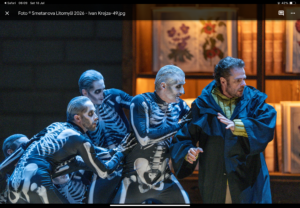
Zuzana Štefunková Rusínová’s colorful costume designs successfully placed the drama in the medieval period, but it was her brilliant designs for Rarach and his skeletal band of ghouls that gripped the imagination and intensified the sense of horror that pervaded the stage. They were dressed as if they had come from Hell itself, as they marauded across the stage in superbly choreographed scenes, designed by Marek Svobodník, in which their unnatural, jerky, devilish movements were expertly coordinated. In Act three, when they emerged from the boulder field, they engaged in an energetic, frantic dance, ingeniously bringing to mind a dance-macbre, that was sensitively lit by Heřman to compensate for the lack of any physical boulders, in what was one of the highlights of the production.
Overall, Heřman’s presentation successfully captivated and entertained the audience, even if the overall cohesion of his interpretation did not always convince.
Štáva Puts on a Hell of a Show
The undoubted star of the evening was the bass Jan Štáva, whose dominating portrayal of Rarach transfixed the audience. His acting and singing were skillfully crafted to develop an integrated, clearly defined character, full of malevolence and hatred, and the strength of his stage presence ensured that an atmosphere of terror and intimidation lay heavily over the stage whenever he was present. Even the comic incidents in which he was involved contained a dark side. His vicious terrorizing of Beneš using a mannequin in his image to mock him was initially amusing but became increasingly brutal as it continued. His posturing was brilliantly measured to play up Rarach’s diabolical nature, yet he was careful never to overstep the mark. His singing was confident, forceful and technically strong. He held the line well while coating the voice with a threatening veneer, which he furnished with neatly placed emotional inflections to intensify the sense of evil.
The target of his ire was the abbott Beneš, who himself was no saint, as he hoped that Vok would fail to find a wife so that the monastery would inherit his money. The role was essayed by bass David Szendiuch, whose compelling interpretation saw him morph from a cowardly worm-like creature, who cowed in front of Rarach, in which one could hear the fear in his voice, to the hero who sends him and his minions back to Hell. It proved a significant turning point, and one that Szendiuch highlighted effectively.
It was difficult to take to baritone Roman Hoza‘s interpretation of Vok. To say the least, Vok is a bit of an odd character, and it is true that there is an undoubted comic element to his role, but too much was made of it to the extent that the character did not sit comfortably within the wider context of the drama. Such were the absurdities of some of his behavior that it undermined the more serious aspects of his character. Vocally, however, Hoza possesses an attractive, expressive and versatile voice that he used with sensitivity and intelligence to successfully portray Vok’s complex emotional state, but which on occasions, could only be fully appreciated by ignoring his silly behavior.
Soprano Kateřina Kněžíková produced a refined, emotionally understated interpretation as Vok’s love interest, Hedvika. Although a fairly passive role, it still allowed Kněžíková to show off her attractive lyricism and the clear-toned beauty of her voice which shone brightly against the rich musical backdrop.
Mezzo-soprano Václava Krejčí Housková gave an enthusiastic reading in the trouser role of Záviš. Although there was a tendency to rely on stock gestures, she successfully captured her character’s youthful energy, which she supplemented with a fresh, bright and cheerful vocal performance.
Soprano Lenka Máčiková immersed herself fully in the role of Katuška with an emotionally full-on performance. She was a peasant girl without inhibitions, determined to enjoy life. She could be playful and flirtatious, and she was certainly not shy in forwarding her opinions. She was happy to stand up to her father and tell Vok that she loved someone else. Her singing was confident, lively, and expressively strong. Her recitatives bubbled with enthusiasm and emotional strength while displaying the flexibility of her voice.
Her lover, the knight Jarek, was hardly a clear-thinking character. Although desperately in love with Katuška, he swears an oath not to marry her so long as Vok is unable to find a wife, which unsuprisingly comes back to torment him. The tenor Peter Berger, cast in the role, produced a suitably noble characterization. He was honest yet earnest and passionate, which he captured beautifully with an expressively strong vocal interpretation that reflected his difficult emotional situation.
Tenor Vit Nosek‘s portrayal of Katuška’s father, Michálek, hit the mark perfectly. Although he is excited and hopeful about marrying his daughter off to Lord Vok, Nosek’s characterization ensured that he came across as a simple, proud and unsophisticated peasant rather than a manipulative self-seeker. He was not inherently uncaring or bad, just a little dumb, which was the source of numerous comic incidents that Nosek played up to the full. His singing was neatly fashioned to develop his character.
Credit must also be given to the dancer František Vlček for his fine performance as Minch.
The Chorus Janáčkovy opery NdB was excellent. The depth and fullness of its singing was one of the highlights of the evening.
The Orchestr Janáčkovy opery NdB under the direction of the conductor Robert Kružík produced a dramatically sensitive rendition that supported the changing dynamics of the plot. It was dark, aggressive and brooding when siding with Rarach’s cruelty; light, bright and frivolous in the comedic scenes; and romantic, passionate and earnest as Jarek and Vok wooed Hedvika and Katuška. Smetana’s melodies were beautifully rendered, while the score’s rich textures were sensitively revealed.
It was noticeable in watching this production the degree to which the work contains within it so many interpretative possibilities: frequently, it would throw up junctures in which other possible readings were clearly possible; a regular feature of many great works! Hérman’s decisions were for the most part excellent, and while some may not have fully convinced, especially those relating to the work’s comedic elements, it was a very entertaining production, and the way he handled the interplay between Rarach and Beneš was particularly well-considered.
Based on this performance, it is a mystery as to why “The Devil’s Wall” has been so neglected in so many countries across the world. It is a truly excellent work with much to admire, not least the quality of Smetana’s beautiful music.