Dutch National Opera 2025-26 Review: Simon Boccanegra
Fabio Luisi Elicits Brilliant Performance from the Concertgebouw Orchestra
By Alan Neilson(Photo: Ben van Duin)
For its final presentation of the season, the Dutch National Opera brought together a stellar cast under the musical direction of Fabio Luisi, conducting the Concertgebouw Orchestra, with stage direction by Jetske Mijnssen for a new production of Verdi’s emotionally and politically complex opera “Simon Boccanegra” in the revised 1881 version with its text by Arrigo Boito. And it did not disappoint!
Mijnssen’s Excellent Staging Spoiled by a Single Unnecessary Heavy-Handed Intervention
Director Mijnssen took an imaginative and provocative stance with her resetting of the narrative in the year of its composition. One may ask, what relevance has “Simon Boccanegra” to the year 1881? Surely 1857, the year that the original version with its warnings of internal division in the lead-up to the Risorgimento would have proved a more pertinent resetting. With the clamor for unification of Italy and a desire to throw off the yoke of foreign occupation, it is easy to draw an analogy with 14th-century Genoa’s wars with Venice and the conflicts within the Genoese state between the ruling families and between the plebian and patrician class. By 1881, however, Italy was a united country. But as Mijnessen rightly identifies, the conflict was not over; it had simply shifted. With poverty increasing, particularly among agricultural workers, a rising gap in the incomes between the north and the south, and calls from nationalists for Italy to assert its identity on the international stage, along with rising conflict between the Church and the State, the Italian government appeared less than secure. Verdi thus used his revision of “Simon Boccanegra” as a call for good governance, an end to political strife and political extremism and used the figure of the doge to describe the characteristics required of a good leader.
Thus, the resetting of the drama to 1881 seems quite natural as it reflects Verdi’s own intentions, and this on its own could hardly be described as provocative or imaginative. However, Mijnssen took it a step further. It was not Simon Boccanegra she sees as an ideal leader but his long-lost daughter, Amelia. She is presented as the opera’s heroine. It is she who saves her father’s life on two occasions, who escapes from Paolo’s imprisonment without anyone else’s help, and who brings about peace between the warring families. She is a perfect leader; she is a peacemaker, and she is courageous and wise. Mijnssen actually has her working as a teacher in her opening scene. But then in the final scene, she takes it a step too far, and instead of Adorno inheriting the dogeship from Boccanegra as per the libretto, it is Mijnssen who has Amelia acclaimed doge, or technically the “dogessa.”
Looking backwards over the performance, Mijnssen’s aim appears to have been to highlight Amelia’s qualities, whether as they are written in the libretto or inserted by Mijnssen herself, such as having Amelia present during the duet between Adorno and Fiesco in order to reinforce her importance, and thus allowing it to appear almost natural that, against all odds given her position as a woman in a man’s world, it was natural for her to attain the highest political position in the State and therefore become the savior of the nation. While such an outcome may well be a pleasing one, it is not what Verdi and Boito wrote, and it does not chime with the political, social or cultural spirit of 19th-century Italy.
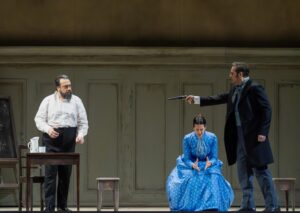
Notwithstanding her less than convincing intrusion in the final moments, it proved to be a very engaging staging. Together with the scenographer Etienne Pluss, Mijnssen opted for a simple yet versatile set that made use of the company’s large stage. The basic design consisted of dully colored scenery to create a large room that was sometimes divided into smaller rooms that could be changed to suggest a classroom, a council chamber, or rooms within a palazzo. There were no gold or ornate trimmings; everything was basic, even bare, although not the normal black that many unimaginative directors opt for to suggest a heavy, oppressive atmosphere. Valerio Tiberi’s lighting designs were used to maintain the general sense of pervasive gloom and heaviness. The only bright coloring came from the interior of a white church that was positioned in the center of the stage for the prologue and the final scene. The overall design successfully allowed the toing and froing of the narrative to play out. The crowd scenes had the space to make a powerful impact, notably so at the end of Act one when the rioting crowd chasing Adorno invaded the council chamber with flags waving and fists raised, storming around in an angry fashion, which brilliantly captured the sense of discontent and chaos. The more intimate and personal scenes were equally successful in their depiction, especially in the scene in which Mijnssen decided to place the singers alone in different rooms to highlight the emotional distances and complex barriers that separate them, which the vast space of the stage magnified.
The costumes, designed by Hannah Clark, were consistent with the period but rarely had much color to them. The men, excepting Simon Boccanegra, were dressed in formal dark suits, while the plebeian class were attired in white, grey and other dark colors. There was nothing flamboyant; even Boccanegra’s formal state uniform and Amelia’s Victorian blue dress were restrained to reflect the degree to which everyone was trapped by their circumstances.
It may all sound like a visually insipid staging, yet that was not the case! In fact, the muted coloring and fairly unimaginative scenery, along with the restrained costuming actually worked well together with the expertly choreographed crowd scenes and sensitively crafted personal moments to create high-impact mises-en-scène that successfully reflected the tenor of the drama.
Given the high quality of the staging, Mijnssen’s heavy-handed intervention in the final Scene left one feeling a little irritated. Everything had been so well executed up to that point. Why bother to carefully construct an interpretation against the background of the upheavals and problems of post-Risorgimento Italy if the conclusion wanders off into a realm of fantasy? It was so unnecessary. Mijnssen had done such an excellent job revealing Amelia’s strong character and her ability to find solutions in life-threatening situations and in overcoming the barriers facing women in a world where men hold the power. The audience was intelligent enough to understand the excellently crafted interpretation without the need for an explicit statement, in which Amelia is unbelievably elevated to the highest political in the land, just in case some of the audience did not quite get Mijnssen’s argument.
Bravo Luisi!
Fortunately, there were no such concerns about the musical side of the performance, which was of the highest order.
Conductor Fabio Luisi was brilliant, with a stunning reading elicited from the Royal Concertgebouw Orchestra. The musical momentum was perfectly aligned to the onstage drama: the restless crowd appeared to be swept along by the energy and pace of the orchestra, while the personal interactions between the protagonists were sensitively supported by both subtle and bold shifts in the rhythmic and dynamic contours of the music to create a more delicate or more aggressive emotional impact. It was the overall quality of the performance, however, that really impressed. The textural detail and clarity generated a warmth and space that was simply beautiful, while the arc of each scene was expertly managed to create an integrated musical block. Rarely, does one experience the quality of this order. It was a delight to behold.
Nor was it a performance that overshadowed the singing. The high-quality cast simply sparkled. From the leading roles to the secondary characters and the brilliance of the chorus, everyone involved produced impressive, well-defined performances.
Baritone George Petean created a compelling, layered portrait of the doge, Simon Boccanegra, who, although he often found himself with conflicting emotions, ensured that his noble and well-intentioned character shone through. He was confident and sufficiently assertive in his position of authority, although not averse to flashes of anger, and sensitively displayed his thoughtful and empathetic nature, in particular his loving relationship with his daughter Amelia and the warmth that he expressed when forgiving his enemies. He possesses a strong stage presence with a handsome voice, which he employed intelligently to reinforce his characterization. His singing was secure, confident and clear with a strong upper register, which he used wonderfully to illustrate his rising passions, underpinned by his ability to caress the line with emotional honesty.
Federica Lombardi Stars as Amelia
Amelia Grimaldi is a woman under severe emotional pressure, often caught between conflicting extremes, to which soprano Federica Lombardi responded with a brilliantly layered, emotional interpretation. Although she expressed her feelings strongly and clearly, her Amelia was always a woman under control. She never overreacted, and there were no hysterical outbursts. No matter the pressures to which she was subject, she managed to maintain her sense of dignity and inner calm. She was portrayed as a woman of substance with a strong moral core. She would have indeed made an excellent political leader, even if the period in which the opera was set made that an impossibility.
What made her performance so captivating, however, was the depth of her vocal characterization and the sheer beauty of her singing. In her opening aria, “Come in quest’ora bruna,” she immediately gripped the attention with her sensitive phrasing, versatile expressivity and glorious upper register, which she employed with ease. In her duet with Boccanegra, “Orfanella il tetto umile,” she displayed her ability to mold the vocal line with emotional strength and detail to highlight her rising excitement at discovering her long-lost father. When singing at full throttle in the large choral movements, her voice soared forcefully and easily above the combined musical forces, to create a thrilling effect.
Bass Georg Zeppenfeld successfully brought to life the depth and complexity of Jacopo Fiesco’s emotional state. In his opening aria, “Il lacerato spirito,” we meet a grieving Fiesco, who has just lost his daughter. Using his palette’s dark colors allied to his ability to furnish his singing with an intense expressivity, he successfully revealed Fiesco’s deep suffering and his desire for revenge on Boccanegra. Throughout the opera, it was his need for vengeance that underpinned his actions, yet his behavior often betrayed a sympathetic sensitivity towards Amelia, in which his noble bearing was clearly present. Although a prisoner to his strong emotions, it came as no surprise, however, given his underlying decency, that he was reconciled with Boccanegra in the final Act, even if Boccanegra’s role in his daughter’s death had not changed. Moreover, Zeppenfeld’s emotionally strong portrait of Fiesco not only convinced in itself, but it also elevated Amelia’s calmer, more reflective nature.
Tenor Riccardo Massi put in a fine performance as Amelia’s lover, Gabriele Adorno. His singing was passionate and lyrically attractive, which he displayed beautifully in his duet with Amelia, “Cielo di stelle orbato.” In true romantic style, he wore his heart on his sleeve and engaged whole-heartedly with life. No emotional response was checked; his feelings were allowed full reign. He was equally at home plotting against the doge as he was courting Amelia.
Baritone Germán Olvera was a suitably trecherous Paolo Abiani. He played up the dark side of his character convincingly in a lyrically pleasing reading, using the expressive force of his voice, which he underpinned with sinister overtones.
Bass Jasurbek Khaydarov was cast as Boccanegra’s one-time ally, Pietr, for whom he created a believable picture of a man who is too easily swayed by ideas and was thus caught up in Paolo’s machinations. His singing exhibited confidence, clarity and the ability to develop a believable character.
The Chorus of Dutch National Opera was absolutely excellent throughout, in particular the scene in which the mob storms the the council chamber was electrifying thanks to their vibrant, energetic movement and the patriotic fever of their singing.
There was so much to enjoy about this production, not least the brilliance of the performance by the Concertgebouw Orchestra under the direction of Maestro Luisi. Although I have been critical of Mijnssen’s decision to promote Amelia to the position of “dogessa” following the death of Simon Boccanegra, the quality of staging was nevertheless very good indeed!