Teatro Real de Madrid 2025-26 Review: Il Trovatore
By Galina Altman(Credit: © Javier del Real | Teatro Real)
There are operas that cannot be separated from the city where they were born. For Madrid, “Il Trovatore” is exactly that kind of story. It did not begin with Verdi but with a young playwright, Antonio Garcia Gutierrez, who in 1836 presented his play “El Trovador” at Madrid’s Teatro del Principe, inspired by the French novels of Victor Hugo. A few years later it caught the attention of Giuseppe Verdi and gave rise to one of the most performed operas in the world repertoire. Every return of “Il Trovatore” to Teatro Real therefore feels not simply like another Verdi production, but like a homecoming to Spain.
Stunning Production
Francisco Negrin–Mexican-born director and great-grandson of the President of the Second Spanish Republic–is known in the opera and film world for his success with productions of exceptional complexity. His work across art forms is characterized by a high degree of integration between dance, technology, and dramaturgy, and by a deep understanding of the cultures he engages with.
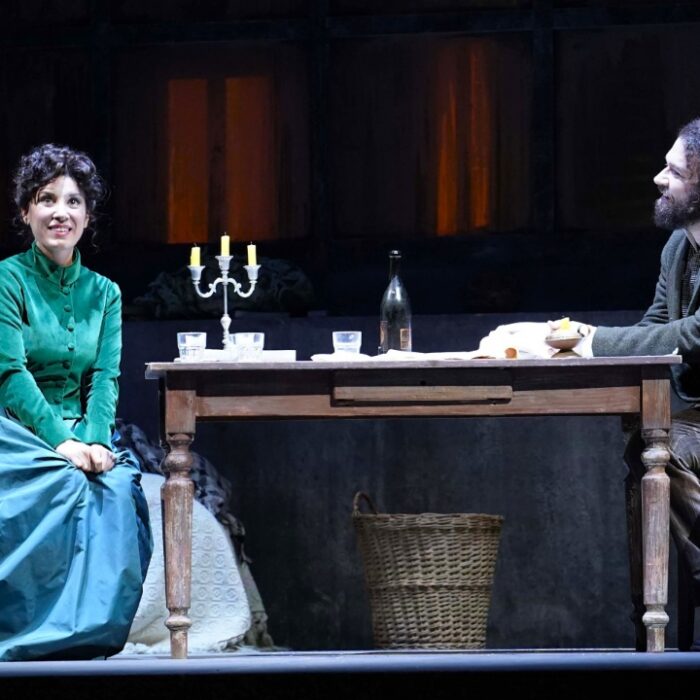
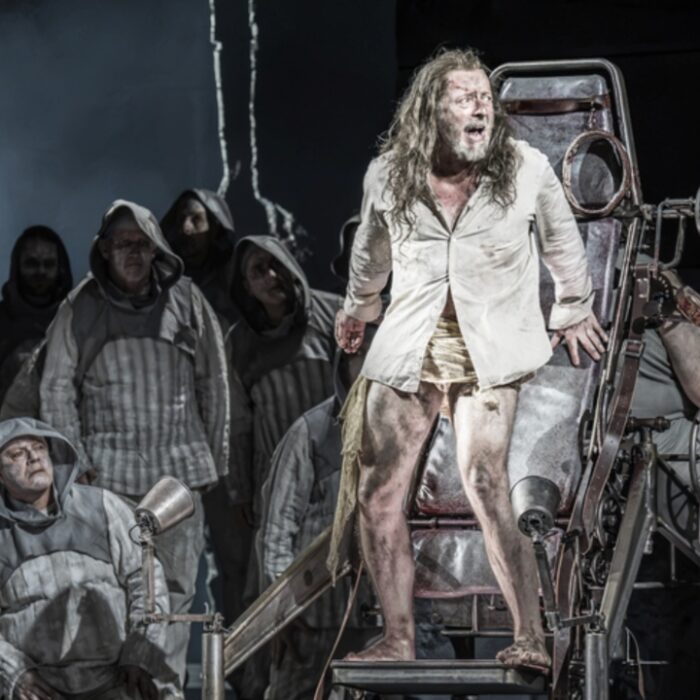
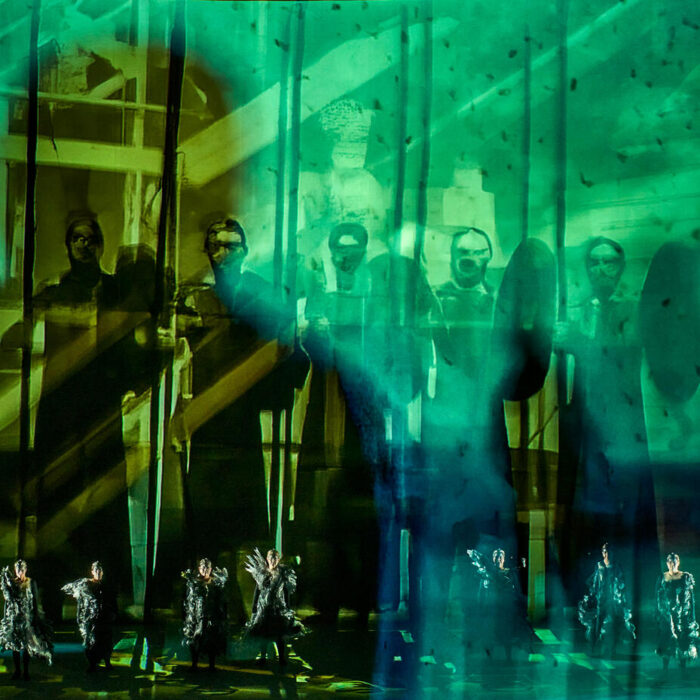
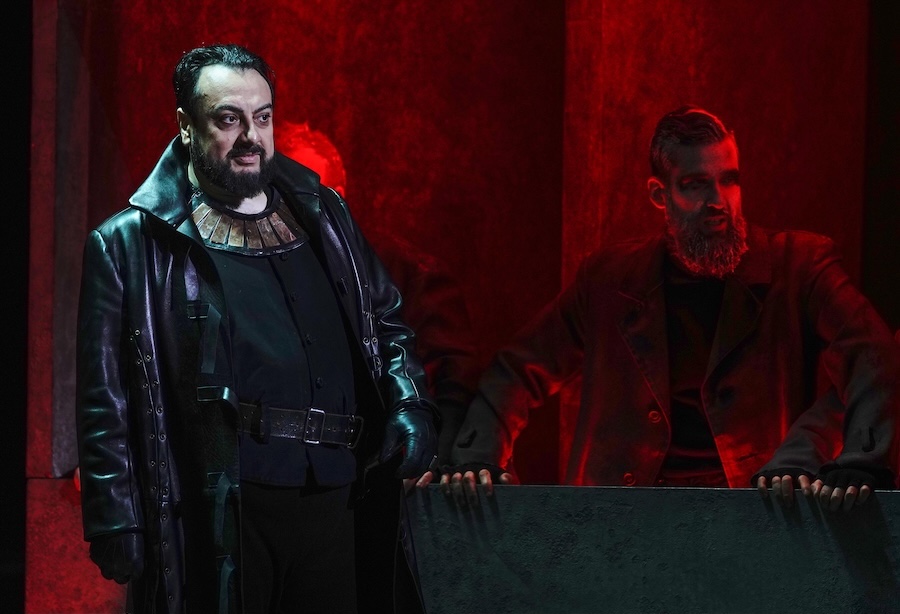
In his Madrid “Il Trovatore,” Negrin abandons entirely the romantic folklore that typically accompanies classical visions of medieval Spain–no castles, no pyres, no bandits or knights in fifteenth-century armor. In their place stands an enormous concrete cube designed by set designer Louis Désiré, paired with stunning work in light and special effects. The result looks like purgatory: a cyclical, enclosed space of human memory from which there is no exit. Here the past and its sins become the central protagonist, and family tragedy transforms into ancient drama.
This kind of minimalism on stage focuses all attention on the vocal and human stories, and demands absolute scenic truth from the performers. Without it, the set design cannot conceal any absence of dramatic engagement.
Cast & Musical Highlights
The musical center of the production was once again conductor Nicola Luisotti. He presented Verdi as few contemporary maestros can: the orchestra sounded powerful but never overwhelmed the singers or the chorus. Even in the loudest scenes, Luisotti continued to breathe with the soloists, allowing each vocal line to retain its natural freedom.
The third cast produced a very different impression from the premiere performances of the first and second. Where the previous ensemble came together as a unified dramatic organism, here the evening moved in separate strong episodes rather than as a continuous emotional current. Many of the duets failed to reach the necessary internal tension, and the relationships between the characters did not always achieve the scenic conviction they require, remaining at times duets and quartets of singers rather than human encounters.
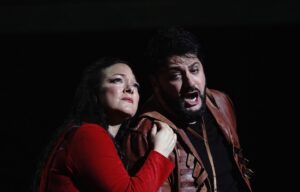
Eleonora Burattо, replacing the indisposed Anna Netrebko, sang Leonora with elegance characteristic of the Italian school. Her voice flowed freely, her phrasing showed a rare musical refinement, and the bel canto foundation of the role dominated every phrase. Hearing her flawless spinto and cantabile legato made clear why Buratto is referred to as one of the great heirs to the tradition of Mirella Freni.
The dramatic magnetism between Leonora and Manrico, however, proved considerably less than this story demands.
Yusif Eyvazov gave the role of Manrico everything he had. His Manrico possessed the necessary power, but at times a sense of strain with the material was perceptible–where the role demands a feeling of absolute freedom, a visible tension appeared. That said, his musical integrity and vocal technique were not in question: lyric tenors frequently drown in the dense Verdian orchestration, while Eyvazov’s voice cut through any acoustic pressure and reached the uppermost tiers of Teatro Real without effort.
George Petean created a noble and very evenly sung Count di Luna–though not a passionate one. His warm baritone was beautiful throughout, but the character himself clearly lacked daring, danger, and psychological depth. This is after all an aristocrat and a military commander accustomed to giving orders, winning, and making decisions under risk. Of such men one says that all is fair in love and war–of Petean’s character one might say he was not entirely certain what he wanted, or whether he truly wanted anything at all.
Credit: © Javier del Real | Teatro Real
Illuminating Vocal Performances
The unexpected protagonist of the evening was Clementine Margaine as Azucena. Around her gathered virtually all the dramatic tension of the production, and in the second act she shifted her vocal palette with each new memory and each new state of her character with remarkable command. Her lower register was dense and rich, her upper voice was free, and her acting was among the strongest in this cast.
Margaine’s Azucena was fully convincing on every level: as the wretched mother who threw her own son into the flames and raised another’s, as the traumatized daughter haunted by her mother’s execution, and as the avenger lost between past, present, and future, pursued by nightmares and shadows. Many in the audience wiped genuine tears during the role’s most penetrating arias. “Stride la vampa” and “Condotta ell’era in ceppi” sounded like the trumpets of Judgment Day.
Special mention must go to Marko Mimica as the captain Ferrando. His account at the very opening of the opera sets the entire mechanism of tragedy in motion, and this bass gave the scene–so essential to the drama’s exposition–the necessary scale of ancient legend. No less convincing was Fabián Lara as Ruiz, a small role in terms of volume but an important structural element in the dramaturgy of this opera.
As always, the Teatro Real Chorus under Jose Luis Basso was magnificent. In “Il Trovatore” the chorus is not background but an independent character, as in ancient Greek theater, and it created beautifully the atmosphere of collective memory, fatalism, and doom that runs through the entire production.
This evening was not, regrettably, one of those occasions when all four principal singers form a unified artistic whole. But it confirmed something else: Francisco Negrin’s production withstands entirely different casts, and even the force majeure of a leading soloist’s cancellation, thanks to the intelligence of the stagecraft and the outstanding musical leadership of Nicola Luisotti. Even when the human chemistry arrives only in isolated flashes, Verdi’s tragedy and his music continue to work with undiminished force.