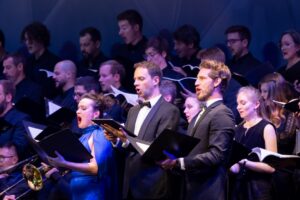
Styriarte Festival 2026 Review: Die Schöpfung
By Mengguang Huang(Photo: Nikola Milatovic)
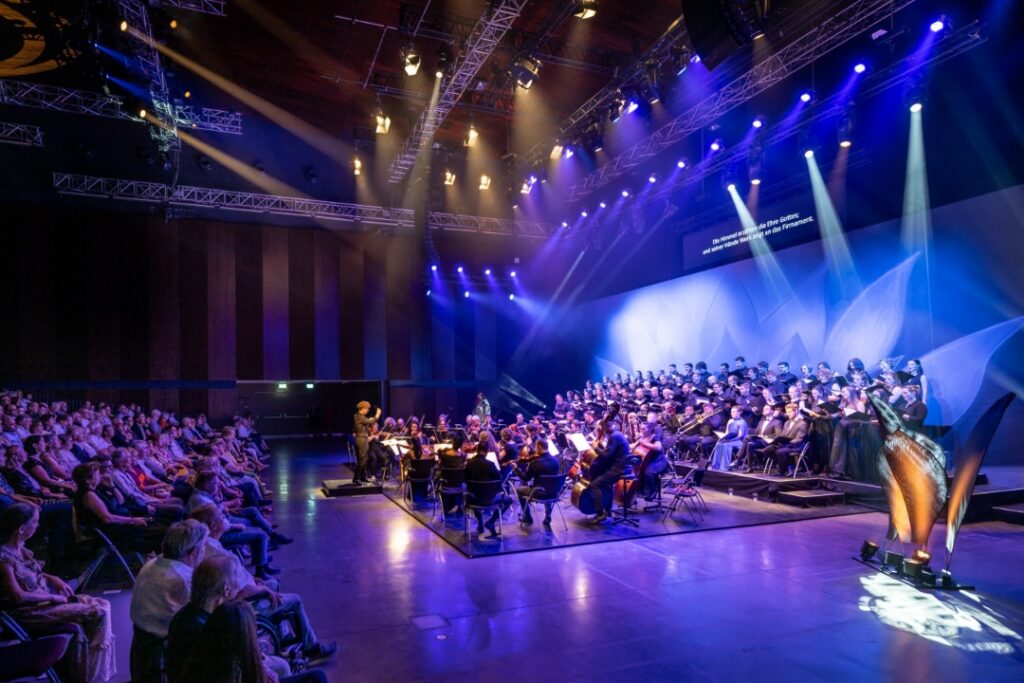
When traveling to Graz for the summer Styriarte festival, one might expect the grand choral architecture of Joseph Haydn to echo through a stunning cathedral in the old town center. The reality, however, arrived as a complete surprise. The festival’s flagship production unfolded beneath an imposing double-facade Science Tower, surrounded by trendy contemporary apartments boasting container-style structures. The Helmut List Halle itself, a venue that, at first glance, resembles a modern exhibition center. Yet, stepping inside this industrial-chic hall—which features tiered seating reminiscent of the Cologne Opera’s current temporary quarters—any initial skepticism quickly evaporates. The hall boasts brilliant acoustics, and perhaps most importantly for Europe at the moment, air-conditioning!
(Photo: Nikola Milatovic)
Production Details
This summer, like the thematic focus of the Potsdam Sanssouci festival, Styriarte also centered its artistic vision on “Light.“ And Haydn’s radical late-masterpiece is an obvious must-have inclusion. When Haydn composed “Die Schöpfung” between 1796 and 1798, he was deeply inspired by the monumental Handel oratorios he witnessed at London’s Westminster Abbey. By fully embracing the Helmut List Halle’s large-scale stage lighting and digital projection facilities, Styriarte Festival transformed the classic oratorio into a vivid, highly efficient, and captivating musical show.
Before the musicians took the stage, a massive screen at the back of the stage projected a grand festival teaser to welcome them. Throughout the performance, this digital backdrop tactfully shifted its contents, acting as a visual compass that offered delicate, non-intrusive cues of vast oceans, pastoral landscapes, and burgeoning vegetation. Most brilliantly, during the section on the creation of man, the screen displayed Leonardo da Vinci’s famous Vitruvian Man, perfectly highlighting the Enlightenment ideals of human nobility embedded in Baron van Swieten’s libretto. The stage lighting itself also worked as musical collaborator. At the pivotal moment of creation, intense horizontal beams of light pierced the hall, visually amplifying the blinding eruption of the sun-drenched fortissimo chord on the word “Light.“
Musical Highlights
We also witnessed this festival motto in the accompanying programs. Virtuoso pianist Bernd Glemser meticulously presented Beethoven’s “Moonlight Sonata” alongside Liszt’s transcription of the Fifth Symphony. While that program shifted the focus to the nocturnal light, the famous transition from the third to the fourth movement of the symphony offered a thrilling parallel to Haydn’s “Die Schöpfung,” journeying from an uncertain harmonic ambiguity into a triumphant burst of sonic light. By contrast, another partner program, “Romantische Nacht,” built an intricate dialogue between moonlight-themed Germanic poetry and chamber music. Yet, in performance, despite the speaker’s best efforts, the spoken word simply could not match the direct, rich emotional immediacy of the music performed by outstanding Confringo Klavierquartett, ultimately leaving the text feeling disproportionately heavy.
(Photo: Nikola Milatovic)
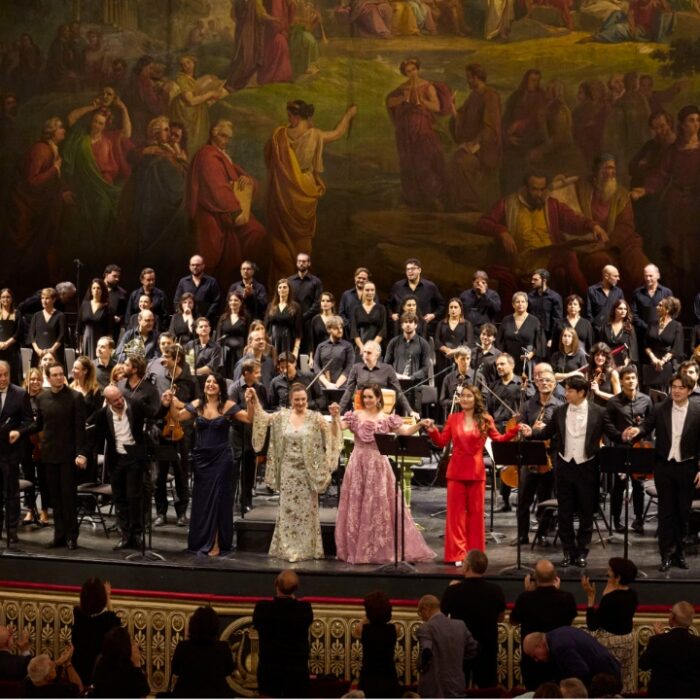
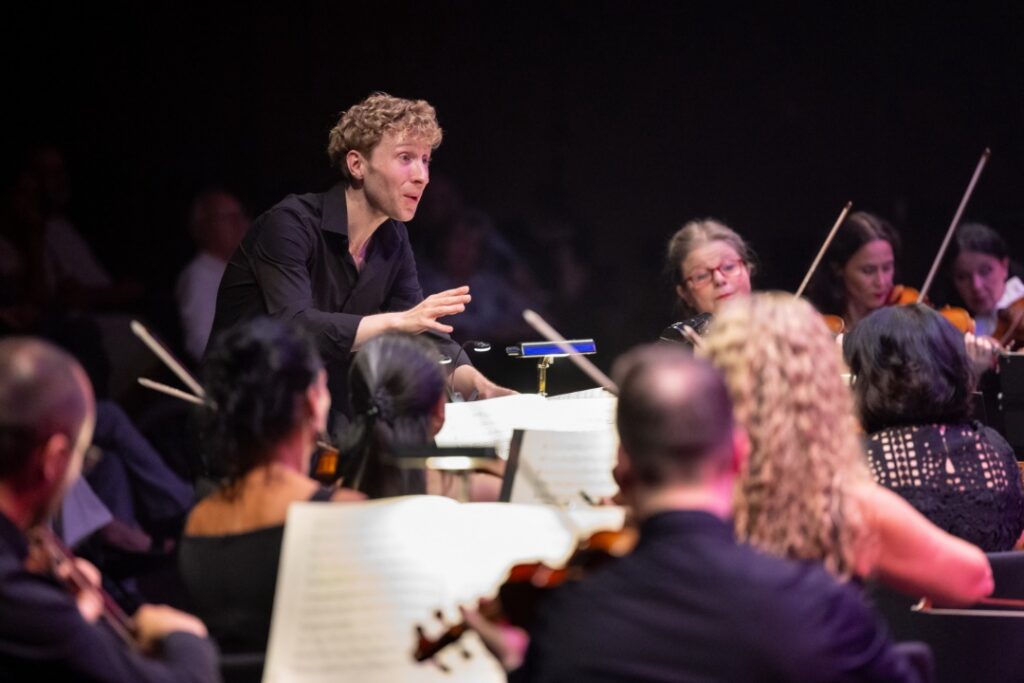
Directed by the young and energetic Patrick Hahn, the Styriarte Festspiel-Orchester performed with a beautifully relaxed yet vibrant vitality, delivering a very contemporary sound that was remarkably clear and transparent. The violin section played with a supple elasticity, while the lower strings maintained a lively drive that powerfully pushed the narrative forward. The woodwinds and timpani emerged crisp and airy, with the continuo cello and fortepiano providing a witty, warm accompaniment that anchored the secco recitatives with spontaneous charm. Hahn’s direction infused the entire combined ensemble with unmistakable affection, and his structural control was most convincing in his handling of contrasts: maintaining long lines of tension during the contemplative orchestral brooding of Chaos, while leading the orchestra through the grand choral fugues with energetic articulation. Seamlessly intertwined with this orchestral brilliance was the chorus, Camerata Styria, prepared by Sebastian Meixner, which served as the undeniable backbone of the evening. In the numerous Handelian fugal sections, they demonstrated an extraordinary ability to maintain superb clarity.
Vocal Performances
The trio of soloists was equally satisfying. Soprano Tetiana Miyus was a vocal treat, possessing a radiant high register. In Part two’s initial avian aria, her voice danced with elasticity against a juicy, lively orchestral backdrop, mimicking the soaring eagle and the spinning song of the lark. Shifting to the role of Eve in Part three, she joined Adam to articulate a deeply sincere, tender gratitude toward the Creator, illustrating the pastoral domesticity of the Garden of Eden. Miyus never hesitated to unleash her vocal potential, allowing her luminous tone to soar over the full force of the festival chorus.
As Raphael, bass Philipp Schöllhorn successfully navigated a highly demanding vocal terrain. Although his depiction of the initial cosmic void in the opening scene felt exceedingly soft, somewhat lost in the harmonic ambiguity of Chaos, he quickly adjusted his calibre after the initial burst of light. He transformed into a confident narrator whose robust voice remained deeply human and visually evocative. His rendering of the fifth day, where Raphael conjures the great whale amidst the rolling waves, was highly vivid. This specific display of sound painting was so packed with color and wit that it evoked the lively canvases of Jan Brueghel the Elder depicting Biblical animal scenes.
Tenor Mario Lerchenberger proved equally adept at painting scenes and manipulating dramatic temperature as the archangel Uriel. In Part one’s accompanied recitative, “In vollem Glanze steiget jetzt die sonne”, his solid tone evoked the blazing sunrise before gracefully capturing the silvery shimmer of moonlight. Though his structural role in Part three is brief, Lerchenberger’s warm, tender blessing of the first human couple left a lasting impression on the hall.
In the audience, some nuns could be seen sitting among the crowd. Yet, this performance was not a deliberate delivery of some religious message. Instead, it was a remarkably contemporary approach to Haydn’s sound painting. In music history, critics had dismissed these literal musical imitations—the roaring lions, the creeping worms, the bubbling brooks—as old-fashioned. Here, however, these vivid tapestries were presented with a sympathetic, unapologetic sincerity. What the audience experienced here was a shared, deeply empathetic joy—an infectious sense of pure, unadulterated enjoyment that brought Haydn’s newborn world triumphantly to life.