Ludwigsburger Schlossfestspiele 2026 Review: Didone abbandonata
Niccolò Jommelli’s Opera Resounds in a Living Time Machine
By Mengguang Huang(Photo: Eva Werner)
In 1753, Niccolò Jommelli moved to Stuttgart under Duke Karl Eugen. Collaborating with court poet Mattia Verazi, Jommelli modified Pietro Metastasio’s famous libretto to pioneer bold dramatic reforms. Utilizing the city’s elite singers and virtuosic orchestra, this creative hub culminated in the February 1763 Stuttgart premiere of Jommelli’s third version of “Didone abbandonata.”
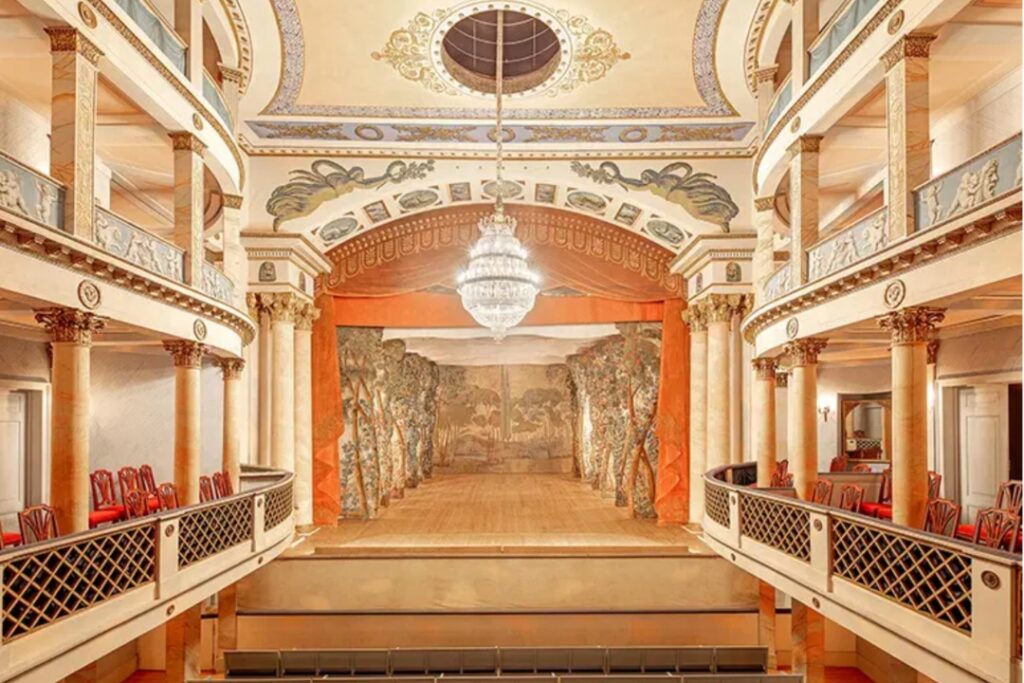
It is clear that choosing this Stuttgart opera as the flagship project for this year’s summer music festival could not be more appropriate. As one of the few surviving court theatres in Europe that still boasts fully functional 18th-century wooden stage machinery, the Ludwigsburg Schlosstheater offers baroque opera lovers a rare, living experience. Attending a performance here is a ritual that begins long before the first downbeat. Audiences retrace the ceremonial steps of 18th-century courtiers, ascending the elegant staircase, and walking down creaking long gallery flanked by aristocratic portraits. Stepping into the auditorium immediately evokes the classic imagery of operatic history: the massive suspended chandelier, the royal box and the beautifully painted curtain depicting ancient gods.
The acoustic environment is poles apart from the spacious, acoustically balanced modern opera houses we are accustomed to today. The sound is remarkably direct. It hits the ear stripped of synthetic warmth, offering almost no ambient decay to wrap around the notes. While some might find it a bit dry, this is perhaps the unvarnished sound of the 18th century—unseasoned, raw, and bracingly crisp.
For director Nina Brazier, Ludwigsburg’s historic stage leaves virtually no room for “Regietheater.” The scenic setup relied on just two perspective-driven historical stage sets: one representing a grand palazzo, the other a pastoral countryside. Accompanied by period-style furniture, subtle lighting to hint at the final fire, and absolutely no digital projections, smoke effects, or surtitles, Brazier’s staging encourages the audience to focus entirely on the human drama.
(Photo: Daniel Stauch)
The Emotional Epicenter of Queen and Trojan Refugee
Perhaps due to the sheer complexity of Metastasio’s verse or limited rehearsal time, during most of the scenes the performers carried their music score on stage. However, since the production creatively integrated these scores into the staging as diplomatic documents, and given the rare privilege of seeing Jommelli’s masterpiece staged with a top-tier cast, this minor detail was easily forgiven. Without modern theatrical gimmicks, the singers delivered a demonstration in textbook baroque blocking and stylized gestures. Every artist was deeply integrated into their role, yet each maintained a vivid display of their unique artistic personality.
Jone Martínez, dressed in a shimmering, floor-length rose gold gown portraying Didone, was the undeniable anchor of the evening, delivering a performance of immense royal dignity and emotional weight. Blessed with a full, resonant vocal production and a commanding stage presence, she kept the tragic center of gravity firmly spinning around the Phoenician queen. She brilliantly mapped Didone’s psychological fracturing. We saw a queen oscillating between self-pity over her departure from homeland, a fierce and sacrificial love for Enea, and the agonizing self-doubt triggered by his impending desertion.
A particular dramatic highlight was Act two, Scene ten, where Didone forces herself to play a flirtatious game with the Moorish king Iarba solely to spark Enea’s jealousy. In this brilliantly crafted trio, as Enea and Iarba exit one after the other, the music opens up into a remarkably free, rubato-laden space. Martínez colored each section with exquisite nuance. Left completely abandoned on stage to the slow, mournful sigh of oboe playing, her singing was deeply moving. Her final moments—where she faces ultimate betrayal after discovering that Enea has already sailed away and that Carthage is burning—were sung with a chilling, resolute finality. Her desperate leap into the consuming flames, accompanied by curses hurled at the gods, forced a profound sympathy for her tragic fate. Her mastery of Jommelli’s expressive style was equally evident in the expansive, emotionally draining recitatives that dominate the first three scenes of Act two.
By contrast, the countertenor Maayan Licht delivered an Enea highly colored by his personal style. Wrapped in a voluminous black-and-white patterned robe, this Enea was somewhat indecisive, visibly paralyzed by the clash between his historical duty to Italy and his romantic impulse toward Didone. Intriguingly, his interactions with Didone’s sister, Selene, even carried a faint, unsettling hint of flirtatious ambiguity, adding layers to his character. Rather than a Trojan refugee driven by destiny, Licht cut the figure of a somewhat shallow, high-born dandy. Vocally, however, Licht’s technique was flawless. In Act one, Scene thirteen, he unleashed a heroic performance filled with a bright, metallic timbre, and his intertwining lines with Didone in the Act one closing duet were gorgeous. Though his performance in Act two, Scene eight felt a bit too casual, his massive exit aria in Act three featured an exhilarating duel with the horn section that thrillingly revived the bravura spirit of the castrato golden age.
A Vibrant Supporting Cast
This slight deviation from the standard heroic cliché stood in sharp contrast to the ultra-masculine, resolute presence of Iarba. Valerio Contaldo’s Iarba was played with a burst of robust masculinity, injecting the character with a potent blend of calculating cunning and a strangely persuasive affection for Didone. His timbre was bright, solid, and sun-drenched, occasionally stealing the spotlight from Enea. His most explosive moment arrived in Act three, Scene eight, delivering a performance of terrifying power as he rallied his forces against the palace. The staging reinforced this vocal storm by lowering the theatrical cloud clusters, effectively signaling the fiery doom of Carthage. Conversely, the countertenor Leandro Marziotte portrayed an Araspe who felt a bit too soft by comparison. Although he retained his principled core—stanchly refusing to obey Iarba’s command to assassinate Enea, and even thwarting the king’s own attempt on Enea’s life—Marziotte’s overall stage profile lacked the sharp definition of his royal peers.
Olivia Vermeulen as Selene matched the tragic depth of the Queen. Elegant in a long, flowing pale pink dress, she projected an image of profound warmth and deep sisterly devotion. She served as her sister’s emotional anchor, using her warm timbre to communicate the deep interdependency between them, even as she secretly harbored her own love for Enea. Whether trying to convince Enea to stay, or stepping between hot-headed men to diffuse a duel in Act two, Vermeulen’s presence was comforting and deeply felt. In this heart-wrenching monologue in Act three, Scene eight, Olivia Vermeulen laid bare Selene’s hidden agony with captivating nuance, transforming this solitary lament into a moment of tragic vulnerability as she confronted Enea’s chilling cruelty.
Meanwhile, Suzanne Jerosme successfully captured the treacherous nature of Osmida, bringing a vibrant, self-assured energy to the stage. Her vocal production was exceptionally direct and unforced. In the first Act, she negotiates her pact with Iarba—offering to help him win Didone in exchange for her own political ambition—with persuasive confidence, even if her scheming appeared naïve when matched against the more seasoned Moorish king.
The Magic of the Freiburger Barockorchester
Under the inspired direction of Francesco Corti, the Freiburger Barockorchester worked tirelessly to unlock the instrumental genius of this rarely heard Stuttgart gem. They convincingly captured Jommelli’s signature orchestral innovations, from the thrilling crescendos to the explosive emotional outbursts that underline the text. Corti and the Freiburger players proved to be thrillingly risk-taking; in the fury arias and high-octane passages, they did not shy away from a certain raw, gritty texture and a surging tempo to convey the opera’s raw vitality. Jommelli’s score is famous for blurring the lines between recitative and aria, creating highly continuous musical scenes. Corti and his players navigated these transitions by utilizing a flexible, highly dramatic use of rubato, allowing the orchestra to breathe naturally with the singers through the extensive obbligato recitatives.
This evening at Ludwigsburg was a rare gift. It offered a modern audience a precious, irreplicable total sensory experience—a time machine that allowed us to step directly into a vivid, hot-blooded operatic world previously only witnessed on a movie screen. The production achieved exactly what Charles de Brosses marvelled at over two centuries ago: a totality of “strength of declamation, harmonic variety, and sublime accompaniment” that remains as deeply moving today as it was in 1763.