San Francisco Opera 2026 Review: Elektra
Eun Sun Kim & Stellar Cast Delivers Thrilling Performance of Strauss & Hofmannsthal’s Opera
By Lois Silverstein(Photo: Cory Weaver/San Francisco Opera)
“Agamemnon! Agamemnon!” The words and tones rang in my ears still, as I emerged from the powerful rendering of San Francisco Opera’s Strauss and Hofmannsthal’s “Elektra.” The sunshine on the street did not turn it down. The 95 piece orchestra, conducted by San Francisco Orchestra Music Director, Eun Sun Kim, and the powerful voices of this ensemble cast, resonated into the June air, all the way home. Forty-five minutes later, they resounded as I faced a screen to turn those tones into words that might even begin to capture a portion of the power.
The opera is a feast for anyone who likes opera that integrates powerful, dramatic sound and sense that rouses an audience to fever pitch. Born and performed first in 1909 in Vienna, the work followed two years after their sensational “Salome” and today brings new as well as seasoned listeners and viewers to an ancient story that chills and ignites associations that go well-back into the psyche. The mother who kills a father. A son who kills a mother. A daughter who eggs on her brother and goads her sister to help promote the death of what cast their world in disarray years before and will not become hospitable to them until those deaths are, in their minds, revenged. It is one of the oldest tragedies still stinging in Western lives, and colored as it is by a German Austrian sensibility a thousand or so years later, it reverberates mightily as the San Francisco Summer season revives Keith Warner’s production from 2017. The combination is opera as it should be: emotional, passionate, richly inspiring, insightful and musically enriching.
Elena Pankratova as Elektra
Elena Pankratova made her company debut singing the title role, with dedication and intensity. From the moment she took the stage, she was in the forefront. Never leaving the scene to anyone else entirely, Pankratova sang with full bravura power and distinction. She lived the hate she felt as her rich, robust power rang across every action, every encounter, every thought she had through the 101 minute drama. She was infused with hate and conviction of the rightness of that hate. Who could stop her? It was clear from the outset that nobody, sister, lost brother, mother, was going to get in her way. Sacrifice of her heart, mind, youth, family, love, at the moments she underwent the living of her revenge for her beloved father’s death, was nothing compared with the satisfaction of this lust to matricide. Not simply matricide, either; get it out of the abstract: plainly, mother murder. She wanted her gone and she would do whatever it takes to get it done. Even, when she thought the brother who was charged with the task, seems to be dead. She tried to enlist her sister, Chrysothemis, sung by Elza Van den Heever, to help her, and when her intensely persuasive attempts went nowhere, she said she would take it on herself. Another task for her alone, a theme throughout the opera, the disconnection between Elektra and everyone else, particularly since her beloved father has been taken from her, by her mother and her lover, and, unjustly, i.e., murdered. It is not only a loss, but it is a loss to the moral order of the world from which she comes and from which she was “exiled,” but the tragedy. That “exile” and isolation, that alienation is, in fact, one of the key themes of the opera, and of what Strauss and Hofmannshtal have created in this and several if not all. Of their extraordinary works, “Elektra,” if not one of their most powerful.
While Pankratova sang with her whole self, taking us into the morbid, toxic hatred she had for the situation in which she saw no other way to restore order than to “re-right” the disorder, we traveled with her through all sorts of hell. Her arias, showed us the dark road she traveled and how her release – e.g., in the finale… the dance… and the celebration… after which she collapsed, we sank under its weight and its tragic inevitability. She sang with conviction and devotion, to the score, to the character, the story. If she added more physical embodiment to her movement, her intense vocal range, her gesture, and facial expression, even more power might have been gained. Her dynamics came largely through her rich and pulsating voice and they remained powerful. More physical flexibility of the whole body plus head might have driven the message even deeper, although her power never flagged.
More Cast Highlights
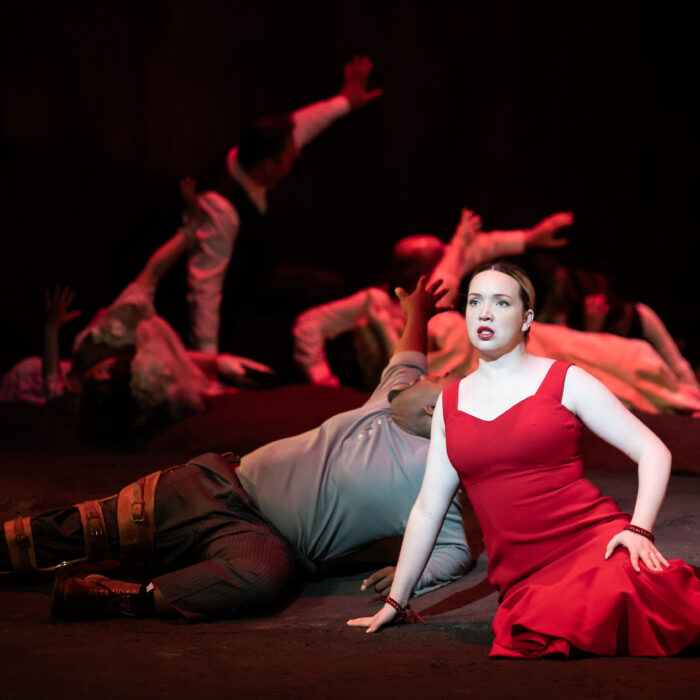
Elza van den Heever performed at the highest pitch in her role as Chrysothemis. Looking girlish as she grew to ghoulish once murder was on the books. She climbed out of teddy bear love into dark and daring defiance of nice and good and traditional woman-type behavior. It was amazing. As was her voice, which rang out higher and more powerful as the piece wore on. Her physically playful movements, racing up and down stairs, her gurgling and gleeful admixture with lyrical and dramatic urgency kept us engaged with her character and how she was going to work out the psychological dilemmas she was trapped in. It was a stellar performance.
Mezzo-soprano Michaela Schuster as Klytemnestra came through with stars, especially after the initial scene. Her voice warmed up and her movement and action smoothed out and her anguish came forth in abundance. Her physicality and her facial expressiveness strengthened as the scenes in which she engaged with her angry daughter, her confusion as mother got clearer to her, her guilt, the enormity of her deed of killing Agamemnon seemed to take over her consciousness and she began to collapse and try to run from herself in the denouement. The kitchen sink murder was aptly grotesque and she sank into it with mastery.
Bass-baritone Kyle Ketelson as Orest appeared and helped turn Elektra from frustrated murderer into a satisfied bystander as well as instigator to the final deed. Their recognition scene brought her back to life, for death, and for their two satisfactions for revenge. He enacted the deed with a voice convinced of his principles and wasted no time over-singing or crooning over the tragedy which had already been well-spelled out.
Tenor William Burden as Aegisth sang aptly then stumbled his way into Chrystothemis’ bed and found his Waterloo quickly. Does he realize what he has done? We don’t much care at this point: get it over is where we have come to by this point. An apt portrayal.
Production Details
The production, Keith Warner’s original in San Francisco in 2017 and Anja Kühnhold in revival, had a set designed by Boris Kudlička, Lighting Designer John Bishop, and Costume Designer Kaspar Glarner. The scene was a museum and the domestic home where the “Family” lived after the first murder–Agamemnon–and the second and third–Klytemnestra and Aegisth. The scene was there when we sat down. The “museum” voice started us off from the outset–“The Museum will be closing…” as if we were participants. The effectiveness of this brought us right into the situation. The TV screens hanging on different walls enhanced that as well, especially with their ancient golden masks. But, a Museum with representations of ancient tragedy, modern couples kissing on the balcony, family trekking through until closing time, security guards, the works. Then, the ancient tragedy brought up to date and brought into a domestic tragedy, a house reminiscent of the 1950s, in which each unit moved when needed; complete with “girlie” bedroom with curtains, dressing table, teddy bear; and kitchen with apple green painted cabinets and sink where believe it or not a murder could be executed, window over it for the garden view, the dining room the French doors. Effective if over-done a little–the “dream” scene in the dining room. So much going on from different eras, different worlds, different levels of feeling. How much did we need? It was used, yes, but the constant movement at moments was unnecessary. We had more than enough drama going on already.
So too the admixture of costumes, ancient and modern, Chrysothemis in pink sequins, fitting the personification of a woman who wanted an ordinary life; Klytemnestra, in her sky-blue sateen and cloak and crown, which Elektra took off; the men in military uniforms, somewhat jarring, and then Elektra, blending in with the backgrounds in all black, pants and jacket and shirt, and sneakers…not blending in. And props–the flashlight moving and flashing to emphasize fear and fright, ineffective…only the axe, effective, and the bag with the head of Klytemnestra, effective, and the bed upstairs with the dead Aegisth. Here was a little more than needed but things had gone that far by then that it didn’t much matter.
Illuminating Music
Eun Sun Kim kept the big orchestra in tow, 95 in total, including four doubling Wagner tubas, six trumpets, one doubling percussion, two harps, one celeste, 47 strings, among others. Three trumpets and celeste perform from the “Torpedo Room” at the rear of the pit, under the stage. “Elektra” has the largest pit orchestra of any production in Company history. Hammering out Strauss’s score, rich and dissonant, filled with chromatic and dissonance, in what was called Strauss’s “most modern” score. In total, we heard and experienced dark terror and erotic evocation. The music gripped and pulled us right into the heart of darkness and there we stayed gripped until the whole story was enacted. They were the sounds that haunt us in the night. They were the collisions that pierce our dreams. These they were the stories of the western tradition Strauss and Hofmannsthal brought into the present by marrying ancient themes with our contemporary ones. Sophocles’ “Elektra” echoes right through our present world: mothers and fathers in conflict, daughters in conflict with each other and sons, family life that is biting, jealous, enraging, discordant.
Once we were taken through the dissonant but electrifying music and story, we wondered why we resisted and ran away from such tales since they spoke honestly about what we felt and struggled with in the midst of our own family lives. We became relieved once we admitted then confronted them, and as we were able then to spring free from such pain and selfishness, we can take a more honest and sincere look at what we are and have been, and become almost elated. Eun Sun Kim kept the music active and vigorous throughout–timpani, brass, winds, all stretching and reaching into us and turning us inside out. She enabled us to tunnel into the whole production through the resounding depths she struck. She and San Francisco Opera gave us much to be grateful for on a sunny afternoon, when the world outside didn’t look exactly the same after.