Deutsche Oper Berlin 2025-26 Review: Die Walküre
By Ossama el Naggar(Photo Credit: Bernd Uhlig)
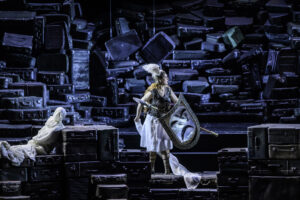
I had high expectations for this production, following the previous evening‘s “Das Rheingold,” as director Stefan Herheim had plenty of ideas for “The Ring‘s” first installment. Sadly, his ideas could not sustain the dramatic textures of “Die Walküre,” as it is replete with long narrative dialogues and less action. Herheim’s tools, the traveling refugees, the suitcases and, most of all, the concert grand piano and score of the opera, are ever present in this production. The idea of the narrator of the action sitting at the piano during intense orchestral passages, as if dictating the action, persisted. Various protagonists refer to the score as if consulting for what comes next. The latter often provided levity, a rare occurrence in most Wagner operas.
Production Details
The opera opens with Sieglinde at the piano in the center of Hunding’s abode (in lieu of the ash tree). Sieglinde strikes the keyboard, but there’s no sound–an indication of her helplessness. An additional element is introduced by Herheim: Hundingling, the fruit of Sieglinde’s forced marriage to Hunding. The child is physically deformed as well as mentally deficient. Initially, he attempts to attack Siegmund but he gradually takes to him. He is even ecstatic at his mother’s passion for the stranger. The euphoric “Winterstürme” is accompanied by a “danse à trois,” a kind of “Tyrolese” between Siegmund, Sieglinde and Hundingling. This blissful “family scene” is antithetical to the budding passion between the twin siblings. Though the child is on their side, Sieglinde slits his throat as Siegmund valiantly pulls the sword from the piano; yes, the piano replaces the ash tree in Herheim’s mise-en-scène. Apparently, Sieglinde feels her liberation can only be accomplished by killing her own son as he symbolises her domination and violation by Hunding. This Sieglinde is beyond modern: self-absorbed, entitled, devoid of empathy or even humanity. At least Medea, in Euripides’s play and the various derived operas, had mitigating circumstances. (Personally, I wished for her to be struck down by Wotan or Fricka rather than Siegmund). As Siegmund extracts the sword, the walls of Hunding’s home, whose bricks are suitcases, crumble. Possibly, the suitcase is a symbol of cherished memories and physical possessions. This symbolism does not work here as Sieglinde has no possessions of her own and even less good memories.
The second act opens with Wotan in his undergarments arising from the prompter’s box, a reference to his subterranean copulation with Erda. To open the act, Wotan is at the piano. The Valkyries are shown as a part of the refugees on the move. When the music starts, they put on their feathered helmets. Some clarification of making the Valkyries refugees on the move would have helped. Overall, all the characters in this production are mobile. They carry different types of baggage; even the gods carry small items corresponding to their baggage; Fricka carries a fancy small white handbag. Again, the piano serves as a transportation vessel through which Brünnhilde and the extenuated Sieglinde arise.
In the final act, the supposedly virginal Valkyries are seen cavorting with the fallen heroes they brought from battlegrounds to Walhalla. When the music starts, the heroes hide under their shrouds and the Valkyries put on their winged helmets. This is a signature moment by Herheim, keen on introducing levity and humanizing the Norse gods and demigods. Further hilarity is introduced when the Valkyries fight over the opera’s score with each snatching a page to remember her part. Things deteriorate when the dead heroes awaken and sexually assault the Valkyries, a gratuitous attempt to elicit laughs that only served to offend, as sexual assault is no laughing matter. Dramatically, it is meant to show the fate Wotan has reserved for the disobedient Brünnhilde.
Surprisingly, among the fallen heroes is Hundingling, the character invented by Herheim. The boy was a victim of an unloving, tyrannical father and a matricidal mother, but he is certainly no warrior deserving of Walhalla. When he sees his mother, Sieglinde, accompanied by Brünnhilde, he is intent on killing her, but two Valkyries prevent him. The creation of this character by Herheim, and especially his murder by Sieglinde, were major mistakes. The story is complex enough without the addition of characters not found in the libretto. Furthermore, many may be willing to accept the love between two siblings, but few will cheer for matricide. Although a gentleman who heard me talking to a friend during the first intermission vehemently disagreed. “Chacun à son goût” or rather “to each his own!”
Herheim’s gimmicks failed to lift the long dialogue between Wotan and Brünnhilde, and the curious refugees reacting to their argument were utterly superfluous. The effects for the final scene, when Wotan lays Brünnhilde were underwhelming: a shroud was brandished by the refugees to engulf both Wotan and Brünnhilde. This is followed by the predictable wrapping of Brünnhilde in the shroud and laying her inside the piano’s belly and lowering the lid. Unfortunately, the magic of this scene–despite the antics–was shattered by raising the birthing Sieglinde from the piano’s belly. Mime, dressed as Wagner as he was in “Das Rheingold,” acts as midwife and snatches the baby Siegfried while Sieglinde collapses dead. To interfere with the magic of this opera’s final scene solely to give a sneak preview of the next work in the tetralogy is uninspired, to say the least.
Matthew Newlin as Siegmund
Fortunately, the singing and orchestra were superior to the mostly inane staging. The absolute star of the show was the versatile young American tenor, Matthew Newlin. Heard last February in the title role of Lully’s opera “Atys,” in Versailles, Newlin is a force of nature. This American tenor is truly amazing. It is hard to conceive of such immense talent in one artist; a versatile singer, a talented actor and a linguist, Newlin impressed me the first time I heard him as Matteo in Madrid in Christof Loy’s production of Strauss’s “Arabella” in 2023. He displayed perfect German, exceptional acting and singing. At the time, I was impressed by the nobility he exuded in both manner and expression. Moreover, he had charisma in spades. One year later, I was astounded by his Don José in “Carmen” in Berlin. This young lyric tenor managed to impress in the heavier role. Once again, his diction, this time in French, was amazingly good.
I was further surprised last summer when I heard Newlin in minor roles in “Parsifal,” “Die Meistersinger von Nürnberg” and “Tristan und Isolde” in Bayreuth. For someone who sings leading roles to take on much smaller ones at the temple of Wagnerian singing indicates either an ambitious tenor looking decades ahead or a curious mind; both rare and laudable attributes. I was both right and wrong; Newlin is indeed ambitious and had big Wagnerian plans, but they were realized much sooner than I had expected. To my knowledge, no other tenor has sung both French baroque and a major Wagnerian role such as Siegmund.
Newlin also impressed with his overwhelming stage presence, only equaled by his vocal excellence. His clear phrasing made his every word clear. Newlin’s Siegmund exuded naïveté, courage and fearlessness, even when his physical condition (in the opera’s libretto, that is) would require more caution. His cries of “Nothung” were beautiful, powerful and from the hero’s soul. They also sounded almost effortless. Thanks to Runnicles playing Wagner softly and elegantly, Newlin never had to force his voice.
Indeed, Runnicles approached the score with tenderness, which worked beautifully in the long scenes between Siegmund and Brünnhilde, and between Wotan and Brünnhilde. He also avoided playing too loudly which allowed Newlin and Teige to shine in the first act. However, at moments, especially in the second act, one felt the tempi were too slow and time almost stood still.
Illuminating Cast
Elisabeth Teige was an incandescent Sieglinde. Her lirico spinto soprano is ideal for this role. Endowed with brilliant high notes, she also sports a strong middle register that she uses to nuance her interpretation. In addition to her beautiful voice, Teige is convincingly expressive and a brilliant actress. Her Sieglinde was truly moving, a broken and helpless victim, not even fulfilled by motherhood (with her deformed child in this weird staging). In her first act duet with Siegmund, “Du bist der Lenz,” one could detect a joy in her voice in such a way that it sounded like an ecstatic rare emotion felt for the first time.
Alas, Danish soprano Trine Møller was not satisfactory in the title role, the Valkyrie Brünnhilde, who sings during much of the second and third acts. From her initial notes, her voice betrayed considerable vibrato that some would describe as a wobble. She sounded too cautious in the second act, which affected one’s perception of the character. Hers was a timid and reserved Brünnhilde, attributes not typical of the audacious Valkyrie. Mercifully, matters improved in the final act, where Møller’s voice was more incisive. Most likely, she was too cautious earlier in the opera in order to manage the demanding final act. She was most moving in her exchange with Siegmund in the second act. Though one could sense her caution, she was vocally more relaxed and affecting in her final scene with Wotan.
American bass-baritone Jordan Shanahan replaced the ailing Iain Paterson as Wotan. Indeed, one could hear fatigue in Paterson’s voice the previous evening in “Das Rheingold.” Shanahan is an exceptional interpreter of Wagner and Strauss. He impressed last season as Barak in “Die Frau ohne Schatten” in Berlin and in three highly contrasting roles at last summer’s Bayreuth Festival, Kurwenal in “Tristan und Isolde,” Klingsor in “Parsifal” and Fritz Kothner in “Die Meistersinger von Nürnberg.” A talented actor, he aptly conveyed Wotan’s torment, both in his row with Fricka and in his repudiation of Brünnhilde. He exuded authority and self-confidence in his opening phrase “Nun zäume dein Ross, reisige Maid.” Likewise, his third act “Wo ist Brünnhild’, wo ist die Verbrecherin?” was appropriately threatening, in sharp contrast to his loving “Leb’ wohl, du kühnes, herrliches Kind!” which he sang softly, beautifully and expressively.
More Highlights
Tobias Kehrer was an appropriately intimidating Hunding. He was the giant Fafner in “Das Rheingold” the previous evening as well as last year’s Ring Cycle at Bayreuth. Vocally impressive with his deep notes, his abusive husband and father was played without excess, which made him more credible than some over-the-top Hundings.
German mezzo Annika Schlicht repeated her previous evening’s appearance as Fricka, the Norse equivalent of Juno or Hera, who demands retribution on Sieglinde and Siegmund for incest, and for Sieglinde having broken her marriage vows (albeit a forced marriage). One wonders how this goddess of marriage and childbirth did not direct more rage at the matricidal Sieglinde and the child-snatching Mime (at least in Herheim’s flawed production). Schlicht was vocally and dramatically powerful. Her rich lower notes matched her bossiness, though she stood out less in this cluttered, overly busy staging in comparison to the much neater “Das Rheingold.” Incomprehensibly, her scene with Wotan was in the midst of Herheim’s “refugees.”
Thankfully, the excellent singing of almost all the soloists and Runnicles’ loving orchestral direction rendered this flawed production enjoyable. However, after a terrific “Das Rheingold” and this disappointing staging of “Die Walküre,” I have serious apprehension for the ensuing two installments of Herheim’s “Ring.” Hopefully, the high quality of the singing and orchestral playing will continue.