CD Review: Naxos’s ‘Tosca’
By Bob Dieschburg
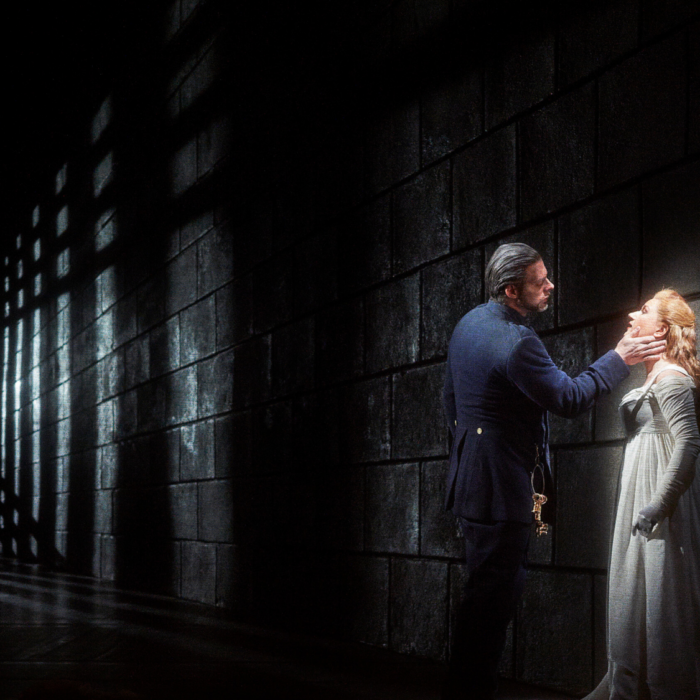
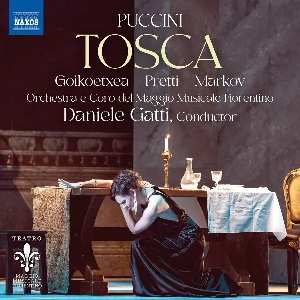
Yet another “Tosca” — this one captured live at the 2024 edition of the Maggio Musicale Fiorentino. The production garnered widespread acclaim, not least for its stark pseudo-fascist décor, evocative of today’s authoritarianism worldwide. But how do its musical qualities fare, and do they warrant the release of Naxos’s new CD set?
The performance is entrusted to the capable hands of Daniele Gatti. He treads an altogether beaten – or better, conservative – path whose meanders feel refreshingly old-school: his “Tosca” is about drama, squarely.
On a stylistic – and however fictitious – spectrum, Gatti sits closer to Victor de Sabata than the analytical mind of Antonio Pappano. As a result, no musical effect feels gratuitous – not even the seemingly trivial pizzicato in the Sacristan’s entrance or, for that matter, the funereal ostinato of the “Te Deum.”
Conceptually, Gatti’s musicianship is iconographic rather than symphonic. He depicts stage action without overemphasis. Yet, while the image of Scarpia amid the Baroque splendor of Sant’Andrea della Valle becomes distinctly corporeal, Gatti understates the pathos elsewhere.
The protagonist’s entrance, for instance, feels somewhat blunt: Vanessa Goikoetxea’s brisk tempi of her triple exclamation (“Mario! Mario! Mario!”) does not do her any favor. Indeed, I can scarcely recall another performance in which this statement piece is dispatched so…unceremoniously.
By contrast, the instrumental prelude to “E lucevan le stelle” is a triumph. Gatti paints Cavaradossi’s isolation with infinite expanse – as if he suspended the narrative for a breather. In part, this spaciousness might be a concession to stage action; yet the effect is one for the books.
What about the cast? Vanessa Goikoetxea, on paper, checks all the boxes: a dramatic profile, secure top notes (including the dreaded High C on “quella lama”), and a disciplined legato. Her “Vissi d’arte” is a showstopper that rightly earns its applause, while the soprano’s delivery of “Avanti a lui tremava tutta Roma” has all the ring of a necrologue. Still, if criticism had to be voiced, it would pertain to a certain monolithism; for example, Tosca’s anguish at the death of Cavaradossi seems overly polite – too much so for a complete suspension of disbelief (caveat: I do not mean to encourage histrionics!).
Alexey Markov appears as a ruffian through and through; his Scarpia is a petty fellow, devoid of cunning but equipped with a relentless forte. His asides, for instance, lack their parenthetical quality.
Markov finds more nuance in Act two, though his phrasing falters during Scarpia’s meretricious self-proclamation (“Già mi dicon venal”). It is a disjointed scene, which requires a balance of legato and declamatory bite – yet the Russian baritone appears ill at ease with either. Puccini’s superlative markings (“con intenzione,” “eccitatissimo”) remain underexplored.
Piero Pretti, as Cavaradossi, proves far more idiomatic. His “Recondita armonia” is showcased with verve, while his lyricism in “Qual occhio al mondo” displays an elegant sprezzatura. In “E lucevan le stelle,” he takes no risks: the diminuendo on “disciogliea” gets omitted, and the phrase breaks before the complement of “dai veli.” That is perfectly defensible; Pretti does not incarnate the Roman hero of the 1950s (think Del Monaco), but a compassionate lover caught in the gears of human tragedy.
Where does this leave us? Gatti’s Florentine “Tosca” is far from anthological. Moments of musical exceptionalism are intermittent, and with the possible exception of Goikoetxea, the cast appears too ingrained in routine work to contribute to the release’s longevity.
The DVD version (on Dynamic) is a viable alternative; the visuals will not redeem the audio deficits, though they might put into context the praise for Margherita Palli’s set design.