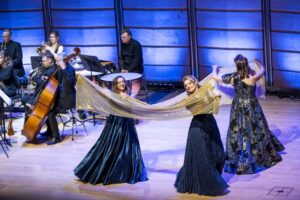
Shaumet Music 2026 Review: Das Rheingold (Dove/Vick)
By Gordon Williams(Photo: Cassandra Hannagan)
Is it possible to reduce the scale of Wagner’s mammoth operas? A “yes” answer clearly underlies Jonathan Dove and Graham Vick’s digest of “The Ring,” Wagner’s four-opera epic. Let’s face it, Wagner’s “Ring” in its original form is nothing less than an account of the unbalancing of the world and the efforts over a series of long nights in the theater by a procession of gods, demigods and human heroes to restore that balance or at least escape the curse that has set these salvage-attempts in motion. Wagner’s “Ring” is huge and in its original version has an outsized orchestra to match its durational scale.
Shaumet Music, a young Australian company “committed to broadening what Sydney audiences can experience” as well as “place emerging Australian artists at their centre” made a bold statement with their presentation on Friday night, April 24th of the first installment in the Dove/Vick reduction, “Das Rheingold,” the “Ring’s first night, at Sydney Recital Hall, Angel Place. On paper, the Dove/Vick version is audacious – reducing the overall duration of the “Ring” to nine hours and slimming down an orchestra of 90+ musicians to an 18-piece chamber ensemble.
The Dove/Vick version was conceived as a way to present this massive work in out-of-the-way halls by the UK’s Birmingham Opera Company (previously known as City of Birmingham Touring Opera), a company committed to “innovative and avant-garde productions of the operatic repertoire, often in unusual venues.” The work, which Birmingham Opera touts as a “pocket-sized miracle,” was first performed at Stockland Green Leisure Centre, Birmingham in 1990. And young Sydney conductor, Toby Wong, writing a foreword in the program to this production, admitted to being fascinated by the idea behind this ‘reduction’, asking what happens “when a work as monumental as Wagner’s ‘Ring’ is reimagined for chamber forces?”
Clearly, one of the outcomes is the possibility of bringing this work to audiences that might not otherwise have the opportunity to witness the work in its original gargantuan form.
That benefit might not necessarily be relevant to Sydneysiders who have in recent years been able to sample the full-strength Sydney Symphony Orchestra’s concert versions of the “Ring” operas under Simone Young. But artistically, according to Wong, the reduction also “reveals the orchestral textures in a new light.” Perhaps more significantly, “The drama unfolds with remarkable immediacy and focus.”
Is all this true?
It should probably be said that this production seemed in a way to be a provisional demonstration of what the company might achieve. Each audience-member had a questionnaire to fill out designed as if to gauge the wisdom of moving forward with the whole project, and at times the presentation gave a sense of being, understandably, ‘indicative’ of what might be done with further work, if arguably not the “fully-staged” presentation which was mooted in pre-publicity.
Reducing Wagner’s 90-strong orchestra to 18 musicians may deny the listener the sumptuousness of Wagner’s orchestration and demand abbreviations: would listeners still really want to listen to the opening’s three-minute expounding of E flat major harmony on 18 instruments? In Dove’s hands it was reduced to about a minute. On the other hand, those three minutes might have been revealed as an interesting precursor of 20th century Minimalism. The shimmering of the ensemble under Donner’s conjuring of thunder at the very end did in fact strike this reviewer’s ears as having contemporary textures especially with the organ in the ensemble. Interesting that Dove chose to include organ, almost a Grainger-esque method of compensating for thinned textures.
But admittedly, there was a point in this production when a listener could feel they were hearing the breadth and volume they would normally hear in a Wagner production. In Angel Place, best-suited for recitals, the vocal immediacy of the Rhinemaidens (Camilla Wright as Woglinde, Katrina Waters as Wellgunde, and Angelique Tot as Flosshilde) came across as thrilling, since we were closer than we would normally be – part of that immediacy that Wong wrote about in his foreword. As conductor Wong kept the work moving in a way that sustained audience-interest in the plot.
Jonathan Dove is an experienced opera composer. “Flight,” about people ‘lost in transit’ in an airport has been much performed. “The Monster in the Maze” is a ‘community opera’ co-commissioned by the Berlin Philharmonic, London Symphony and Aix-en-Provence festival. Dove’s chamber opera “Mansfield Park,” a Jane Austen adaptation, was staged in Australia by Victorian Opera, in regional Ballarat in 2025. Sir Graham Vick was, of course, one of Britain’s great opera directors. There was only one occasion in Dove’s edition when an ellipsis made itself felt to my ears, the example being Wotan’s final “Abendlich” monologue, truncated and causing arguably the only harmonic (but not conceptual) bump in the presentation. But for the rest of it, the changes were seamless. It was only toward the end, actually, that it occurred to me that the gods Froh and Donner had been conflated, Froh incorporated into the part of Donner, sung by Bernard Leong-Lokman. That was a particularly nifty touch. Would a newcomer to the work, the sort of person that this reduction is hoping to reach, have noticed? Overall, Dove’s adaptation well fulfilled Wagner’s adage that composing is the art of transition.
Being so close to the performers gave audience-members ample opportunity to appreciate their characterizations. Bass-baritone Shane Lowrencev was an imposing Wotan as befits the king of the gods, albeit soon wounded. Mezzo-soprano Livia Brash brought a sense of polish to her role as Fricka, Wotan’s wife, often portrayed as a nag. Altogether the gods, including also Bernard Leong-Lokman and Xiaoxu Aleta Shang as Freia, goddess of youth, were a convincing coterie of once powerful beings now trying to retrieve their power.
Charles Cole and Tristan Entwistle relied on their voices to convey their stature as the giants Fafner and Fasolt, although Shane Lowrencev was actually the tallest person on stage, but that could have been read as reflecting Wotan’s stature as chief of the gods. Tristan Entwistle, lighter-hued than Charles Cole, nevertheless conveyed a lovely sense of Fasolt’s yearning for Freia who is the ransom these giants have demanded for building Wotan his citadel.
It was the more villainous or morally slippery characters who benefited most from the audience’s proximity. Raphael Hudson was a suitably wily Loge, his status as god of fire indicated by a red scarf. Simon Lobelson performed under the influence of illness, but the seams of his Alberich grew richer and more detailed as the evening drew on. There were moments when he was absolutely chilling.
Contralto Jill Sullivan was an imposing Erda, the earth goddess come to warn Wotan not to hang on to the ring that Alberich has cursed, but her presence might have been amplified by appearing not from backstage whence the other gods had entered but up in the balcony looming over and behind the audience.
Director Anke Hoeppner-Ryan, Discipline Lead for Classical Voice at the Sydney Conservatorium, provided a good sense of how compelling this Dove/Vick version works as theater. There was something exciting, almost guerilla-theater-like in some of the decisions: a gold ribbon that could neatly be bunched up symbolized the riverine gold that would be turned into a tarnhelm and ring in Alberich’s hands. It should be noted that the singers themselves played the offstage ‘anvils’ that symbolize the gods Wotan and Loge’s descent into Alberich’s realm, Nibelheim.
The use of illustrated slides to signal the basic turning-points of the plot may, once or twice, have acted as a spoiler. “Brother slays brother” alerted us well ahead of time that Fafner would murder Fasolt in fulfillment of the ring’s curse. And perhaps a future production could aim for more visual interest to balance the reduction in orchestral color. But the slides were remarkably effective as a basic orientating device, revealing how little may be necessary to keep an audience informed. Surtitles might have provided more consistent insight. Perhaps that technical feature awaits a future production. But it was a shame not to more fully enlighten the audience about plot specifics in a staging aimed at unfolding the drama with “remarkable immediacy and focus.” Would it have been possible to sing in English, as Wagner himself once suggested to a correspondent in Melbourne, Australia? We were close enough to appreciate the clarity of the singers’ diction.
Still, my companion on the night, new to Wagner, remained engaged throughout the whole 110 minutes, suggesting this is a project that could well act as an introduction to “The Ring” for those who might otherwise baulk at the scale of the original, and whether or not the economics might encourage performances in places Wagner normally doesn’t reach. What will the results of the questionnaire say?