Royal Ballet & Opera 2025-26 Review: Peter Grimes
The First Revival of Deborah Warner’s Production is a Theatrical & Vocal Triumph
By Benjamin Poore(Photo: ©2026 Tristram Kenton)
If you have ever visited to the Suffolk seaside town of Aldeburgh, where Benjamin Britten lived, and which inspired his 1945 opera “Peter Grimes” – based on George Crabbe’s poem “The Borough” – then you will surely remember the remarkable views from the sea front: vast, empty skies, sunlight blazing on the water like a purifying fire, and a bleak, flat countryside, punctuated by marsh, inlet, and reedbed. “I am rooted here”, the eponymous (anti)hero of the opera sings. This landscape, forbidding and beautiful, seemingly on the precipice of the world, is the alpha and omega of Deborah Warner’s production of “Grimes”, which returns to the Royal Ballet and Opera after a celebrated debut in 2022. Its horizon – an existential as much as a physical threshold – bisects the back wall of the stage, with the world – like the visionary outsider Grimes – caught between the heavens and the deep. At its outset and conclusion an aerialist in fisherman’s gear (Jack Horner) floats down from the flies, seemingly calling Grimes – either to ascend to the stars or drown in the moonlit depths. We know, of course, how it will end.
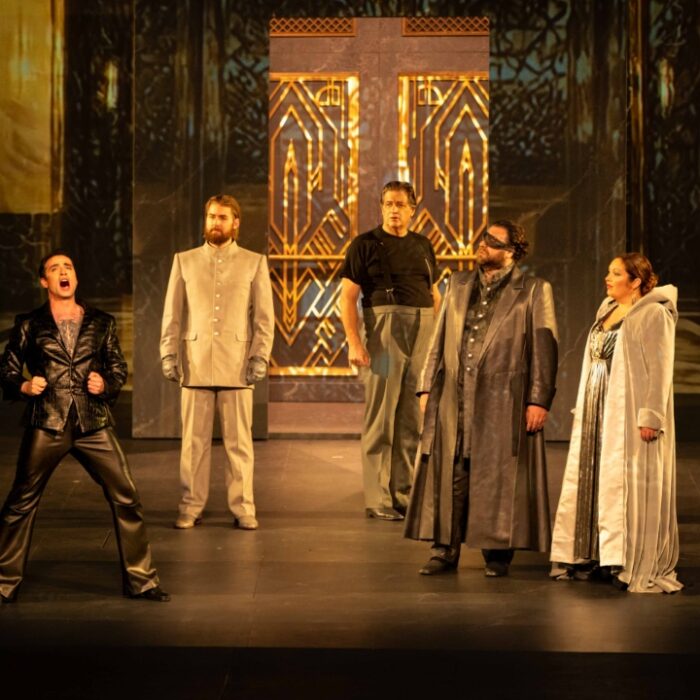
A vehicle for Allan Clayton, who is now established as one of the greatest singers of Britten’s music in the world, it is conducted by Jakub Hrůša, in his first season at RBO Music Director. Warner’s production – with designs by Michael Levine and Luis F. Carvalho, lighting by Peter Mumford, and movement by Kim Brandstrup – pivots between a gritty social realist naturalism and a more dreamlike, speculative, space of psychological hallucination. The action of the opening scene is presented as Grimes’ nightmare, his internal demons as terrifying as the outward ones – a furious mob born from the poverty and deprivation of these abandoned seaside towns; the St. George flags, torches, and effigies that are borne aloft by the raging crowd in Act three a nod to the way these communities have become the stalking ground of the Far Right, who are making increasing political inroads there.
Britten’s debt to “Wozzeck” in the creation of “Peter Grimes” is quite clear – the reworking of traditional musical forms into the overall dramatic arch, the use of diegetic onstage music – but feels especially keen in Warner’s production. Its equal focus on internal and external pressures shaping a total psychological and social alienation is articulated brilliantly; Warner of course directed the work at the house in 2023. It is a production unequivocal about the political significance and intentions of Britten’s scenic works, to shattering effect.
In a programme book interview, Allan Clayton mentions that the first time he sang Grimes was when he was still a chorister at Cambridge; the performance was so close to the end of Evensong he had to sing the latter in his costume. Clayton’s reading of the role has moments of raw lyrical power, swerving into what we might call the Jon Vickers and Stuart Skelton traditions of the role, marked by an Italianate ring and wiry intensity in the vibrato, such as in his Act one duet with Balstrode. It was the perfect foil for Hrůša’s expressionist, tightly-focused string sound (more on that later). But what makes this a real tour-de-force – still one of the most completely realised vocal and dramatic revelations of a character on the opera stage I have ever seen – is the memory of that chorister in his sound – floated, ethereal, unearthly, and fragile, as he tries to walk the passaggio tightrope of ‘Now the Great Bear and Pleiades’. He is a poet about to fall into the abyss, teetering on the brink, with Clayton finding a remarkable mix of registers on that treacherous note, so beloved by Peter Pears.
What makes Grimes’ tragedy so unbearable is the way Clayton’s performance summon evokes that image of a child chorister too – as frightened, damaged and vulnerable as the young boy who ends up dead at the foot of the cliff in the opera. The mad scene is still astonishing, not least for the timbral adventures Clayton took us on – rasping and guttering, slipping wearily off the voice, introducing bends in tuning and pitch that could belong to contemporary repertoire as much as that of the twentieth century. Again, the image of Berg’s “Wozzeck” appears as a watermark in the show.
The production reunites many of the original cast, who have since taken the show around. As a consequence the stage action and nuances fit like a glove. There are plenty of stand-out turns, with many characters as close to the brink of madness as Grimes. John Graham-Hall returns as Bob Boles, his tenor artfully pinched and twisted by the Methodist character’s mania and neurosis, his religious squall soaring over the big scenes in Act one. Christine Rice gives a skin-crawling performance as the paranoiac Mrs. Sedley, whose chest voice in ‘Murder most foul it is’ from Act three comes from darkly Gothic depths.
Clive Bayley’s Swallow is another reminiscence of “Wozzeck”, with a clipped delivery in the prologue’s trial scene recalling Bergian sprechgesang and in the final Act, a lurid and obscene authority figure like Berg’s Doctor. James Gilchrist’s affable tenor – sweet, measured, and relentlessly reasonable – underlines his insouciant uselessness as the town’s busted moral compass as the Reverend Horace Adams. Jacques Imbrailo turns his more heroically lyrical instrument to something more oleaginous as the drug dealer and petty criminal Ned Keene. Catherine Wyn-Rogers is a weary Auntie, at times almost slipping into dreamlike lyrical reverie.
Bryn Terfel as Balstrode makes a huge impact, his relatively unblended sound a fine figure for the character’s ambivalent relationship to the rest of the Borough; it also means he cuts unequivocally through the chorus scenes in which he plays a role as leader and trickster. It’s the bright intensity of his sound that leads us back, as with everything in this production, to the coruscating light of the Suffolk coastline, the sunlight searingly reflected by the waves. As he sang ‘Seahorses’ whilst looking out at cresting waves of the violently approaching storm, its first vowel had an unearthly, piercing gleam. As one of the few characters in the work gifted with insight into the Borough, the events of the piece, and Grimes himself, it is apt that his voice somehow identifies him with the sea itself. Maria Bengtsson – returning as Ellen Orford – has a silvery delicacy and tenderness that is at its most heart-breaking in the climactic scene of the opera, as she offers to take Peter home. The hope implied in its ringing brightness has long since vanished.
Britten’s complex contrapuntal writing for chorus, especially in Acts two and three, is oratorio-like in character, and grew to ferocious climaxes. Warner’s inspired decision to place them offstage for the opening chorus of Act one made for a haunting, disembodied sequence of hushed intensity, as dawn breaks over the beach.
Special praise must be reserved for Hrůša’s conducting and the Orchestra of the Royal Opera House. Detailing is astounding – finally, some decent church bells for the Sunday Morning peals in Act two – but the string-playing in particular stood out. The sound was ferocious and compressed, giving a strong sense from the very first ‘Dawn’ interlude of the pressure-cooker psychology of the Borough that made even the lyrical taut and threatening. Tempo-wise, the foot was on the gas throughout, and the symphonic quality of Britten’s motivic development of the opera felt terrifyingly inevitable. The more tortured passages of the Passacaglia took on the contrapuntal intensity of late Mahler – Hrůša is a celebrated exponent of the eerie Seventh Symphony anguished Ninth – as well as Berg; parts of the storm interlude could have come from the Three Pieces for Orchestra. This is opera at its most eloquent and immediate; get a ticket if you can.