Washington National Opera 2025-26 Review: The Crucible
Ryan McKinny Triumphs in Robert Ward’s Timely Opera
By Francisco Salazar(Credit: Scott Suchman)
On March 21, the Washington National Opera opened “The Crucible,” its second production of the spring season at the Lisner Auditorium. The Washington National Opera’s decision to showcase this work spotlights the importance of art’s resilience in times where where institutions like the John. F Kennedy Center for the Performing Arts are being taken over by regimes and being used for propaganda.
Revival
For this staging, the company brought back Francesca Zambello’s acclaimed 2016 production which first premiered at the Glimmerglass Festival. The production is anchored in the time of the 1600’s, the period of the witch trials and opens with women dancing around what looks to be a cauldron and fire before Betty Parris falls ill. It then turns into a minimalist set with a bed and wood walls that bring us into the interior of the Parris household. The rest of the evening keeps the wooden walls that transform into the proctors household and the courtroom. A scene in the forest in Act three uses branches hanging from the top and a black curtain to create the minimalist space and and the jail scene in Act four uses the wooden benches and the black screen to create ominous scenery.
Lighting is impressive, especially during the courtroom scene when mass hysteria erupts and lights go from red to purple hues, evoking the chaos in the room. The final image of the nooses, coming down as Rebecca Nurse and John Proctor stand in the center with the everyone else around them, is evocative and powerful.
Neo-Romantic
The 1961 score by Robert Ward is lush and melodic and through-written with the action never stopping. The music has moments that soar in the vein of Puccini and Wagner but also passages that are derived from folk lyricism. However, it is a score that constantly keeps the intensity of the action and almost feels at times like a play with music. However, one wishes the melodies could be more memorable and the contrast in sections more distinct. It sometimes feels like the music always maintains itself in the same heightened tension and never gives us a moment of calm or reflection except in the opening scene of Act four.
Under the leadership of Robert Spano, the score soared to great emotional heights as the conductor led the orchestra, which was divided into two separate rooms with some members in the pit and others backstage. With the help of sound mixer Mark Rivet, the orchestra sounded cohesive and lush. Spano was particularly impressive in the ensemble work, leading to big climactic crescendoes. Also strong were the preludes that opened each act. Spano also followed his cast to perfection, one of the highlights being the dark and moody opening aria of Act four and the ever-growing crescendo of Elizabeth Proctor’s aria.
Outstanding Cast
Ryan McKinny gave a towering performance as John Proctor giving his complex and contradictory character various dimensions from tender and loving in his scene with Elizabeth Proctor, to defiant in the courtroom scene. His performance also featured the singer’s stunning bass-baritone that showcased his highest range and his lowest notes.
His opening lines brought out a warm timbre and legato line that showcased Proctor’s tenderness. As he sang the aria, “I’ve forgotten Abigail,” McKinny sang with remorse emphasizing the darker tones in his voice but also giving it a gentler feel. As the aria progressed, his voice obtained more accented phrases, foreshadowing the upcoming scene.
During “Mary Warren, how do you go to Salem,” McKinny brought out his strength in both his stage presence and vocal delivery as he questioned Mary, creating fear in the young woman. The tension continued to grow, especially in the Act three duet with Abigail, where his voice gained an aggressive character with more accented lines and defiance. And in the courtroom scene, he started out with a cool and legato phrase before lashing out and confessing “Yes, with her in my house” and “I have ruined my name” with a booming baritone that resonated throughout the auditorium. His voice obtained a gruffness that emphasized the character’s distress but also his resistance against his accusers.
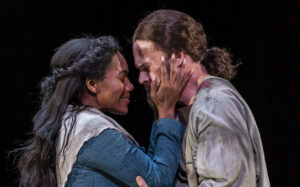
Act four was heartbreaking but also showcased one of the most beautiful musical moments of the evening with Ryan McKinny and J’Nai Bridge’s voices blending with beauty. In the final scene, when McKinny sang “I want my life,” his voice brightened with a suave sound only to turn to defiance as he emoted, “I have given you my soul, leave me my name” to great emotional effect. It was a moment of heroism and, in McKinny’s hands, you could sense all the pain but also the calm in the character’s decision.
In the role of Elizabeth Proctor, J’Nai Bridges showcased a plush sound that evoked the character’s dignity. In her opening scene with McKinny’s John, there was tenderness in her “What’s Keep’s you?” as she sang with piano sound. As the scene developed and she pleaded with John to go to Salem, Bridges displayed intensity in her singing. Her “I Do not Judge you” was a tour-de-force as her voice slowly crescendoed with the orchestral line, eventually reaching a forte sound that displayed Elizabeth’s desperation. In the courtroom scene, Bridges showcased a noble mezzo sound as she denied the accusations against her husband and in her final duet in Act four with McKinny, “What word of the Children,” there was a warmth to her singing that displayed her beautiful legato line and her resonant chest voice. It was a moving scene that showed Bridges capture Elizabeth’s desperation, heartbreak, grief but also her strength and resilience. This was furthered displayed in her final phrases “God forbid I take it from him.”
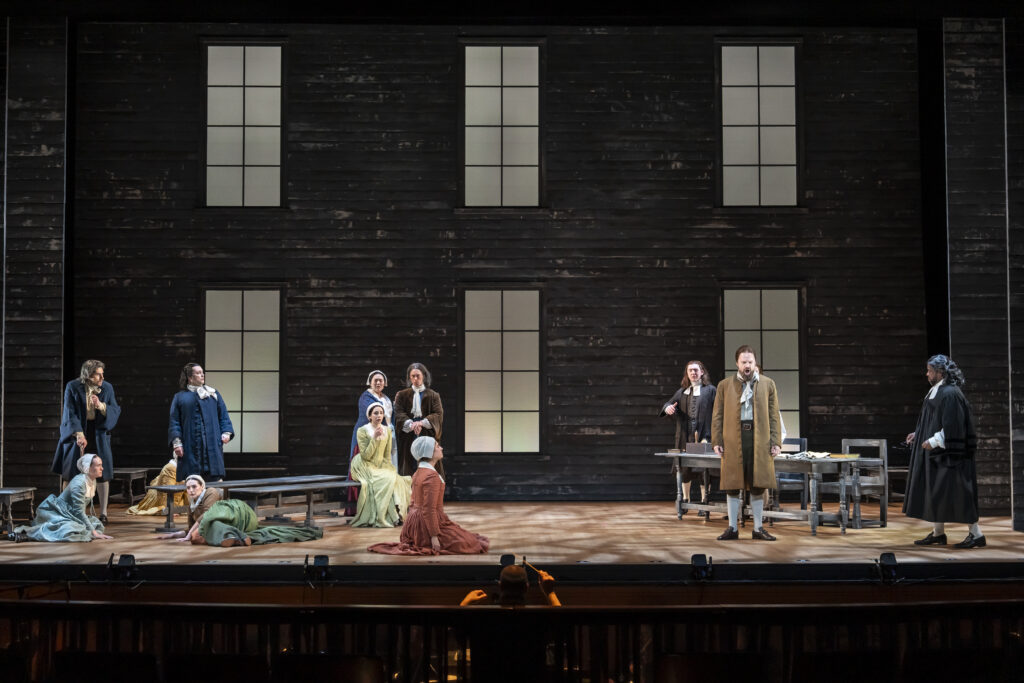
Photo credit: Scott Suchman
In the role of Abigail Williams, Lauren Caroll showed a ravishing lyric soprano with bright high notes that could easily ring over the ensemble of the first act. She was particularly arresting in her Act three duet with McKinny, “John, I Knew” and Act four aria, “John, My Darling” where Caroll expressed Abigail’s desperation and jealousy at being rejected. Her voice grew in strength as the tension between the two characters also increased. In the courtroom scene, Caroll displayed great physicality and virtuosity especially in the “mad scene” and worked well with the ensemble of women, blending her voice beautifully with the choral passages.
Kresely Figueroa was one of the standouts of the evening in the role of Mary Warren. Her bright, burnished soprano was affecting in her scene with McKinny’s Proctor in Act two, bringing physicality to each moment and at one point lying on the floor in a fetal position almost looking for protection from the entire village. You could sense her emotional distress as well as her innocence as she sang “He will. He sentenced her.” Her fragility came to the fore through her staccati lines and her coloratura passages. In the Act three choral scene, Mary’s brittle state finally broke with Figeroua displaying the character’s madness through her higher and lower notes.
Ronnita Miller was a highlight of the evening, bringing her gorgeous round mezzo-soprano to the role of Tituba. Her Act four aria, “The Devil say he’s coming,” was a scene stealer as she sang with a gorgeous legato line going deep into her chest notes.
As Judge Danforth, Chauncy Packer brought an imposing tenor to the proceedings, singing with ringing high notes, raw sound, while also bringing comic touches.
Anneliese Klenetsky sang the role of Sarah Good and Ruth Putnam and was particularly effective with her vocalise lines in Act four that displayed a gorgeous flowing legato. Veronica Siebert captured Betty Parris’ fright and madness in Act one, while Alexandra Christoforkais, as Susanna Walcott, was outstanding in the Act three courtroom ensemble. Chandler Benn and Tiffany Choe as Thomas Putnam and Anna Putnam were commanding in their roles. Benn showed a very conniving spirit, especially in the Act two scene. Meanwhile, Nicholas Huff and Joshua Dennis were a good duo as Giles Corey and Ezekiel Cheever displaying bright and piercing tenor voices that conveyed each emotion in their characters.
Michelle Mariposa gave nobility to her Rebecca Nurse, while Atticus Rego showcased a firm bass. Alexander McKissick as Reverend Samuel Parris was effective in the first act, bringing out the fear, distress and hopelessness of his character. Robert Frazier, as Reverend John Hale, demonstrated remorse and depth through his vocal prowess, especially in the final moments of the opera as his character realized he had participated in injustice.
Overall, this was an evening to remember in an opera that powerfully portrays a reality not too far from our society today. It also demonstrated Washington National Opera’s resilience in time of change and the importance of the company more than ever.