Wiener Staatsoper 2026-27 Review: Adriana Lecouvreur
By Laura Servidei(Photo: © Wiener Staatsoper / Marcel Urlaub)
Few operas blur the line between theatrical fiction and real-world tragedy quite as dramatically as Francesco Cilea’s “Adriana Lecouvreur.” Premiered in 1902 at the height of Italian verismo, the work dramatizes the glamorous life and mysterious, poison-laced death of the historic 18th-century Comédie-Française actress. Driven by a lush score rich in soaring melodies, Cilea transforms a story of backstage rivalry, aristocratic intrigue, and lethal jealousy into an irresistible showcase for vocal virtuosity. What emerges is not merely a melodramatic tale of fatal love, but a poignant homage to the sheer artifice and seductive power of the stage itself.
Verismo, Drama & the Power of the Stage
Director David McVicar grasped this core aspect of the opera brilliantly. His 2010 production, which has since toured the world, is built upon a meta-theatrical concept — hardly the most original idea, of course, but one that fits this particular work like a glove. The theater remains omnipresent throughout the story: it becomes a “locus of the mind” where the characters’ lives unfold and which provides coherence to otherwise barely comprehensible events. In fact, the opera is notoriously hamstrung by Arturo Colautti’s labyrinthine libretto, which crams so many convoluted political feints, sudden twists, and implausible motives into four Acts that tracking the plot — let alone believing it — becomes a bewildering chore. The action, supposedly taking place in the early 18th century, is preposterously set… exactly in the early 18th century! The horror.
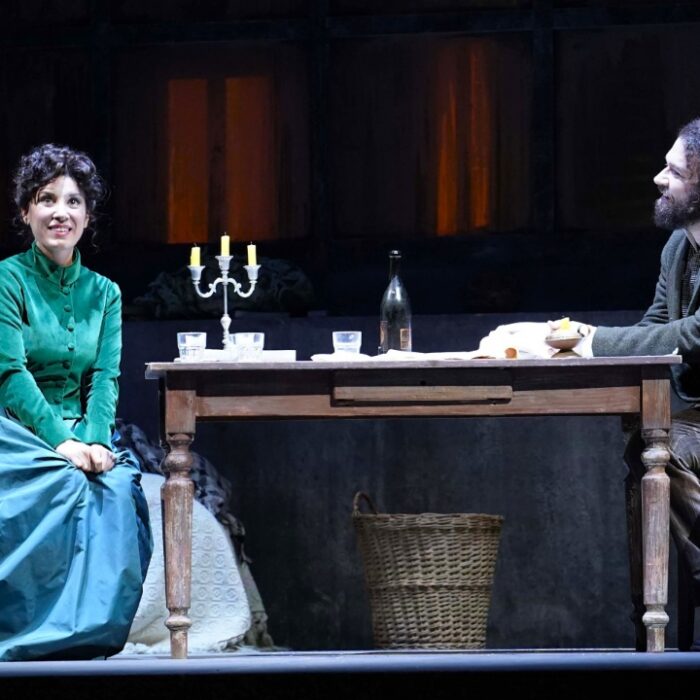
Yet the atmosphere of the Comédie-Française during that era is rendered in an enchanting way, with the aura of the theatrical arts pervading the entire show. In the first Act, set backstage during a performance of Racine’s Bajazet, excited performers prepare for their entrances with bustling zeal. There is a constant flurry of activity and the rustle of hoop skirts, while a transfigured Adriana rehearses her lines in the center of it all. One can vividly sense the stage fright and tension; nothing feels stiff or dusty. While Adriana waits to take the stage, the play continues offstage, visible from behind almost as a Chinese silhouette shadow play. It is a genuinely engaging production with beautiful visuals that unearths elements and human values that feel remarkably easy to relate to, even in our modern era.
Armiliato’s Delicately Perfumed Soundscape
Marco Armiliato led the State Opera Orchestra in the creation of a varied, richly colored soundscape. The strings sounded voluptuous during the introduction to Act two, and the overall orchestral sound was full and vibrant. However, Armiliato — a well-known verismo specialist — focused wholeheartedly on the floral delicacy, pastel hues, subtle perfumes, and contemplative moments of repose embedded in Cilea’s late-Romantic score.
A Divinely Expressive Tragedienne
In this interpretation, he may well have been inspired by the vocal strengths and artistic approach of the protagonist, Ermonela Jaho. Jaho offered a tender, deeply emotional interpretation of the tragedienne Adriana; her soprano, sweet and agile in its upper register, was exceptionally expressive and supported her incisive, tragic acting. As is her custom, Jaho threw herself completely into the role, enlivening the diva right before our eyes. In the third Act, during a party at the Prince de Bouillon’s palace, Adriana recites a spoken monologue from Racine’s Phèdre, which she uses as a vehicle to hurl thinly veiled insults at her rival, the Princess. Jaho’s recitation was worthy of a consummate tragic actress — she was nothing short of phenomenal.
Her voice was not particularly large, and at times the role might have benefited from a bit more raw power in the middle register. Her absolute best assets, however, were her ethereal, silken timbre in the high register, which completely spellbound the audience. Jaho never flaunted her technical prowess for its own sake; every vocal accent and every pianissimo was strictly at the service of the music. “Io son l’umile ancella,” indeed.
The final Scene was truly mesmerizing. The set returned to the backstage area of the theater from Act one, but now presented in a decadent, dilapidated state that mirrored Adriana’s deep despair over losing her love. As she dies — famously poisoned by a bouquet of faded flowers — she sings of seeing an alluring light (“Ecco la luce”). Slowly, the lights of the theater turn back on as her art calls to her one last time, her fellow actors appearing on stage to bow to the audience as she passes away. The exquisite transparency that Armiliato extracted from the Staatsoper Orchestra served as the perfect companion to Jaho’s single, translucent, ecstatic thread of voice.
A Chilling and Splendid Rival
Elīna Garanča found an ideal vehicle for her vocal talents in the role of Adriana’s rival, the Princess of Bouillon. Garanča’s powerful, honey-hued mezzo managed to convey the full spectrum of her character’s passion — verging on an obsession for Maurizio — alongside her cold, calculating vindictiveness. Garanča looked splendid in a dark blue robe à la française (with costumes designed by Brigitte Reiffenstuel), her haughty, aristocratic countenance and chilling beauty hardening rather than softening the villainous nature of the Princess. Her signature aria, “Acerba voluttà,” was utterly splendid.
Soldierly Panache and Unrequited Love
Luciano Ganci portrayed Maurizio, the man contested between Adriana and the Princess. His tenor was powerful and virile, featuring bright, ringing high notes. While his delivery was perhaps not the most refined or elegant, that is easily forgiven in this style of music. He brought a soldierly panache to the stage that suited the character well, giving his absolute best in his rousing war reminiscence, “Il russo Mèncikoff.”
Michonnet, the loyal stage manager at the Comédie-Française who is deeply and silently in love with Adriana, was sung by Roberto Frontali. His smooth, well-projected baritone successfully conveyed both his hopeless romantic longing and his fatherly affection for the protagonist, expressing a sincere, tender concern for her well-being. Simonas Strazdas rounded out the principal cast as the Prince de Bouillon, leaving a strong impression with his booming, velvety bass despite the brevity of the role.
Spirited Ensemble Work
The cast was completed by a plethora of minor characters who elevated the performance. Adriana’s theater colleagues gave a spirited, engaging rendition of the ensembles in the first and fourth Acts, singing with sharp precision and total commitment, while Andrea Giovannini interpreted the Abbé with a light, pleasing tenor and a delightfully fizzy comic flair.