Wexford Festival Opera 2025 Review: Deidamia
George Petrou Shines As Both Musical & Stage Director
By Alan Neilson(Photo: Padraig Grant)
In 1752, Händel’s final complete composition, his oratorio “Jephtha,” was premiered at London’s Covent Garden Theatre, bringing to an end the composer’s illustrious career.
Just over ten years earlier, he had premiered his opera “Deidamia” at London’s Lincoln’s Inn Fields Theatre, in what proved to be another significant landmark; it was to be the last of his 42 opera compositions. And it was a failure! It managed only three performances before falling into a period of neglect for over 200 years. It was revived with a production in Germany in 1953, since which time it has received only infrequent performances. This year’s Wexford Festival Opera’s production was, therefore, a welcome opportunity to view Händel’s swan song for the opera stage.
The entire drama plays out on the Greek island of Skyros against the background of the Greeks’ preparations for the Trojan War. The oracle has predicted that the great warrior Achilles will die if he goes to fight, so his father has sent him to hide on Skyros, where, dressed as a woman, he is brought up among King Lycomedes’ daughters. Being the red-blooded hero he is, he inevitably falls in love with Deidamia, the king’s eldest daughter.
Greek myths, however, rarely run smoothly, and neither does this one, for Ulysses arrives on the island determined to flush out Achilles and convince him to join the fight against the Trojans. The plot then takes a number of absurd twists and turns, as Achilles, still dressed as a woman, attempts to stay hidden while Ulysses tries to unmask him. Alongside the high emotions, it is not unsurprising, therefore, that many scenes often quickly morph into comedy, such as when Ulysses, suspecting that Achilles is disguised as a woman, attempts to seduce him, which Achilles finds quite funny, especially when he realizes Deidamia is listening from the side.
The opera ends in a sugar-coated tragic finale. While the fleet lies ready to sail, Deidamia and Achilles are eventually united with Lycomedes’ blessing, and the chorus urges the lovers to take their pleasures when they can. All the characters and the audience, however, are fully aware that Achilles will meet his death at Troy and Deidamia will never see him again.
Petrou’s Insightful Reading Draws Attention to the Connections that Bind the Past to the Present
The conductor for the production was George Petrou, who also took charge of the stage direction, assisted by the set and costume designer, Giorgina Germanou.
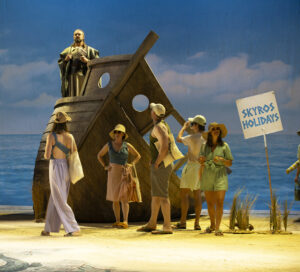
Petrou decided to set the drama against the background of the temples and ruins of ancient Greece, in which Achilles, Deidamia and the other characters go about their business, while present-day tourists sunbathe on the beaches, pose for photos against classical marble columns from antiquity and visit a museum exhibiting the armor and weaponry of the period. The past and the present are thus combined in a shared space, in which the participants are, for the most part, unaware of each other’s existence. It was an inspired and well-presented staging that uncovered many themes while at the same time presenting many opportunities for comic episodes.
The tourists did what tourists do; that is, they consumed. They consumed the natural beauty, they ate the local food while watching traditional dancing, they visited cultural sites, they took part in art classes and even explored the depths of the local seas in search of treasure. It was all done to experience the real Greece and get to know its history. Next year, they will have moved on, possibly to Egypt to experience the “Land of the Pharaohs.” Their behavior is all so superficial, and this is how it was presented. Clad in comfortable modern-day clothing, we watched them relaxing on the beaches, occasionally squabbling, and sipping wine. It was so important for them to get the right photographs; after all, they will have to show off their first-hand appreciation of the art of classical Greece when they get home. Even the actual characters of “Deidamia” occasionally became sick of the tourists’ behavior and at one point gave one of the tourists a slap as they walked past, leaving him a little perplexed, and not knowing exactly what had happened.
Maybe this is too cynical an interpretation. The tourists are treading in the footsteps of the past; we all do this every day of our lives – it is part of our existence! In this instance, however, they simply want to experience a different past and feel the echoes of different footsteps, even if only as a backdrop to a relaxing holiday.
It was also a presentation that drew attention to how we view and understand the past. Whether a myth or a reality, the Trojan War has had a major impact on Western culture. We commonly view the events as heroic, epic, and something we contemplate with a sense of awe and amazement. The tourists’ superficial engagement with the past can thus appear as vulgar, even contemptible. Yet, by positioning them alongside the heroes of the past, it offers up another perspective. We sneer as one tourist tries to seduce a young woman, which precipitates a quarrel with her partner. How mundane and immature it all appears in the context of the Greeks’ preparation for war. But we are reminded that the causes of the two conflicts are essentially the same, and yet we view them so differently. Imagine the audience’s reaction if the offended tourist had reacted by murdering the want-to-be Don Juan! It is a perspective that is actually embedded in the libretto itself through its use of comedy, which Petrou expertly exploited to draw attention to the banality of the Greeks’ own behavior as they readied themselves for war.
In fact, Petrou dealt with the comic episodes very well, whether when relating to the specifics of the libretto or moments he developed within the context of his own staging. A wonderful example was when Deidamia’s friend, Nerea, discovers one of the tourist’s suitcases and rummages through their belongings and becomes increasingly perplexed with what she finds, such as sunglasses, a tampon and a bra.
What particularly impressed was the way in which the two storylines coexisted. Both made sense in their own terms, and both reflected, highlighted and supported each other to varying degrees as the story progressed; sometimes it was just an aria being acted out in a different way by the tourists to provide an alternative interpretation or means of drawing attention to the significance of the context. On other occasions, there were small interactions between the tourists and the characters, which were quite amusing and left one of the parties somewhat perplexed. Yet, nothing jarred or seemed out of place; it all appeared quite natural.
Germanou’s staging was beautifully fashioned to evoke the blue coloring of the Aegean sky and sea, and the positioning of ancient columns and open sandy beaches was equally successful in conjuring up images of present-day Skyros as that of the ancient world. Even when the scenes shifted to a contemporary setting, as in a museum or a restaurant, the presence of the past was still present in the artifacts in display cases or the Greek landscape seen through a window. Yet, nothing seemed out of place. The two worlds fitted seamlessly together, cementing the connections that bind the past to the present.
Petrous’s Compelling Dramatic Musical Interpretation
Petrou elicited a brisk, sensitive reading from the Wexford Festival Opera Orchestra, in which he successfully managed the underlying momentum to support the dramatic pace and emotional tensions of the narrative. Certain conductors prefer an understated, even reverential, approach when performing Händel’s operas in an attempt to reveal the beauty and delicacy of the music. This is not the case with Petrou. His focus is on bringing the story alive, responding to its dramatic twists and turns, emotional highs and lows and engaging with its comic episodes. It has an energy and a direction that both helps create and respond to the onstage events; there exists a close harmony between the two. Nor is it at the cost of the beauty and delicacy of the music; rather, they arise naturally and are thus integrated within the performance and not ends in themselves.
Sophie Junker Leads a Stellar Cast
Soprano Sophie Junker made a splendid impression in the role of Deidamia, whom she portrayed as deeply in love with Achilles and thus open to the passions that love brings; she constantly worried about his disguise being discovered, became anxious when Ulysses pretended to woo Achilles, and exploded in rage at Ulysses when he finally convinced Achilles to join the fight. It was a masterful interpretation, in which she successfully gave voice to the depth of her emotions. Recitatives were expressive and delivered with conviction, while her arias allowed her to display her interpretive skills and vocal beauty to good effect. Her arioso “Due bell’alme innamorato” is a sensitive expression of her love, which Junker captured perfectly, drawing in the audience with a delicate, bewitching rendition. Very different, however, was her delivery of the aria “M’hai resa infelice” in which she curses Ulysses. In the slow A section, she was reflective and measured, then everything suddenly exploded in an exciting B section as she unleashed a vocal assault onto Ulysses backed with a vicious coloratura display, coated with undisguised rage, in which her anger was palpable. It was a brilliant performance!
It is rare to find a role with so little import yet with so many strong arias to sing, as is the case of Princess Nerea, Deidamia’s friend and confidante. She has little to do other than act as a device for bringing Deidamia news; true, she also has a love interest in the form of Phönix, but it is fairly low-key and hardly impacts the drama. However, soprano Sarah Gilford, essaying the part, managed to make the most of the character, playing up the comedy where possible and providing her with a neatly defined personality. She was, of course, helped in no small measure by her fine singing. Her recitatives were delivered with an expressive, confident energy, while her arias were beautifully crafted to bring out their emotional content.
Male soprano Bruno De Sá certainly does not lack stage presence. His animated, at times, even exaggerated, acting, along with his beautifully distinctive and expressively strong voice ensures he will always struggle to fade into the background. Playing the role of the hot-blooded hero Achilles, who for almost the entire opera parades around the stage dressed as a woman, was therefore an opportunity he simply could not ignore and he engaged enthusiastically with the character’s gender-fluid associations. He took every opportunity to play up the sexual ambiguity that the role presents, deliberately bringing in the audience with knowing looks and amused smiles and suggestive gestures, which occasionally bordered on the vulgar but had everyone laughing along; he knows how to play the comic, although it was definitely crafted with broad strokes. It followed almost naturally that his recitatives were boldly delivered, full of life and, in this case, focused on any allusions to sex and gender. As expected, his arias were wonderfully crafted, containing beautifully ornate embellishments and explosive passages of coloratura that simultaneously captured the meaning of the text.
Male soprano Nicolò Balducci was cast as the earnest and passionate Ulysses, who is determined to find Achilles and convince him to join the fight against Troy. It is not the heroic role one might expect from such a character, but he does have a number of excellent arias, which Balducci dispatched with his usual flair and dramatic sensitivity. He also finds himself in the middle of a number of the main incidents, notably the comic episode with Achilles, in which the two heroes play out a seduction scene. Particularly pleasing was his rendition of the aria “Un guarda solo,” in which he showed off the elegance and delicacy of his phrasing, replete with refined embellishments and relatively short passages of light coloratura as he tries in vain to win Deidamia’s favor. In other arias, he engaged in longer, more complex ornamentations, which he furnished with an energetic sparkle, and in which he was clearly very comfortable, confidently spinning out lines with skill and precision.
It must have been a little daunting for baritone Rory Musgrave, cast in the role of Phönix, to play alongside such a stellar cast of baroque specialist singers, but he did not let himself down. His two arias were given solid, if not particularly exciting, renditions, while his recitatives were clearly articulated and delivered with a confident swagger.
Bass Petros Magoulas essayed the role of Deidamia’s father, Lycomedes, successfully capturing his decent, thoughtful and loyal character that added a necessary balance to the drama, devoid of exaggeration and emotional excess. He possesses a voice with a warm, attractive timbre. Recitatives were measured yet firm and reflected his kingly status, while his arias were thoughtfully rendered to highlight his wise counsel.
Overall, this was a production that worked on every level. It brought out the comedy at the heart of the narrative while cleverly exploring a variety of perspectives on how we engage with the past. As for the musical side, it would be hard to imagine a better performance. It was excellent.