Teatro Real de Madrid 2025-26 Review: The Bartered Bride
By Galina Altman(Credit: Javier de Real)
Some operas carry the weight of national myth—and that weight can obstruct a purely musical experience. Smetana’s “The Bartered Bride” is very much one of them. When it was first performed in Prague in 1866, the Czech nation had no state of its own, and this first opera in the Czech language became something far greater than entertainment or musical theatre: it was a declaration, a self-presentation to the world. Its exuberance, humor, peasant cunning, and inextinguishable vitality offered a portrait of a people asserting their right to exist.
When “The Bartered Bride” finally reached Paris in 1928, French critics wrote about precisely that. By then the opera had already toured Vienna, Chicago, London, and New York—triumphantly each time—with celebrated Czech sopranos Emmy Destinn (Ema Destinnová) or Jarmila Novotná (a star of the Metropolitan Opera from 1940 to 1956) in the lead role of Mařenka.
Madrid had seen the opera only twice before 2026. The first time was in March 1924, when Teatro Real hosted a production by Teresa Storras—a moment of particular cultural significance: the staging arrived as a symbol of young Czechoslovakia, newly independent, and its presence on the Madrid stage was as much a political gesture as an artistic one, a strengthening of ties between two countries. The second time was in 1973, at the Teatro de la Zarzuela, performed in Spanish—at the twilight of Francoism, as Spain cautiously reopened to the world. Half a century of silence lay between those two dates. And now, a hundred years after that first triumph, the opera has returned to Teatro Real—once again in Czech.
The plot is deceptively simple: a village, matchmakers, lovers prevented from marrying, and a clever young man who outsmarts everyone. Mařenka loves Jenik; her parents want to marry her off to Vašek; Jenik signs away his claim to his bride for three hundred florins, but with a secret condition that turns everything upside down and leads to a happy ending. When the truth comes out, the comedy of errors becomes something unexpectedly human.
Smetana wrote this music as a Mozartian—with the same transparency of texture, the same capacity to conceal the serious within the light. Dance rhythms permeate the score from start to finish, and even the polka and furiant serve not as ornament but as genuine dramatic engines.
Production & Musical Details
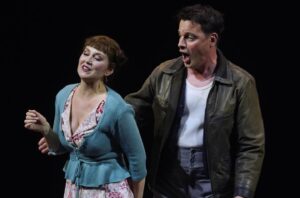
Laurent Pelly staged the production in his unmistakable manner, and this time it worked with remarkable precision. The vast empty stage, objects suspended from above, the near-total absence of realistic decor—in this context, none of this reads as minimalism. It is a deliberate choice. Pelly abandoned the postcard image of a cheerful Czech village and created an environment in which the story of the bartered bride resonates as both celebration and ordeal. The costumes and makeup play a vital role: simultaneously rooted in a rural twentieth-century setting and boldly stylized in the spirit of the avant-garde.
Throughout the story, Mařenka inhabits not a cloud of folk gaiety but the space of her own inner world and her own choices—with anxiety, dignity, stubborn faith, and hope. Lighting designer Urs Schönebaum built atmosphere with great subtlety, conjuring intimacy and cold from almost nothing. When the third act finally explodes into color and warmth with the arrival of the circus, the cinematic contrast lands precisely because the first two acts held a very different temperature.
The discovery of the evening was Svetlana Aksenova as Mařenka. This was not merely fine singing and a beautiful soprano voice—it was a direct penetration into the soul of the audience. A voice of rare inner warmth, vibrato that serves meaning rather than working against it, and a deep theatrical honesty that allows not a single phrase to pass without purpose. Stanislavski would have given a standing ovation. The great aria of the third act—added to the score by the mature composer some twenty years after the premiere and considered the crown jewel of the work—was delivered as though everything before it had been leading to this single moment. Complete commitment, not a gesture played to the gallery.
Pavel Černoch as Jenik offered a confident, even, brilliant voice. What was occasionally missing was the sharp play of intonation, the roguish wit that makes this character a truly irresistible schemer—but the singer’s professionalism was beyond reproach. Bravo.
More Cast Highlights
Günther Groissböck as the marriage broker Kecal was tremendously convincing and comic, though his lower register called for greater weight: it is there that the true, irresistible power of this bass voice resides.
A real event of the evening was Mikeldi Atxalandabaso as Vašek. Stuttering as a vocal device is a trap for any singer—it is easy to slide into caricature and parody at the expense of genuine singing. Atxalandabaso found the exact measure: funny, touching, flowing, and technically flawless. Behind the apparent ease lies serious vocal culture, and his theatrical instinct is entirely natural.
The Teatro Real Chorus under Jose Luis Basso performed with its characteristic organic quality—not only in singing but in dance as well—earning the most enthusiastic applause of the evening, entirely deservedly.
At the podium, Gustavo Gimeno likewise never allowed the score to collapse into a folkloric picture postcard. The orchestra sounded like a fully realized symphonic organism, with weight, contrast, and genuine dramatic breath—including, at moments, a tragic one. The overture was set at an almost dizzying tempo, and that impulse held to the very end. The lyrical episodes of the opera’s second half—the strings in particular—sang with the warmth that Smetana clearly demands and that is so easily lost in the pursuit of sheer energy. The conductor understood this music from the inside and presented it to a twenty-first-century audience as a rich, psychologically contrasting canvas, not an illustration for a dance comedy.
“The Bartered Bride” has returned to Madrid after a hundred years. And it turns out that behind the folk costumes and village gaiety lies a far more complex story than is generally assumed. It put me in mind of the Spanish zarzuela—and I very much look forward to the 2026-27 Teatro Real season, which brings “Blood Wedding,” based on Federico Garcia Lorca’s play, created by a contemporary Spanish composer.