HamburgMusik 2025-26 Review: Mezzo-Soprano Magdalena Kožená’s Song Recital
The Silver Oracle: Kožená’s Theatrical Transmutation at the Elbphilharmonie
By Mengguang Huang(Photo: Sophie Wolter)
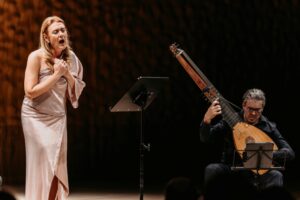
It was just two people on stage: Magdalena Kožená and Azul Lima. The Recital Hall of the Elbphilharmonie became the kind of intimate space that forced the audience to reckon with the sheer, raw physical force of Kožená’s mezzo-soprano. This wasn’t the usual polite early music one might be used to; it was a high-energy exhibition of the soul. By leaving only a single voice and a plucked string, the program forced direct confrontation between the 1600s’ Golden Age of melancholy and the fractured, avant-garde screams of the 20th century.
The Sculpture of Melancholy
Kožená began the evening empowering the stakes of Baroque song. Traditionally, the vocal miniatures of Henry Purcell and John Dowland are treated with a delicate, chamber-like restraint & elegance. Kožená, however, chose a different path. Utilizing her full, resonant mezzo—rich with magnetic power and an expansive lower register—she elevated these pieces to the status of miniature dramas. By employing extreme messa di voce, she sculpted each phrase to reveal a sense of internal conflict. She wasn’t just performing songs; she was imbuing the music with massive dynamic contrasts and an expressive ebb and flow.
In Purcell’s “Music for a While,” her voice didn’t just float above but wrestled with ground bass. She treated each phrase as a sculpted object, using her distinct vocal registers to create a sense of internal conflict. This chiseled approach continued into Dowland’s “In Darkness Let Me Dwell,” where the cult of Elizabethan melancholy was presented as a raw, visceral state of being.
The visual and musical climax of Merula’s “Canzonetta spirituale sopra la Nanna” saw Kožená transcend the role of a mere singer. Clad in a sweeping silver robe while utilizing dramatic, physically charged body gestures, she nearly became an oracular figure— foretelling the dark future of the very child she was rocking. The swaying bass, introduced by Lima’s naturally flowing improvisational arpeggios, mimics the Virgin’s tender motion. The final passages, delivered with a breathy, suspended intensity, possessed a transcendental quality, as if she were witnessing the inevitable Crucifixion from a great distance. Merula’s piece, built on its 162-fold rocking bass, was thus transformed into a visceral solo cantata.
Modern Echoes and Instrumental Limits
Following the solo brilliance of Lima’s Kapsberger “Ciaconna”—where his control of the diapasons filled the hall with a golden, resonant warmth—the program turned to Brett Dean’s “Gertrude Fragments.” The texture here was startlingly airy and crisp, momentarily echoing the modernism of early Schoenberg or Webern. Kožená moved effortlessly between the icy, detached vocal lines of Second Viennese modernism and a raw monologue that felt like a stylized spoken-sung monologue.
Then came Purcell’s “Dido’s Lament.” Here, Kožená’s chest voice was at its most potent, delivering a performance of immense weight. However, it was here that the inherent limitation of the arrangement was most felt. Despite Lima’s heroic effort to provide a rich harmonic foundation, the lone theorbo lacked the structural mass of an orchestral string ensemble, lacking the sheer physical mass required to match Kožená.
Passion, Paradox, and the Avant-Garde
In Barbara Strozzi’s “Lagrime mie,” the difficulty of the writing was evident. While Kožená was technically commanding, there was a slight rigidity in the transitions between the strict rhythmic pulse and the free, improvisatory lamentation outburst—a rare moment that felt slightly tethered to the page.
However, the momentum surged back with Luciano Berio’s “Sequenza III.” This was the theatrical climax of the night. Kožená performed this deconstruction of the female voice with the ease of a master vocal ventriloquist. Navigating Berio’s 44 specific instructions—nasal humming, clicking teeth, laughter, and gasping—she made the impossible seem effortless. She brought a sense of humor and spontaneity to the piece, turning what could have been a cold technical exercise into a living, breathing human portrait. She built a coherent psychological arc, making the sudden shifts from laughter to gasping feel like a living, breathing stream of consciousness.
This theatricality breathed life again into the Italian masters. Caccini’s erotic descriptions in “Odi, Euterpe, il dolce canto” were delivered with breathless sensuality, while Cesti’s “Disseratevi abissi” brought a Mediterranean heat to the Lamento-Bass. The program concluded with Merula’s “Capriccio” (“Quando io voisi l’altra sera”) where Kožená masterfully subverted the pain of spurned love with a mocking, rhythmic dance—wielding irony as effectively as a tear.
A Confident Feast
The evening concluded with two Monteverdi encores. Magdalena Kožená and Azul Lima presented a program that was as intellectually rigorous as it was emotionally taxing. By bridging the centuries, they demonstrated that the flowerings of culture—from the melancholic court of Elizabeth I to the fractured avant-garde circles of 1960s’ Italy—all spring from the same primal need to give voice to the human passion. It was a supremely confident, exquisitely curated invitation from a mature artist who knows exactly how to command a stage.