Washington Performing Arts at Strathmore 2026 Review: Cécile McLorin Salvant’s “Book of Ayres” & The Brandee Younger Trio
By Arnold Saltzman(Photos: Erin Patrice O’Brian & Tsuneo Koga)
The music of John Dowland with early music instruments combined with contemporary keyboard, flute, bass, and percussion in a Jazz combo, left one wondering if this program would work musically. It turned out, for me, to be a surprisingly entertaining concert with fine performances by all.
Illuminating Performances
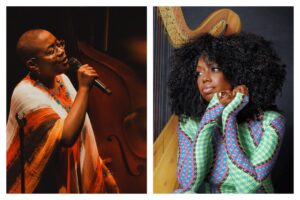
“Obligations lead to expectations which lead to resentment” was the theme of vocalist-storyteller Cécile McLorin Salvant’s “Book of Ayres,” a concert revealing this theme in the perennial music of John Dowland.
Elizabethan England composer John Dowland was given a new life by crossover artist, Cécile McLorin Salvant, whose music resides in that region of classically trained singer-musician-visual artist described by the late Jessye Norman as “a unique voice.” She is a storyteller connecting blues, folk, jazz and baroque music all with a touch of humor.
The concert experience was a surprise interpretation of Dowland’s music, mixed with old and new instruments, brilliantly played by the assembled artists. “If music be the food of love, play on” is a line from Shakespeare’s “Twelfth Night” spoken by Duke Orsinio. Dowland’s original work was written for voice and lute. The program began with new combinations of instruments including a duet between Emi Ferguson (flute) and Yasushi Nakamura (bass), in which Cécile McLorin Salvant used her vocal registers to sound like a silvery soprano, a hearty mezzo, and I was surprised by the masculine sound of her low voice, all smoothly delivered without any breaks in the sound.
Purcell’s “The Indian Queen” (1695) is a selection about one who falls in love with her captive:
“I attempt from Love’s Sickness to fly in vain
Since I am myself my own fever and pain…
For love has more power and less mercy than fate
To make us seek ruin and love those that hate…”
This included accompaniment given with great sureness and flare by Sullivan Fortner on harpsichord, together with percussion by Keita Ogawa, who played small bongos.
An Ayre by Dowland written for Queen Elizabeth I, “Say, Love, if ever thou didst find, A woman with constant mind? None but one,” (1603) is an ode to the Queen. A strophic song accompanied by flute and synthesizer/electronic keyboard. Cécile McLorin Salvant remarked that it reminded her of a steel drum player in Miami, which made little sense to me, although the song was delightful.
Among the most impressive moments in the concert was “Flow not so fast, ye fountains; What needeth all this haste?” This famous air, published in 1603, was accompanied by Dušan Balarin on theorbo/lute. He gave a moving interpretation that stood out from the program which contained a lot of humor. It was here that the voice of Cécile McLorin Salvant connected emotionally to the meaning while accompanied by the full ensemble of harpsichord/keyboard, drums, bass, flute and the voice, demonstrating great breath control and several vocal registers in interpretation of the text.
Another highlight was an original song in an endangered language of Cécile McLorin Salvant’s ancestors and translated into Creole. Wonderful improvisations were presented from the ensemble including drums, the Latin beat in the flute obligato, bass and theorbo innovations. This performance was very much appreciated by the audience.
The Dowland song, “Can She Excuse My Wrongs” is associated with Robert Devereux, 2nd Earl of Essex, executed for treason against Elizabeth I. At this point in the program, there was much charm including the Commedia dell’arte wardrobe worn by Cécile McLorin Salvant and ending a delightful concert evening.
The Brandee Younger Trio
The concert also highlighted performances by the Brandee Younger Trio. This group presented an original contemporary trio sound with harp, bass and percussion. The musicians were outstanding. Using pentatonic scales and chords, the harp played by Brandee Younger sounded regal, a kind of pentatonic in blues, with chords and obligato, demonstrating finger independence and counterpoint as drummer Allan Mednard used drum sticks on rims. He built a wonderful crescendo with the improvisation. Brandee Younger said she added drums and bass to make the work sound angrier.
There were impressionistic moments, contrasting minor modes. Bass player Rashaan Carter gave a wonderful improvisation with slides and walking bass. At times the drums sounded like a rumble, with a fight going on, and ready to take off…
A ballad with just harp was a special treat, hearing the harp instead of the piano in the Alice Gold ballad. Brandee Younger demonstrated how she stretches boundaries and limitations for harpists. In 2024 she won the NAACP Image Award in the category of Outstanding Jazz Album for her latest album “Brand New Life.”
Categories
Reviews