Bayerische Staatsoper 2025-26 Review: Norma
By Ossama el Naggar(Photo: G. Schied)
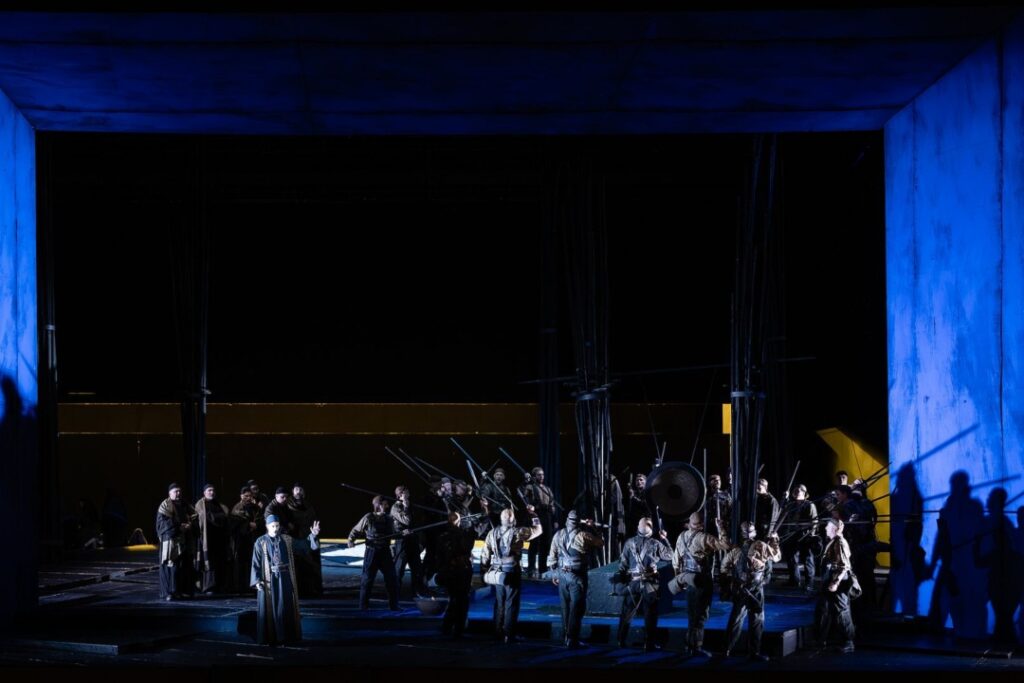
It was deeply gratifying that the Bavarian State Opera continued to preserve Jürgen Rose’s magnificent production (seen July 17), first unveiled in 2006 and now deservedly regarded as one of Munich’s exemplary repertory stagings. At a time when “Norma” has too often fallen victim to directorial concepts eager to relocate ancient Gaul to psychiatric institutions, corporate boardrooms or anonymous dystopias, Rose’s interpretation remains a model of intelligent fidelity. Serving simultaneously as director, set designer and costume designer, he demonstrated complete confidence in Bellini’s drama, recognizing that it required neither conceptual reinvention nor ironic commentary to retain its contemporary force.
(Photo: G. Schied)
Jürgen Rose’s Timeless “Norma” in Munich
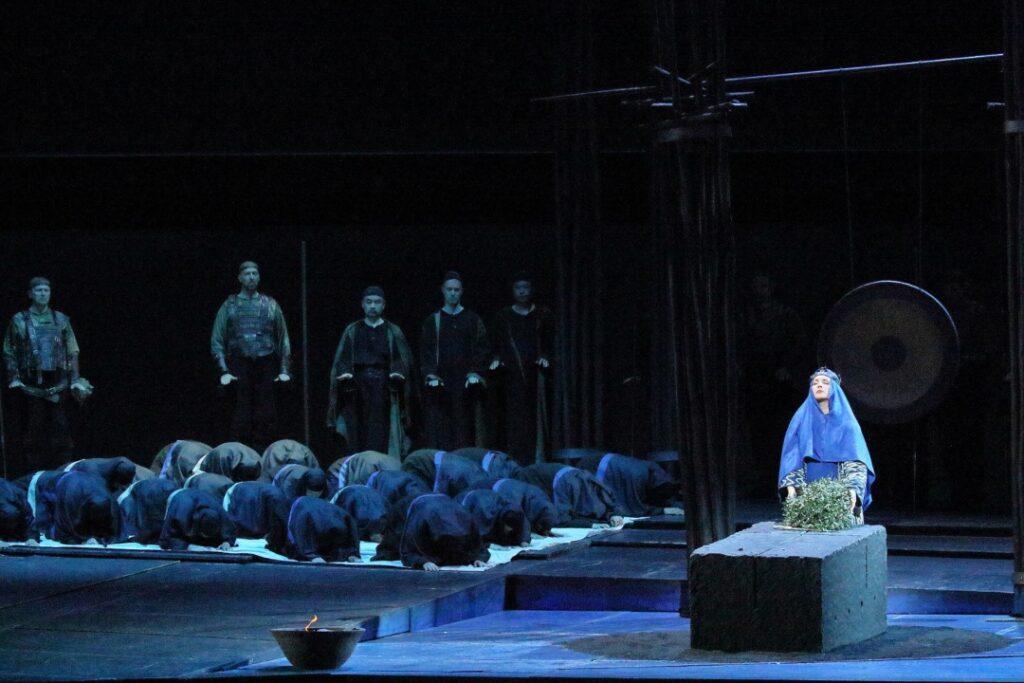
Rose’s visual world possessed monumental simplicity and ritual dignity. Vast stone architecture suggests both sacred sanctuary and political fortress, while towering monoliths, austere ceremonial spaces and sacred groves evoke an ancient civilization whose spiritual certainties had begun to crumble under Roman occupation and internal moral conflict. Michael Bauer’s finely judged lighting enveloped the action in shifting moonlight, twilight and sacrificial fire, creating an atmosphere that seemed to emerge organically from Bellini’s score rather than merely illustrating it. The opening invocation to the moon unfolded with an almost metaphysical stillness, while the final immolation acquired a ritual grandeur that transcended theatrical spectacle.
Perhaps the production’s greatest achievement lay in its profound understanding of restraint. Nothing appeared imposed upon the work from outside; every movement, gesture and dramatic emphasis arose naturally from the characters themselves. The Druids were presented neither as picturesque relics nor as transparent modern political allegories, but as a deeply religious society whose ceremonial life governed every aspect of existence. Against this carefully realized background, the opera’s intimate emotional relationships retained absolute primacy. Norma’s conflicting identities as priestess, mother and abandoned lover, Adalgisa’s painful struggle between innocence and guilt, and Pollione’s moral irresolution all unfolded with remarkable psychological clarity.
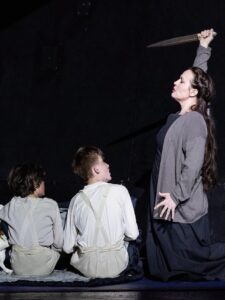
The great confrontations consequently possessed exceptional dramatic truth. The extended duets between Norma and Adalgisa emerged not merely as opportunities for vocal splendor but as emotionally intricate conversations, tracing the gradual transformation of their relationship from mistrust to forgiveness and ultimately to solidarity. Rose also handled Norma’s children with uncommon sensitivity, integrating them naturally into the action without resorting to sentimentality. The result was a production of rare intelligence and humility, one that illuminated Bellini’s masterpiece by allowing its humanity, rather than directorial intervention, to remain at the centre of the drama. At the close of the first act, one felt profound compassion for Adalgisa as she discovered that Pollione was not only Norma’s lover but also the father of her two young children. Directed with remarkable naturalness, the children instinctively sensed that the stability of their family was under threat and clung imploringly to their father’s legs. Seen through their eyes, the emotional pathos of the scene was immeasurably intensified.
(Photo: G. Schied)
Cast Highlights
Fine productions ultimately depend upon exceptional musical performances, and this revival was crowned by a cast that fully embraced Bellini’s formidable demands. Russian soprano Elena Stikhina emerged as the evening’s undisputed triumph. Her unusually wide repertoire—from Puccini and Verdi to Strauss, Wagner, Tchaikovsky and Cherubini—had clearly furnished her with the technical resources and dramatic experience required for one of opera’s most taxing roles. She negotiated Bellini’s florid writing with impressive assurance while bringing to the music the amplitude and expressive richness of a true dramatic soprano.
More importantly, Stikhina captured the multifaceted nature of Norma herself. She moved effortlessly between spiritual authority, maternal tenderness, passionate despair and tragic resignation, never allowing one aspect of the character to eclipse another. Her “Casta Diva” was notable for its serenity, sustained by long, beautifully controlled phrases and an unforced nobility of expression. Elsewhere she invested the score with remarkable dramatic urgency, particularly in the great confrontations with Pollione and Adalgisa, where the gradual collapse of Norma’s emotional certainty unfolded with striking psychological insight. Her final self-revelation possessed genuine tragic grandeur.
Cuban-American mezzo Emily Sierra proved an ideal partner as Adalgisa. Her glowing mezzo-soprano blended seamlessly with Stikhina’s darker, more powerful instrument, and together they shaped Bellini’s extended duets with exceptional musical sensitivity. Sierra wisely avoided portraying Adalgisa as a passive ingénue, instead presenting a woman whose innocence coexisted with moral courage and emotional maturity. Their shared scenes possessed an intimacy and tenderness that became central to the evening’s dramatic success.
Uzbek tenor Najmiddin Mavlyanov sang Pollione with tireless energy and fearless attack throughout the demanding tessitura. While his interpretation occasionally prioritized sheer vocal impact over stylistic elegance, he conveyed the character’s impetuosity and eventual remorse with conviction. Italian bass Roberto Tagliavini brought imposing vocal presence to Oroveso. His resonant bass combined authority with paternal warmth. The smaller roles were equally well taken, with Aebh Kelly and Michael Butler making strong contributions as Clotilde and Flavio.
Illuminating Interpretation
Giacomo Sagripanti led an interpretation of notable stylistic integrity. Rather than imposing unnecessary grandeur upon Bellini’s score, he allowed its lyricism to unfold naturally, shaping the music with elegant phrasing, flexible tempi and scrupulous attention to balance. The Bavarian State Orchestra responded with playing of exceptional transparency, revealing harmonic subtleties and orchestral colours that too often remained unnoticed. The Chorus of the Bavarian State Opera sang with admirable discipline and sonority, giving the great ceremonial scenes both majesty and dramatic purpose.
The performance ultimately demonstrated how compelling “Norma” could be when musical excellence and dramatic intelligence were placed unequivocally at the service of the work itself. Without recourse to fashionable reinterpretation or theatrical excess, Munich offered a reading that honored Bellini’s supreme achievement with rare conviction, allowing its timeless humanity to emerge with remarkable clarity.