Teatro Real de Madrid 2025-26 Review: Il Trovatore (Cast B)
By Mauricio VillaTeatro Real de Madrid closed its season with 17 performances of its own production of Giuseppe Verdi’s “Il Trovatore.” There was no fixed casting for the run, especially after the cancellation of Anna Netrebko, with five sopranos, four tenors, three baritones, and five mezzo sopranos rotating across the different performances. OperaWire attended the performance on July 8, which marked the house debut of tenor Vittorio Grigolo.
Production Details
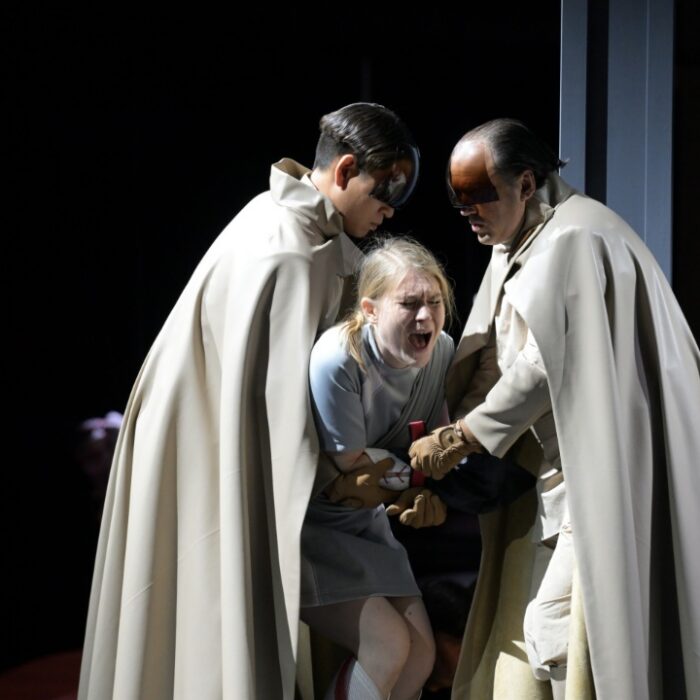
OperaWire reviewed the production by Francisco Negrin in 2019, and nothing has changed since. It remains abstract, ugly, and meaningless. The stage is essentially a concrete cube with an open gallery where the chorus, dressed as “zombies,” sings for most of the production. A handful of minimalistic elements appear for different scenes, including two large bars of bright LED lights that cross the stage and form different shapes. This works when the lights are colored, but proves uncomfortable when they shine bright white directly at the audience. When will lighting designers realize that bright white lights facing the audience are uncomfortable and blinding?
The production makes heavy use of pyrotechnics, and the ghosts of the burned child and the gypsy appear throughout the opera with detailed gore makeup. Why the director remains so fixated on zombies is unclear. It is widely recognized that the libretto of “Il Trovatore” is weak and somewhat absurd, centered mostly on a love triangle. The impression left by this production, however, is one of witchcraft, fire, and zombies.
Vittorio Grigolo as Manrico
Tenor Vittorio Grigolo, as Manrico, and mezzo soprano Anita Rachvelishvili, as Azucena, both made their house debuts, a surprising fact given that both have numerous solo recordings and have sung in many theaters across Spain.
The role of Manrico was written for a spinto or dramatic tenor for two reasons. First, the tessitura is largely central, requiring a strong middle register; it moves around the passaggio, as most tenor roles do, and usually doesn’t rise higher than A flat, with the exception of the duet with Azucena, which climbs repeatedly to A natural. It is a low tessitura role with only a single B flat in the Act One terzetto, marked as an “oppure,” meaning Verdi wrote it as optional. The remaining B flats and the famous high C’s of “Di quella pira” are interpolated by tradition. Second, the role requires a strong, heroic sound for its vocal characterization.
Grigolo’s voice is purely lyrical, with a bright timbre, a pronounced vibrato, and easy access to high notes. Although he has recently added spinto dramatic roles like “Tosca” and Turiddu to his repertoire, his career has largely been built on lighter roles such as “Rigoletto,” “L’Elisir d’Amore,” and “Romeo et Juliette,” which would not seem ideal preparation for Manrico. Still, his projection has improved considerably. While his timbre sounded somewhat stark and lyrical for the role, his voice was big and strong, and his characterization was determined and passionate. The high B flats of his first aria, “Deserto sulla terra,” and the following terzetto were effortless, bright, and delivered with squillo. He was a compelling Manrico: heroic, aggressive, ardent, and lyrical when the music called for it. He also demonstrated dynamic control and mezza voce, as in “Tu vedrai che amore in terra,” where he executed a clean diminuendo on a high G. His fraseo, legato singing, and breath technique were on display in his third act aria, “Ah sì, ben mio,” which he closed with an original variation. “Di quella pira” was ardent and delivered with determination, though he lowered the key by a half step from the version used in more lyrical repertoire in order to hit the high C’s rather than B naturals. His final two scenes, at the tower and in the prison, were sorrowful, lyrical, and aggressive by turns. He was, overall, a strong Manrico.
Saioa Hernández as Leonora
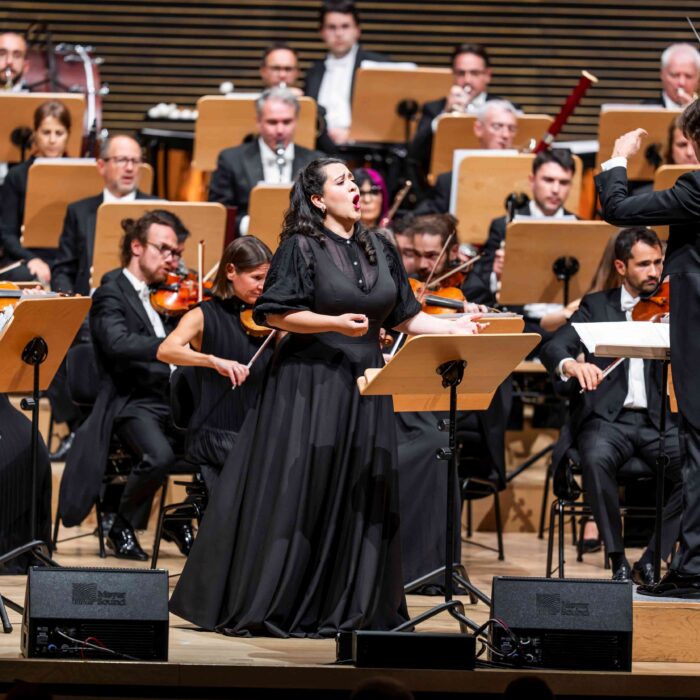
Saioa Hernández performed the role of Leonora. OperaWire recently reviewed her interpretations of Gioconda and Maddalena, spinto dramatic roles that have made her known for a genuinely dramatic instrument. Leonora, by contrast, written in the same period as “La Traviata” and “Rigoletto,” is a true lyric coloratura role.
Hernández sang the first aria, “Tacea la notte placida,” with long, expansive legato lines and secure, straight attacks on her B flats, alternating mezza voce with a strong, dramatic, and powerful sound. She added an unwritten D flat, attacked straight on and completely exposed in the final cadenza as the orchestra fell silent, a surprising and thrilling choice given that sopranos who attempt the note typically approach it by scale rather than head on. The note is also not a comfortable one for a dramatic voice like hers, underscoring her vocal flexibility.
The cabaletta “Di tale amor” was sung with impeccable coloratura, clear trills, fast scales, and bright high notes, a further surprise given that Verdi wrote Leonora’s coloratura in a more lyrical and light style than the Verdi coloratura roles, such as “Nabucco” or Bellini’s “Il Pirata,” that Hernández has sung before. She proved capable of lightening her sound and executing clean, fast scales, and by the end of the aria she had fully claimed the role, crowning the close of Act One with a thunderous D flat.
After delivering what may be the opera’s most beautiful melody, “Sei tu dal ciel disceso,” with deep emotion and lyricism, Hernández offered a lesson in bel canto and soaring legato in her fourth act aria, “D’amor sull’ali rosee,” reaching high B flats and a high C. She turned dramatic, aggressive, and resigned by turns in the subsequent cabaletta and duet with Count di Luna, delivering thunderous high C’s, and her death scene was genuinely moving.
Hernández proved the strength of her technique throughout the performance, showing an ability to lighten her sound, sing clean coloratura, and move fluidly between lyric and dramatic repertoire.
Anita Rachvelishvili as Azucena
Anita Rachvelishvili remains one of the finest singers of her generation, not only for her astonishing, dark, and penetrating voice, but for her magnetic stage presence and considerable acting ability. Her voice sounded as powerful as ever, though she omitted the role’s high notes. Azucena’s part includes a written high C and several high B flats that are not optional in the score. While it is generally accepted that the high C is omitted, as it lies at an extreme for a mezzo soprano, it is unusual for a performer to skip all of the written high B flats in a performance of “Il Trovatore.”
The first, in the Act One duet with Manrico on the line “mio figlio avea bruciato,” was barely noticeable to anyone not intimately familiar with the score, but the final “Sei vendicata, o madre!” forms the climax of the opera, and its absence was more apparent. Rachvelishvili’s penetrating and potent low register remained intact and powerful, as she demonstrated on the line “drizzarsi ancor,” written well below the stave and descending to low A naturals, though she did not sing above A natural, skipping the written high notes throughout. Her characterization of Azucena, nonetheless, was thrilling, frightening, and magnetic.
Juan Jesús Rodríguez as Count di Luna
Juan Jesús Rodríguez was an ardent, impeccable Count di Luna. His dark, sizable instrument had no difficulty with the role’s extreme high tessitura, which sits consistently around high E and high F sharp. His performance in the terzetto was powerful and aggressive, with strong, sustained G flats. He turned lyrical and sorrowful for the difficult aria “Il balen del suo sorriso,” which, despite its high tessitura, demands high F’s in mezza voce, long legato lines, and two exposed high G’s over a lightly scored orchestra; he delivered all three with ease and security. He shifted to a heroic, aggressive sound for the subsequent cabaletta and the fourth act duet with Leonora.
Conductor Nicola Luisotti created a strong balance between orchestra and voices throughout the performance. His tempi in arias and cabalettas gave the singers room to perform comfortably, and there was a clear connection between conductor and cast throughout the run. The Coro y Orquesta Titulares del Teatro Real matched the high standards the company consistently maintains.