Washington National Opera 2025-26 Review: Treemonisha
A Triumphant Return with a Stellar Cast & Direction
By Francisco SalazarOn March 8, the Washington National Opera (WNO) presented its first opera, “Treemonisha,” after having broken ties with the John F. Kennedy Center for the Performing Arts.
For the occasion, the company returned Lisner Auditorium, the venue where it started 70 years ago and a noticeably smaller one when compared to the opera house at the Kennedy Center. As such, it was clear that this would be an adjustment for the WNO.
Upon entering the space, however, it was safe to say that the audience was excited and positive energy was immediately palpable. As Artistic Director Francesca Zambello and General Director Timothy O’Leary walked out on stage, the two got a standing ovation with the audience clearly endorsing their decision to leave the Kennedy Center.
Following their words that spoke about “creative freedom” and the idea of “American civil society,” the audience sat for what would be a performance of celebration.
A New Adaptation
For this new adaptation of Scott Joplin’s opera “Treemonisha,” conductor Damien Sneed created a new adaptation and orchestration that also included some new dialogue and lyrics by Kyle Bass. According to program notes, there were some new scenes and spoken text that worked well as the opera’s transitions flowed well and maintained a cohesion within the score that would honor Joplin’s original intentions. Being new to the work, the score and its story seemed tight and flowed, never stopping the momentum of its light but important story.
The new production, directed by Denyce Graves, who had recently retired from the stage, was an inspiring one filled with energetic direction and choreography. One of the highlights was the overture where Graves depicted Treemonisha’s upbringing as the singers and actors came in and out and time passed in an organic fashion. You could tell that Graves’ experience on stage made her a perfect fit for her cast as she spaced out the blocking in a way that it always felt like you could see everything happening on stage. More importantly, and this is where the mark of a good opera director is most visible, the chorus was well-employed and you never felt like that the ensemble was bunched up, aimless, and just there because the score called for it. In Graves’ hands, the larger ensemble was very much alive and part of the fabric of the story being told.
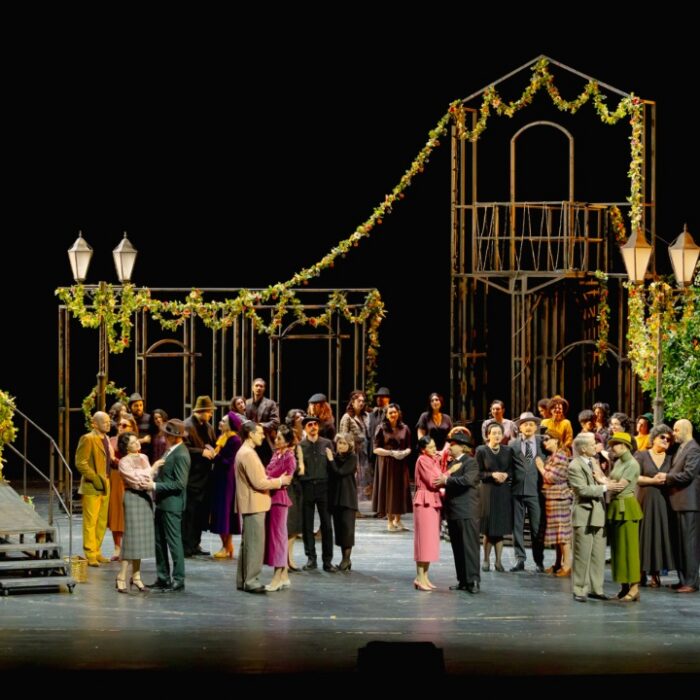
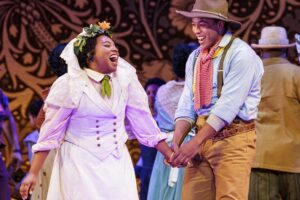
The set design by Lawrence E. Morten III was made up of minimalist colorful panels decorated in an Art Nouveau-inspired botanical pattern that suggested the woodland and rural setting for the story. There was also always a tree at the center to represent life. The lighting by Jason Lynch added to the cohesion of the sets, while the costumes by Lynly A. Saunders created a distinction between Treemonisha and the rest of the village, showing the lead character with a white schoolgirl dress in contrast to the rest of her village dressed in farming attire. Even more striking were the conjurer’s wardrobe, which showed this community with patched up colorful costumes that is emphasized a poverty level that contrasted with Treemonisha’s community. Eboni Adams’ choreography was fantastic, especially during “We’re goin around,” “A Real Drag” and the “Frolic of the bears.” The choreography always utilized the stage and spaced the dancers in a way that never got in the middle of the singers.
In all, this production was effective. At the end of the opera, as Graves took her solo bow, the company sang “Happy Birthday” on stage and the audience gave the legend a standing ovation.
An Excellent Cast
In the title role, Viviana Goodwin showcased a vibrant lyric soprano that displayed a range of dynamics and flexibility. She was especially moving in her Act two aria as she sang with a gorgeous middle range and slowly increased her dynamics to express her despair of being kidnapped. Her solo in the final “A Real Drag” was also a highlight as Goodwin’s voice brought a spirited bright timbre that showcased her flexible high range. In the ensemble work, the soprano’s voice easily rang with clarity especially in “We will trust you as our Leader” and the ensemble “Treemonisha’s bring up” in Act one. Goodwin’s stage presence was also superb as she moved about the stage with grace. It was hard to take your eyes off her, especially in the two dance sequences “We’re goin around” and “A Real Drag,” where the soprano showed some virtuosic moves.
As Remus, Justin Austin brought an ardent tenor, especially in his aria “Wrong is Never Right” where he exhibited a gorgeous legato and general fluidity of line. The high range could sound a bit metallic at times but that did not hurt what he was doing musically. In his small exchanges and duets with Goodwin, the duo shared great chemistry on stage and their voices blended beautifully. It was most vivid during “The Rescue” and at the end of “Wrong is Never Right.”
Jonathan Pierce Rhodes’s Zodzetrick was the most unpredictable of performers, moving about and playing his hand as to what new antics he was going to pull; whether it was spreading a magic powder or simply slipping into the scene with confidence and power, he was unpredictable. Vocally, he emoted a lot of lines but also sang with a light tenor that was rhythmically precise. His scenes with the conjurers in Act two saw Rhodes dominate and it just seemed like he was having the best of times portraying the role.
As Ned, Kevin Short displayed a booming bass-baritone in the first act as he commanded the scene and also brought out a sympathetic side in his exchanges with Tichina Vaughn as she sang her solo “Treemonisha’s bringing up.” But perhaps Short’s stand out moment was in the second part in “When Villains Ramble Far and Near,” where he sang with impeccable phrasing that demonstrated the expertise in his line and even gave him an opportunity to showcase a rich and resonant low D that brought the house down.
As Monisha, Tichina Vaughn gave gravitas to the character, especially in her big solo “Treemonisha’s bring up.” Hakeem Henderson’s Andy was also a stand out with his energetic rendition of “We’re goin around,” while Nicholas LaGesse demonstrated a sonorous baritone as Parson Alltalk. Nina Evelyn, as Lucy, also brought charisma on stage.
The rest of the ensemble was also exceptional. Kedrick Armstrong led a precise and rhythmically cohesive ensemble that emphasized the various musical styles of Joplin’s score. You could hear the influences of the ragtime through the use of the piano and the Black folk-songs with the banjo. The spirituals element blended beautifully within the romanticized arias and choral work. The overture was especially swift and precise.
In all, this was a triumph for the Washington National Opera, which will undoubtedly build on this success with upcoming performances.