Washington Bach Consort 2026 Review: Mass in B Minor BWV 232.4
By Arnold SaltzmanBach’s “Mass in B Minor,” early music authentically performed on period instruments is alive and well thanks to the Washington Bach Consort.
The “Mass in B Minor,” among Johann Sebastian Bach’s greatest achievements, was presented in concert on April 26, 2026 at 4:00 PM. This was an ideal time to appreciate the beauty of the music and the National Presbyterian Church’s stained-glass window design and vibrant colors.
The ‘sold out’ performances, Saturday and Sunday, received an enthusiastic welcome for this arts organization including the sponsors the Honorable & Mrs. John D. Rockefeller IV and Barbara Bankoff & Robert Crandell who underwrote the program. This is reminder that great works of music presented by ensembles like the Washington Bach Consort (WBC) do not happen without support, in addition to lots of people showing up for concerts. We live in a time when government cuts to the arts have jeopardized arts organization. Thanks to the many fans of WBC, the concert series next season will be secure.
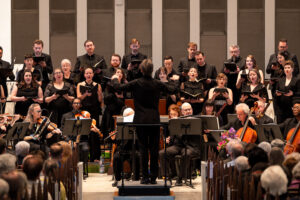
If you’re in New York City, an early music ensemble would not be unusual. Yet in the nation’s capital, the Washington Bach Consort is a wonder of musical excellence presenting the best of Bach and Handel. The chorus for this performance consisted of 25 singers divided into SSATB, and five soloists, all specializing in the vocal technique dominant in northern European early music performance practice.
The instrumentalists numbered 27 including Violone, Organ, Oboe d’amore, baroque horn and trumpets. Andrew Fouts, concertmaster was an excellent soloist in some sections in the manner of Concerto grosso. Dr. Dana T. Marsh, the WBC Artistic Director since 2018, conducted with precision and communicated his direction with great intensity. Following an intermission, he paid tribute to WBC founder, Dr. J. Reilly Louis. At this point in Maestro Marsh’s tenure one can say that Maestro Marsh has continued the tradition of this ensemble and made an important contribution to its development. The musicians were totally responsive to his direction.
The five vocal soloists sang lyrically, bringing out many beautiful moments in the Mass. They included soprano Amy Broadbent, soprano Chelsea Helm, mezzo-soprano Kristen Dubenion-Smith, tenor James Reese, and baritone Jonathan Woody.
One question about “Die große catholishe Messe” is why Bach, a Lutheran, set this particular text. Perhaps it was because it was in the cannon of great settings of this particular text which Bach wished it to be included. The answer seems to be that it is a setting of the ‘Ordinary of the Mass’, liturgy common to every celebration. It is a Christian Mass as opposed to a Roman Mass, according to Daniel R. Melamed’s program notes. The work overall is the culmination of Bach’s cantatas and vocal works. Taking the opening Kyrie with its unusual and memorable chromatic sequences, Bach gives us his most memorable line statement and fugue which is developed around it. Another memorable aspect is the very long vocal lines requiring enormous breath control for the entire chorus. These long melodies are a hallmark of Bach’s design in music with the fugue section beginning from the top voice down, and returning in the final statement with a reversal from the lower voices up through the soprano voice. For me, this may be the most memorable of all Bach’s fugues and it was beautifully revealed in the WBC performance.
The Gloria section was everything one might expect from Bach’s brightest moments. Baroque trumpets, full string orchestra, and long joyful choral lines, filled with melismatic singing, the way Bach blurs the line between how he treats instrumental parts and vocal parts. The section is also reminiscent in the major key of Bach’s setting of the Magnificat.
There is a sense of wonder and gratitude in listening to the magnificent achievement of Bach’s setting of the Mass, and Dr. Dana T. Marsh’s expertise in leading a moving performance of this work representing one of Bach’s peak achievements in composition.