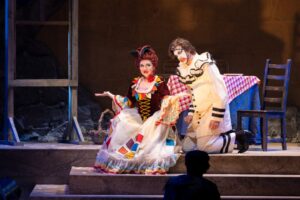
Virginia Opera 2026-27 Review: Pagliacci
By Sabrina Matthews(Photo: Dave Pearson)
Virginia Opera opened its 2026-27 season on November 6 with Ruggero Leoncavallo’s “Pagliacci” (“Clowns”). One of the world’s most famous verismo operas, the action takes place in almost real time, from the afternoon arrival of a troupe of commedia dell’arte players to a small Italian village through the troupe’s would-be comedic performance that same evening.
It would be satisfying enough to render each of the vignettes of this opera as they appear at first blush: comedic, frightening, romantic, or tragic. But to simply call “Pagliacci” ‘layered’ would be tantamount to referring to lasagna as ‘noodles.’ In this dramatically rich production, the tension between the performative surface and the underlying motivations was ever-present.
A brief overture presages the themes of the opera, and then the Prologue appears, delivered by the clear, effortless baritone of Kidon Choi. Most of the cast has two roles, their everyday selves and the part each plays in the “comedy.” Choi had three: his first was when he stepped in front of the curtain to sing the introduction Leoncavallo wrote for the opera (or perhaps for the entire verismo style). The warmth of Choi’s Prologue pulled the audience in from the first note, and he held the crowd as if in conversation, convincing us to open our hearts to him before stepping behind the curtain—and, seamlessly, the fourth wall, allowing it to become opaque again.
The curtain opens on a village square in neutral colors where the chorus, as a gaggle of bustling townsfolk, celebrates the return of the clown Pagliaccio and his company. These are the happiest characters in this opera, who display the excitement, prodding, and various small conflicts of daily life. One of the great joys of opera is a good chorus, and Brandon Eldredge has coached the Virginia Opera (VAO) choristers to deliver a beautiful, robust sound with crisp harmonies and ringing notes. Solo lines were performed by Herndon Foundation Emerging Artists Douglas Culclasure and Joel Clemens.
The orchestration of Pagliacci fluctuates between accompaniment, answer, and counterpoint to the action unfolding onstage, and it is performed with great nuance by the Virginia Symphony Orchestra (VSO) under the baton of the company’s Artistic Director, Adam Turner. The horns took center ring to invoke the clowns or suggest a circus-like atmosphere, but were otherwise restrained and perfectly modulated. Most of the score, especially in the beginning, had a familiar, lyrical sound, string-led and even romantic at times, which was particularly effective when suggesting what the characters might feel… but do not.
Any joy and hope conjured by the orchestra was counterbalanced by the calculating and reactive nature of the characters themselves. As the troupe arrived, the music continued to be gay. Each of the principals leaned into the full depth of their character (impressive considering that, outside of Choi, the entire principal cast was making their role debuts). Even in the latest crowd of enthusiastic fans, the players could barely keep a brave face. These were not two-dimensional clowns who were switched on and off for each performance; they were three scrappy guys and a pretty girl who spent most of their time bumping around the country together in a rickety cart.
Canio, AKA the “Great Pagliaccio,” reserved his enthusiasm for paying customers and free booze. His wife Nedda, the troupe’s Colombina, was exhausted by the demands of the men who surrounded her. Beppe, who portrayed the nimble Harlequin, kept his personality light in his efforts to keep the show on the rails. In a way, Tonio (the commedia Taddeo), was the most reliable of them all, which might be appreciated if it weren’t for his disfigurement and thereby fouled nature. As soon as there was no one there to watch, the strands of the players’ lives began to separate.
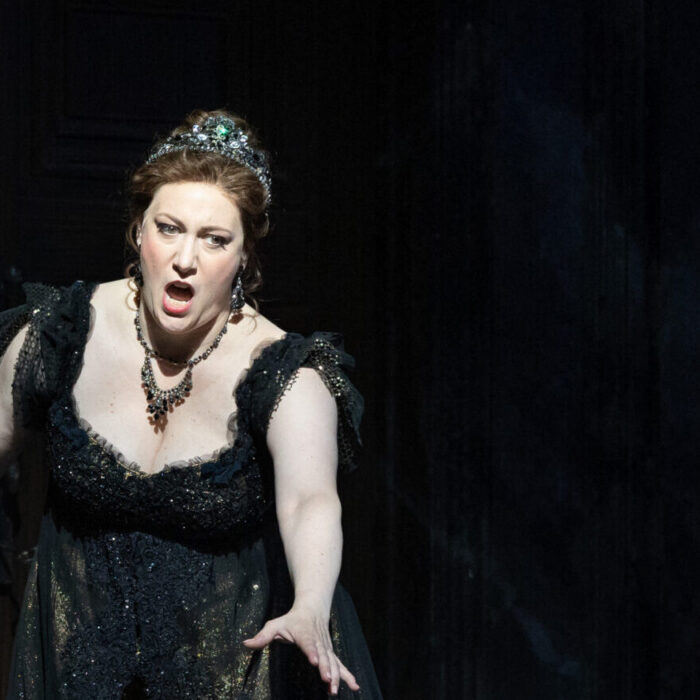
Even in an art form that rarely shies away from the transactional nature of women’s lives, Sarah Tucker’s Nedda stood out as uniquely isolated. Tucker’s bright soprano was carefully textured to capture all of the facets of a bleakly calculated life suddenly offering a ray of hope. Married to an apparent alcoholic, she tried to mollify Canio’s more abusive instincts. Nedda was pursued by Tonio and defended herself when his spurned advances turned brutal. When left alone to her thoughts, Nedda didn’t quite know what to do with them. In response to the joyful bird sounds of the orchestra, she was confused over what birds want; perhaps she was less envious of the birds’ freedom than the fact that they know what to do with it.
Silvio arrived to woo Nedda in the form of bass-baritone Hunter Enoch. Enoch’s lyric tone easily established his romantic credentials, softening effectively to lay bare Silvio’s anxieties before Nedda returned his sentiment.
Too soon, Canio returned, and the opera accelerated toward its tragic conclusion. Zach Borichevsky charted Canio’s erratic descent from irritable to jealous to murderous: starting from a resonant baseline, his impressive sound expanded, remaining under the tenor’s control even as Canio lost his grip. Borichevsky’s delivery of opera’s most famous breaking point was singular and deeply satisfying.
With “Ridi, Pagliaccio!” Canio lamented that he had to laugh as his heart lay in pieces. The line’s fame is well-deserved, and as a contemporary opera-goer, it would be easy to focus on Canio’s soul-shattering inner conflict. In this vocal climax, however, the duality of this production’s characters also paid off as a core of verismo. When “Pagliacci” premiered in 1892, the stab of heartbreak, stifling of dreams, and sanguine nature of revenge had been opera’s stock in trade for generations. Verismo unveiled the day to day sameness of life, the risk that if one follows a dream, and seeks to change that life, they risk losing everything they have. Tragedy for most people, as my opera companion put it, is that you gotta go to work even when your life is going to hell.
“Pagliacci” features an under-appreciated intermezzo that is often relegated to covering a set change. No change is required in this production: the set is static throughout the opera. Varying levels and multiple routes on, across, and offstage provide plenty of terrain for the scenes, and consequently visual interest for the audience. This versatility lends itself to clever transformations. Jonah Schnell’s lighting design is mood driven, and subtly shows the changing light of the day. More dramatic horizontal angles and monochromatic shades begin to take over during Canio’s famous aria; this style peaks during the orchestral interlude. In a stunning visual, Canio sits in the beam of a single footlight as he battles to apply his makeup without breaking down. Most of the set vanishes as the footlight casts an immense shadow on the wall behind him. This shadow looms over Canio, the expressionless, overwhelming shape of Pagliaccio, riveting the audience’s attention and allowing the VSO’s luminous performance of the intermezzo to land as a revelation.
Finally, the townsfolk return, excited to see a stock commedia dell’arte plot that closely mirrors the drama that the audience has been made privy to. Carlos Ahrens’s bright, agile tenor made a natural fit for Beppe. Like a utility ball player, he just wanted the team to hold it together and finish the season. Beppe seemed blissfully ignorant of the other men’s darkest instincts or else he might not dismiss Canio as “hot-tempered but good-hearted.” Or he might: after all, this is a business venture, and a good gig is fleeting. Most of Beppe’s vocal role comes as his commedia character, Harlequin, when Ahrens has a chance to showcase the sweetness of his voice.
The layers of the drama blur as audience members responded along with the townsfolk. Tension built, the townsfolk started to doubt that Canio was still acting, and even cheerful Beppe couldn’t stop the tragedy that brought the story to an abrupt end.