Dutch National Opera 2026-27 Review: St. John Passion
By Irit van der Veldt(Photo: © Koes Broos)
Whoever transforms a deeply respected oratorio into a theatrical spectacle must be prepared to pull out all the stops. Choreographer and director Sasha Waltz seems to have embraced this challenge when she was commissioned in 2021 to combine dance and theater in Johann Sebastian Bach’s “Johannes-Passion.” With remarkable scenographic precision, she translates the musical event into visual imagery. This craftsmanship brings the story to life in a deeply human and accessible way, making it appealing to a broad audience.
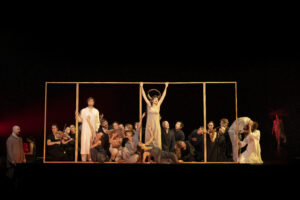
As the audience took their seats, twelve choir members dressed in white took their places on either side of the stage. The musicians were also positioned on both sides. On one side were several string players, an organ, and the conductor, while the other side accommodated additional string players, a harpsichord, a Baroque cello, a double bass, an oboe, and a flute. Other choir members, dressed in white shirts, sat or stood among the audience, handling white pieces of cloth.
At the beginning of the performance, a long row of sewing machines were seen on a slightly elevated black stage. When eleven nude female dancers took their places behind the machines, they begin sewing their white shirts. The harsh noise of the sewing machines gradually faded into swelling mechanical sounds that resembled electronic soundscapes. When these sounds finally disappeared, silence fell, and the opening chorus began with “Herr, unser Herrscher.”
The performance, conducted by Leonardo García-Alarcón, brought together the Dutch National Opera Chorus and the chorus and musicians of the Netherlands Bach Society. Lyrical musical phrases were translated into graceful dance movements, while scenes of betrayal, imprisonment, and death were accompanied by wooden sticks, blocks, planks, and trembling bodies.
For Waltz, illustrating the biblical story of the “Johannes-Passion” is not her primary objective. Rather, she seeks to make the work accessible and appealing even to audiences without a religious background. Her main source of inspiration is the Isenheim Altarpiece by Matthias Grünewald, housed at the Unterlinden Museum in Colmar, in the French region of Alsace.
The altarpiece consists of several panels that can be opened and closed. It depicts the suffering of Christ in deeply moving detail. His body is almost tangible: blood runs from the crown of thorns on his head, thorns pierce his skin, blue veins show beneath the surface, and his lips are purple. In the second part of the “Johannes-Passion,” Waltz translates the altarpiece’s panels into structures made of wooden sticks that can open and close. Within these structures, the dying and dead Jesus appears in various forms.
In the 18th century, such a performance would have been difficult to imagine. When J.S. Bach was appointed Thomaskantor in Leipzig in 1723, he was subject to strict regulations. His contract stipulated that he had to arrange the music so that it “did not last too long, did not come across as opera-like, but incited the listeners to devotion.” Even the “Johannes-Passion” as it is performed today, without the theatrical spectacle, would have been considered too daring by many at the time. In Waltz’s production, musical events are brought to life almost literally.
The “Johannes-Passion” recounts the final hours of Jesus’ life. Following Judas’ betrayal, Jesus is arrested, and Peter denies knowing him three times. Jesus is then brought before Pontius Pilate. Although Pilate finds no fault in him, the crowd demands his crucifixion and chooses the release of Barabbas instead. After being scourged and mocked, Jesus is taken to Golgotha, where he is crucified and dies. Finally, his body is taken down from the cross and laid in a new tomb.
Cast Highlights
Andreas Wolf as Jesus was an almost timid figure, both in appearance and in sound. His Jesus believed in goodness because he was without blame. If others catch him off guard, he seemed willing to accept his fate. Wolf’s powerful bass-baritone contrasted with the Evangelist’s ethereal tenor, creating an interesting vocal contrast that reinforced the dramatic layers of the performance. It was particularly impressive how Jesus retained his character under Pilate’s pressure, with Wolf delivering his lines with pitch-perfect clarity. His magnificent bronze-colored timbre and commanding voice made him a compelling interpreter of the Baroque and Classical repertoire. He also collaborated frequently with García-Alarcón.
Austrian singer Florian Boesch was a convincing Pilate, dressed in a purple cloak. He asserted his authority over Jesus and threatened him with death if he refused to cooperate. Boesch proved particularly effective in these moments, employing warm, earthy tones and considerable expressive power. It was especially striking when he ran across the stage at the beginning of the second part, as the crowd chose Jesus’ fate and demanded the release of Barabbas.
David Fischer delivered the Evangelist’s recitatives with remarkable clarity. His supple vocal sound was consistently convincing throughout his performance. His singing was articulate, pure, and warm, making him a pleasure to listen to and watch.
Swiss soprano Chelsea Zurflüh had a strong affinity for the Baroque repertoire. A prize-winning singer, she stood out in this production with her bright soprano. She combined the ability to sustain long, graceful melodic lines with remarkable concentration and poise. In the aria “Ich folge dir gleichfalls mit freudigen Schritten,” she convincingly conveyed the joyful desire to follow Jesus.
Tenor Matthew Newlin delivered a compelling interpretation of the aria “Ach, mein Sinn,” which reflected Peter’s anguish after denying Jesus. Peter’s shame was explored at length in a powerful dance scene filled with remorse. Newlin’s performance gave the aria considerable emotional weight, capturing Peter’s growing self-awareness and regret.
Countertenor Paul-Antoine Bénos-Djian is known for his sensitivity and dramatic intensity. His interpretation of the aria “Es ist vollbracht” was particularly moving. With great credibility and emotional depth, he brought this pivotal moment to life as the second part of the “Johannes-Passion” drew toward its conclusion.
The two choirs also deserve special mention. They performed the choral sections in both small and large groups, sometimes spread throughout the auditorium. Their collective sound was deeply moving. Maintaining the impression of a unified voice was particularly challenging when a small ensemble was divided into two groups, yet the singers succeeded in bringing warmth, expressiveness, and emotional depth to their performances.
Sasha Waltz & Leonardo García-Alarcón
Yet the greatest achievements undoubtedly belong to choreographer Sasha Waltz and conductor Leonardo García-Alarcón. Through meticulous musical direction, García-Alarcón successfully brought together two small orchestras, soloists, and choirs positioned throughout the auditorium, while also playing the organ. His command of these complex forces was truly impressive.
Waltz’s achievement was equally remarkable. Had she succeeded in giving this oratorio a human face? The answer was an emphatic yes. Every detail was carefully considered and brought to life, from the purple and white robes to the white cloths, wooden sticks, planks, blocks, and carpentry structures. Superb lighting by David Finn and spectacular costumes by Bernd Skodzig completed the visual picture. Nothing seemed to have been left to chance.
Moreover, the dancers drew the audience deeper into the music, making it come alive in a more immediate, accessible, and human way. Another particularly clever scenographic decision was the placement of the choirs on both sides of the stage and throughout the auditorium. As a result, spectators were repeatedly required to turn their heads from left to right, following the opposing sides of the crowd as they chose between Barabbas and Jesus. This physical involvement forced the audience to consider its own position: Whom do I want to watch? Whom do I support? Where would I stand? What is my own role in this story?
These were precisely the questions at the heart of this oratorio, and Waltz’s production confronted the audience with them directly. Spectators were left with little choice but to bow their heads, close their eyes, and reflect on their own humanity. The moving chorus “Ruht wohl, ihr heiligen Gebeine” brought the oratorio almost to its end, offering a profound sense of consolation, resignation, and hope.