Wiener Staatsoper 2026-27 Review: Otello
By Laura Servidei(Credit: Marcel Urlaub)
Verdi’s “Otello“ stands as one of the ultimate crowning achievements of the late Italian operatic canon. The libretto, a brilliantly concise and reasonably faithful adaptation of William Shakespeare’s tragedy, was penned by Arrigo Boito – a renowned poet, librettist, and composer in his own right, affiliated with the Scapigliatura, Italy’s bohemian literary movement. Boito’s dramatic genius lies in his streamlining of the plot: by excising Shakespeare’s entire first act in Venice, he thrusts the audience straight into the action on the storm-swept shores of Cyprus. Here, Otello, the commander-in-chief of the Venetian fleet, arrives in triumph after defeating the Ottoman forces in the name of the Republic. The backstory of his romance with Desdemona is instead distilled into the sublime love duet that closes Act one, universally considered one of the most enchanting duets in the entire operatic repertoire. Boito’s poetry is sculptural, visceral, philosophically charged, and steeped in high literary archaism. Verdi matched this poetic grandeur note for note, crafting a potent, intensely dramatic score of unflagging momentum.
Thunder and Shimmer: The Vienna State Opera Orchestra
At the Wiener Staatsoper, the legendary Orchestra of the Vienna State Opera proved once again why it dominates the late nineteenth-century romantic repertoire. Under the incisive direction of conductor Bertrand de Billy, the performance opened with a thrillingly visceral storm sequence. The brass section sliced through the dense orchestral texture like jagged flashes of lightning, the timpani rumbled with thunderous foreboding, and the strings cut through the hellish sonic landscape with a combination of razor-sharp precision and lush sonority. Above all, the ensemble retained its signature Viennese shimmer; even in the darkest, most terrifying passages, the orchestra seemed to glow from within. Given such magnificent orchestral splendor, it is understandable that a conductor might occasionally succumb to the irresistible temptation of letting the sound soar. Shushing an instrument this glorious must feel akin to sacrilege, though at times the sheer volume of the orchestra risked overwhelming the singers on stage. Yet, given the acoustic magnificence on display, it was a compromise well worth making.
Edwardian Elegance: Adrian Noble’s Unobtrusive Production
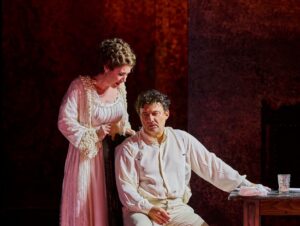
The production itself – staged by Adrian Noble in 2019 – is subtle, traditional, and visually unobtrusive. Dick Bird’s scenic design centers on clean, abstract spaces supplemented by minimal thematic props to evoke the Cyprus shorefront, the public spaces of Otello’s palace, or its serene gardens. For Act four, Desdemona’s bedchamber was rendered with quiet intimacy: a soft profusion of flickering candles, a small kneeling prayer stool, and a dramatically raked bed provided an ideal setting for the tragedy’s fatal climax. Noble updates the action from the fifteenth century to the dawn of the twentieth, utilizing Bird’s elegant Belle Époque and Edwardian costuming, with Otello and his officers outfitted in crisp military uniforms of the era. As is frequently the case with modern updates, there was no obvious thematic justification for shifting the time period, as it added little new insight to the narrative; nevertheless, it did no harm to the storytelling either. In the contemporary operatic landscape, an unobtrusive concept that simply lets the drama breathe can be considered a resounding success.
The Falling Warrior: Kaufmann’s Psychological Depth
Star tenor Jonas Kaufmann returned to the title role of the Venetian commander, a part uniquely tailored to his dark and sensual timbre. Kaufmann’s upper register was ringing and focused – his opening offstage shout of victory, “Esultate!,” was electrifying – while his mezza-voce singing during the Act one love duet remained hushed, intimate, and profoundly suggestive. His line “Venere splende” brought the entire auditorium to a spellbound silence, perfectly capturing the noble warrior’s naïve, all-consuming devotion. As Otello’s psyche begins to unravel in Act two under Iago’s insidious manipulation, Kaufmann’s singing grew increasingly taut and visceral, subtly charting the character’s descent into paranoia and obsession. Though the passage of time has inevitably shaved some sheer acoustic volume from his instrument, causing his projection to struggle occasionally against de Billy’s lush orchestral balance, his dramatic intelligence shone through. During “Dio! mi potevi scagliar,” where a shattered Otello mourns his lost honor, de Billy’s lingering affection for Verdi’s delicate orchestral details slightly threatened to drown out Kaufmann’s softer inflections, yet the emotional impact remained deeply poignant.
Desdemona’s Last Night: A Heartbreaking Finale
Opposite him, soprano Nicole Car offered a compelling Desdemona, even if her voice diverges from the purely ethereal, silvery lyric soprano traditionally cast in the role. Car possesses a rich, warm, and golden timbre laced with streaks of bronze – a deeply passionate voice grounded in a seamless blend of chest and head registers. Consequently, her finest artistry emerged in Act four, where the dramatic tension reaches its breaking point. Desdemona’s final hours were rendered with heartbreaking intensity. Car brilliantly conveyed the young woman’s underlying dread, her desperate attempt to soothe her fears through the nostalgic “Willow Song,” and her profound, heartbreaking prayer to the Virgin Mary (“Ave Maria”). Her frantic call of “Emilia, addio!” echoed through the hall as a desperate cry for help. Crucially, in her final moments beneath Otello’s grasp, Car’s Desdemona was neither passive nor meekly resigned; she fought for her life until her very last breath.
The Anatomy of Evil: The “Credo” of Luca Salsi
The villainous Iago represents Boito’s most significant departure from Shakespeare. Where Shakespeare provides ambiguous personal motives for Iago’s malice, Boito conceives him as a purely nihilistic, demonic force who delights in cruelty for its own sake. In his iconic Act two soliloquy, the “Credo,” Iago outlines his terrifying worldview: a belief in a vengeful God who created man in His own corrupt image to spread chaos. Italian baritone Luca Salsi, one of today’s foremost Verdian stylists, does not naturally possess a demonic timbre or menacing stage presence; his baritone is intrinsically noble, rounded, and supple. Yet through sheer vocal power and commanding projection, Salsi delivered a menacing, ruthless portrayal of a man completely devoid of human compassion. He sang with terrifying, almost possessed intensity, all while maintaining impeccable Verdian vocal line.
A Strong Ensemble and a Resounding Triumph
The supporting cast offered exceptional strength throughout. Mezzo-soprano Daria Sushkova’s Emilia was assertive and vocally commanding, providing a solid anchor in the Act three ensemble and delivering a fiercely scornful condemnation of Iago in the final scene. Tenor Botond Ódor brought youthful warmth, bright projection, and crisp nobility to the role of Cassio. Dan Paul Dimitrescu conveyed formidable dignity as the Venetian ambassador Lodovico, while Carlos Osuna (Roderigo), Leonardo Neiva (Montano), and Ferdinand Pfeiffer (the Herald) rounded out an ensemble of high caliber.
Ultimately, this performance proved to be a triumph of musical drama, leaving the audience breathless, and yours truly in tears, as the final curtain fell.