Ciclo Aura 2026 Review: Gala Lirica Featuring Nadine Sierra & Freddie De Tommaso
By Luciano Ayala(Credit: Juanjo Bruzzo)
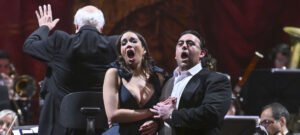
Two towering figures of the international opera scene, Freddie De Tommaso and Nadine Sierra, were entrusted with closing Ciclo Aura’s highly successful 2026 season at the legendary Teatro Colón. The public of Buenos Aires has already had the opportunity to appreciate the American soprano in all her artistic facets – from fully staged opera productions to intimate chamber recitals – culminating now in this “Opera Gala.” For the British-Italian tenor, however, the evening marked his highly anticipated debut not only in Argentina but in South America.
Accompanying the soloists, the Ciclo Aura Orchestra, under the baton of guest conductor Constantine Orbelian, provided a functional musical foundation. While the ensemble had little room for individual display – their purely symphonic interventions were limited to the overture from “Norma,” the intermezzi from “Cavalleria Rusticana” and “Manon Lescaut,” and the prelude to “Carmen” – these pieces felt exceedingly brief and ultimately uninspired, relegating the orchestra to an unassuming background role in an evening explicitly designed for sheer vocal spectacle.
Freddie De Tommaso opened his presentation with an overwhelming rendition of “Recondita armonia” from “Tosca.” Exhibiting a broad and resonant middle register that seemed to defy the massive dimensions of the Teatro Colón, the tenor proved his possession of a penetrating squillo. While this quality undoubtedly sets him apart from other tenors of his generation, his second piece, “La fleur que tu m’avais jetée” from “Carmen,” exposed the slight limitations of his instrument. Although his breath control was impeccable, the aria revealed a glaring absence of pianissimo or the required nuances in the French opera repertoire.
He was far more at home in the Italian dramatic repertoire. De Tommaso captivated the house with an imposing “Nessun dorma” from “Turandot,” tackling the demanding aria with complete vocal capacity and zero strain. The true highlight of his debut, however, was the grand scene of Manrico, “Ah! sì, ben mio” followed by the cabaletta “Di quella pira” (“Il Trovatore”). Here, the tenor showcased a steadfast appoggio and a dark almost baritonal hue that contrasted thrillingly with the blazing acuti crowning the piece. His resounding execution of “Mamma, quel vino è generoso” from “Cavalleria Rusticana” further confirmed his absolute affinity for the blunt, dramatic demands of verismo.
Nadine Sierra began her contribution with a vocally opulent but interpretatively superficial “Un bel dì, vedremo” from “Madama Butterfly.” Armed with a torrential volume and immaculate legato, the soprano unleashed her characteristic vocal power. Yet, for this iconic Puccini aria, a greater dose of psychological fragility and dynamic shading was sorely missed; her approach leaned heavily on sheer decibels rather than capturing the tragedy of Cio-Cio San.
Sierra found significantly firmer footing in repertoire that relies on technical bravura, delivering a pristine “Tu puniscimi, o Signore” from “Luisa Miller.” With a full sound completely devoid of tension, she offered a masterful reading of this Verdian gem. Her dominance was revalidated in “Amour, ranime mon courage” (“Roméo et Juliette”), proving why Juliette remains a signature role of her career, as well as in a sparkling and agile “Chi il bel sogno di Doretta” (“La Rondine”).
One of the program’s successes was the inclusion of the grand sequence from the first act of “La Bohème.” Far from the convention of offering isolated arias, this sequence allowed the audience to envision a complete production with these two artists. The power and expressiveness of both singers converged in a massive display of Puccinian style, though at times it prioritized volume over poetry. In a similar vein, the duet “Vicino a te s’acqueta” from “Andrea Chénier” – a piece requiring a massive wall of sound – suited them perfectly, as the pair successfully crystallized the overwhelming ecstasy of the opera’s finale.
The generous run of encores began with a rather heavy-handed choice: the waltz “Lippen schweigen” from the operetta “Die lustige Witwe” (“The Merry Widow”). Lacking the idiomatic diction and delicate lightness the piece demands, they managed to push through it on sheer vocal gleam, allowing the tenor to once again highlight his rich baritonal middle register. Sierra then redeemed any stylistic missteps with a dazzling “Sempre libera” from “La Traviata,” imparting a masterclass in brilliant coloratura; followed by De Tommaso’s “E lucevan le stelle” and Sierra’s “O mio babbino caro,” culminating in a triumphant reprise of “O soave fanciulla.”
This “Gala Lírica” undeniably stands as a major vocal event of the Teatro Colón’s 2026 season. Conceived as a greatest hits catalog, the program served as a vehicle for unrelenting vocal amplitude, allowing the voices of both performers to flood every corner of the hall, driven by their shared, exquisite squillo. While purists can rightfully lament the pervasive lack of dynamic shading, the absence of some stylistic nuances and an uninspired orchestra, the sheer decibel level and magnetic stage presence of Nadine Sierra and Freddie De Tommaso delivered a visceral thrill that will remain in the public’s memory.
Categories
Stage Reviews