Smetana Festival Litomyšl 2026 Review: The Kiss
Klecker Leads a Young Cast in a Strong Presentation
By Alan Neilson(Photo: Ivan Krejza)
Just a couple of hours’ train journey from Prague, situated among the rolling hills of the Bohemian countryside, lies the small, picturesque town of Litomyšl. It was here in 1824 that Barbora Smetana gave birth in the castle brewery to its most famous son, the composer Bedrich Smetana, who was to become known as ‘the father of the Czech national music,’ owing to his music’s connection to the culture, mythology history and landscape of his native country. Although the family left Litomyšl when he was only seven years old, the town proudly celebrates its association with the composer each year in a month long summer festival with a series of concerts, operas and recitals that includes music a wide range of composers, with Smetana at its heart. At this year’s festival, its 75th, along with operas by Martinu, Verdi, Gyrowetz, Gershwin, Štedron, Stravinsky and Johann Strauss, there were also performances of two operas by Smetana, the first of which was his fifth opera, “The Kiss,” completed in 1876 to a libretto by Eliška Krásnohorská.
The production employed young singers in the early years of their professional careers, who had just finished their training. It ran for three performances, using two casts, and took place in a small to medium-sized theater called Smetana Haus, which has absolutely nothing to do with the house in which Smtana lived, and nor was it in its vicinity.
The narrative of the opera amounts to very little. A peasant named Lukáš has been left with his child following the death of his wife and so turns to his childhood sweetheart, Vendulka, in the hope of marrying her. She also wishes to marry him; however, in true storybook fashion, the path to true love does not run smoothly. Not only does her father have strong reservations, but Vendulka has also managed to anger Lukáš by not allowing him to kiss her until after they marry, fearing that if she does, she will provoke the ire of the ghost of his dead wife. This causes a temporary breakdown in their relationship before, as expected, all is forgiven. Lukáš apologizes to Vendulka’s father for his own bad behavior, and, in front of the celebrating local villagers, they eventually kiss. Add in a scene in which a band of smugglers working alongside the local people manage to hoodwink a local custom’s official, and that is it. The success of the opera thus relies more on the quality of Smetana’s music than on its thin, sentimental narrative and its folksy portrayal of traditional rural ways.
A Strong, Low-Budget Presentation
The director, Magdalena Švecová, decided on a traditional, simple presentation. There was no attempt to explore hidden undercurrents or impose an ill-fitting concept onto the narrative. Rather, she chose to play up the positive aspects of the drama through the development of clearly defined characters and relationships, in which their emotional tensions were given full reign. Light-hearted episodes were neatly incorporated, notably so in the scenes with the smugglers, in which Švecová had them moving around the auditorium, using the audience to ferry their contraband as a means to outwit the customs official, while her imaginative use of chorus added energy, color and a sense of the claustrophobia that is inevitable in small village communities.
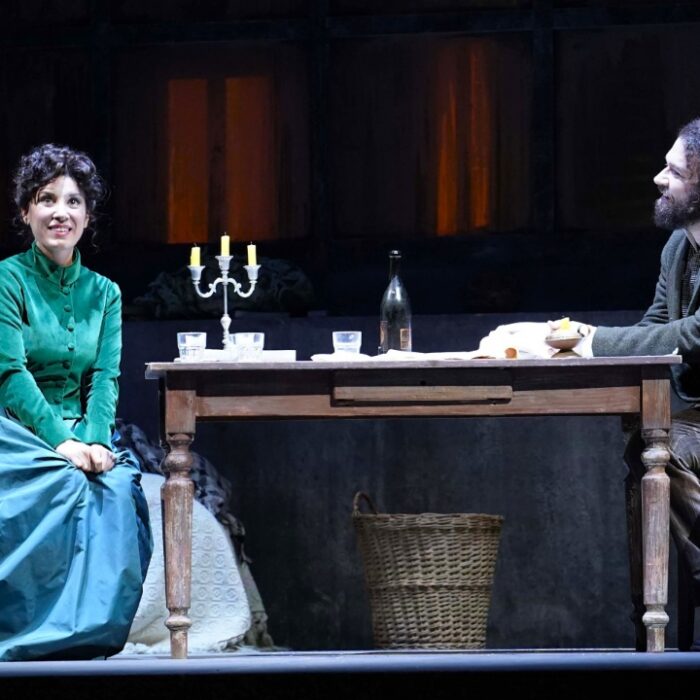
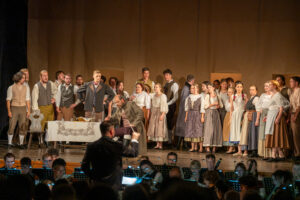
Barbora Malenínská’s traditional 19th-century costumes clearly fixed the context of the opera. The villagers were clothed in similar-colored, folk attire, with the soloists’ clothing distinguished by brighter colors and subtle stylistic differences. Although the stage designer Martin Cerny. was clearly hampered by financial constraints, he nevertheless still managed to create a successful staging that captured the drama’s changing atmosphere. The performance opened with a bland staging with a few chairs and a table and a sideboard positioned in front of a backdrop of brown paper, which is more normally used for wrapping parcels. Even the colorful costumes and pleasing lighting could not fully deflect from what was a fairly drab stage. However, in an explosive final scene to Act one, with Lukáš’s behavior and his relationship with Vendulka rapidly degenerating and their emotions reaching boiling point, the brown paper backdrop was violently torn apart as Lukás and his rowdy party flooded the stage, bringing it to a visually suitable climax. The second act opened with mist rolling in across a black stage that perfectly conjured up the threatening ambience of the dark forest, in which the smugglers and the officials played out their game of hide-and-seek. He ended the opera with an open stage, in which the villagers celebrate Lukás and Vendulk’s reconciliation and pressurize them into kissing each other.
It was a well-thought-through production, which, although clearly low-budget, still managed to present the drama in a visually satisfying manner.
With its young, relatively inexperienced cast, one would normally expect enthusiastic, fresh, high-energy performances, tempered by their lack of experience. Yet, this was not the case! There was a level of reflection and nuance in their vocal and acting performances that brought an emotional depth that was truly impressive, and it would be no exaggeration to say that the singers would not have been out of place on the stages of opera companies across the world.
A Standout Performance from Levková as Vendulka
Among the many excellent performances, it was soprano Karolína Levková, playing the role of Vendulka, that stood out. It was a performance that succeeded on many levels, not least on the depth of expression that she was able to bring to her singing: her anger and sense of betrayal at Lukáš’ cavorting with the village girls was brilliantly essayed. Her voice is strong and secure, able to fill the hall as it soars with ease above an orchestra, and her strong technique allows her to clothe the vocal line with emotional depth, which she successfully employed to characterize her relationships with her father and Lukáš. Her rendition of the famous Act two lullaby, “Sleep Sweet Angel,” was beautifully crafted to illustrate the charm, sensitivity and innate lyricism of her voice.
Tenor Filip Štovíček convinced as the emotionally volatile Lukáš, moving easily from an earnest, confident lover to a self-centered individual, whose treatment of Vendulka at the end of the first act verged on cruelty. He possesses a beautiful, high-lying tenor voice, with an attractive upper register, which he is able to imbue with a passionate intensity and confidence that made his encounters with Vendulka fizz, whether motivated by anger or amore.
Bass-baritone Florian Rostislav produced a strong performance in the role of Vendulka’s father, Paloucky, whom he presented as a firm, thoughtful and loving parent, sensitive to the possible conflicts arising from the stubborn personalities of both Vendulka and Lukáš. His singing displayed balance, clarity and an ability to furnish the vocal line with authority tempered by understanding, and brought stability to the emotional excesses and posturing of the loving couple.
Baritone Dominik Klapka used the relatively uninteresting role of Lukáš, his straight-laced, responsible brother-in-law, Tomeš, to show off his vocal quality with a fine performance that highlighted his pleasing timbre, expressive phrasing, and firm, confident delivery. His relationship with Lukáš was expertly developed so that it appeared natural and wholly believable.
Soprano Kristyna Kukalová, playing the role of Vendulka’s aunt, Martinka, produced a solid, well-characterized interpretation that captured the close relationship between the two women.
Bass David Malát showed off his strong presence in the role of the old smuggler, Matouš, with a clearly defined performance and successfully involved the audience in his clandestine business with his well-directed comments. His singing was confident and secure with an impressive ease of delivery and an attractive lyrical lilt, which he illustrated in his Act two trio with Vendulka and Martinka.
Soprano Katerina Burešová, cast in the role of the servant girl, Barče, produced a lively, bright and animated reading, in which her ability to dance lightly across the vocal line with an affecting dexterity and charm impressed.
Tenor David Cizner produced a suitably amusing portrait of the Customs Officer, which had the audience laughing out loud.
The substantial chorus rarely appeared on stage but instead was forced to crowd into the sides of the auditorium, not because the stage was too small, but because access was not particularly easy, and to be fair, the production did not suffer. In fact, to a certain extent, it made the performance a more intimate experience. Certainly, the sound was not compromised; it sang with the enthusiasm and energy of youth to create a terrific effect.
The conductor, Jakub Klecker, elicited an energetic, vibrant and lyrically strong performance from the Czech Virtuosi Orchestra supported by members of the Janáček Academic Orchestra that captured the rich textural qualities of the score. His expert handling of the musical pace and dynamic and rhythmic contrasts was carefully crafted over the course of each act to build climaxes and release tensions, which resulted in a well-integrated reading that neatly supported the onstage drama.
Overall, it was a very good production, both musically and theatrically, and proved to be a worthwhile addition to the festival.