The Person Behind The Opera, Pt. 5: Baroness de Pontalba
By John VandevertFor the past few months, you may have noticed the series, ‘The Person Behind The Opera.’ In May, we began the series by looking at the person, Malcolm Little (or Malcolm X), the focus of Anthony Davis’ 1985 opera, ‘X: The Life and Times of Malcolm X.’ The next month, we looked at Harvey Milk, the San Francisco gay rights vanguard whose life was made into the eponymous opera by Stewart Wallace in 1995. For part three in July, we got a detailed look at the life and death of Beatrice Cenci, a 16th-century daughter to a brutal father whose death was as controversial then as it remains now, immortalized in opera by numerous composers during the 20th century.
Part four, published in August, was dedicated to the enigmatic figure, St. Alban, England’s first martyr, at the hands of Roman colonizers, but whose story was given an operatic setting by Todd Wiggall in 2009. This part was special as information on the opera, and even a photograph of the opera poster, was obtained from Wiggall himself.
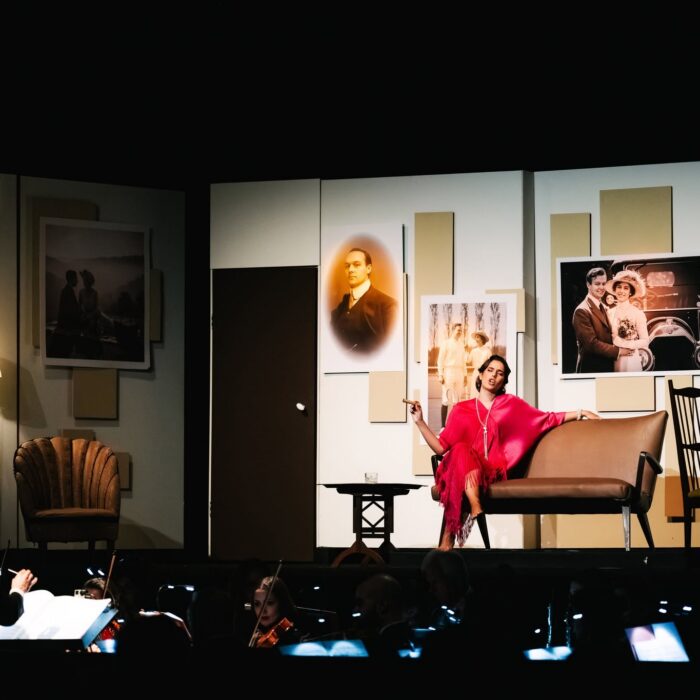
In the final part five, we will explore the captivating woman, Micaela Leonarda Antonia de Almonester Rojas y de la Ronde, Baroness de Pontalba (Micaela Leonarda for short). Famous for her buildings in downtown New Orleans, disaterious marriage, and miraculous survival from an attack by her step-father, Micaela Leonarda was a woman and mother of great tenacity. In 2003, her life was the subject of the opera, ‘Pontalba,’ by the Scottish composer Thea Musgrave, whose compositional oeuvre includes ten operas and an extensive array of choral music. Having written others operas on historical female figures like Harriot Tubmann (Harriet, the Woman Called Moses, 1985), Musgrave’s ‘Pontalba‘ was a hugely expensive affair, and one still waiting for its contemporary revival.
The life of Micaela Leonarda began in the late 18th century, born in present-day New Orleans which was then part of the Kingdom of New Spain. Spanning from upper British Columbia, down to Venezuela, including the Phillipines and parts of Micronesia, Leonarda’s beginning were financially secured but relationally insecure. Becoming the heiress to a large fund, and being properly educated as per her station at the Old Ursuline Convent, she was set to be married according to the traditions within the Louisiana Creole.
Set to be married to Joseph-Xavier Célestin Delfau de Pontalba at only 15, the new couple moved to France to live with his family but soon came to be burdened by Celestin’s submissive position under his father, Baron Joseph Delfau de Pontalba. This then began a problematic chapter in Micaela Leonarda’s life as her new father-in-law attempted to covet her wealth through various means, eventually acquiring ample real estate in France upon the death of her mother. This only made her situation worse, however, as Baron de Pontalba was now even more emphatic that she submit her wealth in the US to him in exchange for her now acquired property. Naturally, she refused and visited her estates in New Orleans in an extended tour of New Spain which, ostensibly, included a visit to President Andrew Jackson (1829-1837).
-
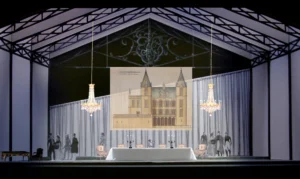
- Stage design mockup of Pontalba (2003) by Erhard Rom.
After her return to France, her freedoms were more overtly curtailed by de Pontalba which, equally naturally, resulted in the dissolution of her marriage and beginnings of her attempt for divorce and separation. Thwarted by law, going in and out of legality until 1884 when it was finally and permanently made legal, divorce was not a feasible option. Angered by her unwillingness, de Pontalba shot her multiple times yet, miraculously, she lived and later that evening, de Pontalba took his own life instead. After his death, she became an official Baronness and, with the money inherited, constructed a mansion which is today the Hôtel de Pontalba.
But as French life grew increasingly unstable, that is in the dawning of the 1848 French Revolution, Baronness Micaela Leonarda left France for New Orleans. At this point, her name would be solidified in New Orleans history as the woman responsible with updating and renovating the French Quarter to be in in-line with Parisian architectural styles at the time. Owning most of the land where Jackson Square (or Place d’Armes) currently stands, she completely redesigned it and constructed ‘row houses’ (or terraced houses) as per the Parisian standard in the courtyard style of Place des Vosges. Following the famous America tour of Swedish soprano Jenny Lind, Baronness Leonarda soon returned to France with her children where she remained for the rest of her life.
Musgrave’s opera follows her life, although taking as inspiration European historian Christina Vella‘s 1997 book, Intimate Enemies: The Two Worlds of the Baroness de Pontalba. An expensive affair when taken on by New Orleans Opera in 2003, the opera was premiered at the Mahalia Jackson Theater of the Performing Arts during her 75th birthday. Featuring singers like Jake Gardner (1947-2021) and the late Yali-Marie Williams, the opera was a true work of history in every capacity. Whilst lacking a contemporary revival, the opera was and remains a work of art waiting for its time to shine once again.
Categories
Special Features