Teatro San Carlo 2024-25 Review: Un Ballo in Maschera
Anna Netrebko & Ludovic Tézier Reign Supreme in Verdi’s Opera
By Francisco Salazar(Credit: Luciano Romano)
On Oct. 4, the Teatro San Carlo brought a new production of Verdi’s “Un Ballo in Maschera.” The evening was much anticipated as it featured the role debut of Anna Netrebko as Amelia, and reunited the famed soprano with baritone Ludovic Tézier, following an exceptional “La Gioconda” last year.
While the two superstars lived up to their hype, the evening turned out to be a mixed bag due in part to a stale production and uneven conducting.
Traditional doesn’t mean better
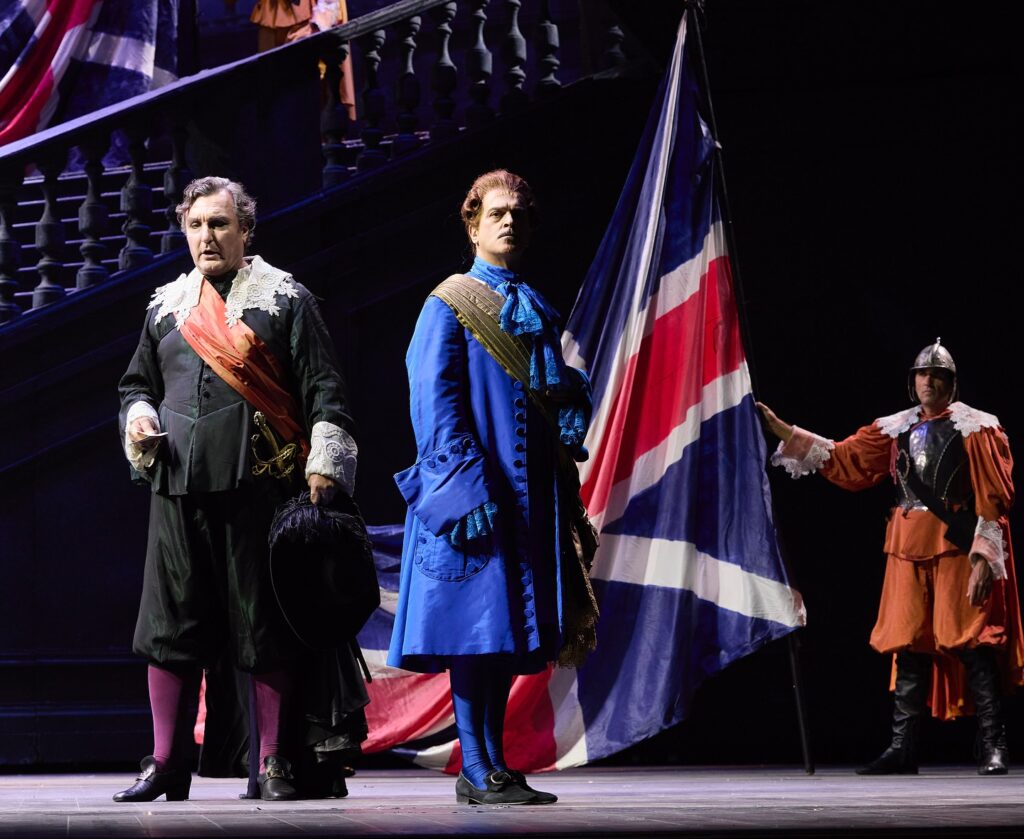
Before I get to Netrebko and Tezier and the cast, I want to address the negative aspect of the evening. Massimo Pizzi Gasparon Contarini’s production is not new, as it has already been staged in Parma and Modena, but it was the first time it was being shown in Napoli. The production is traditional in aspects, yet minimalist in others. The first scene is held in front of a staircase to Riccardo’s home, while the second scene is in some type of cavern. The second act begins in a graveyard shrouded in smoke, while Act three takes place in Amelia and Renato’s home, featuring an altar of musical instruments at its center, and in a giant ballroom with painted walls that give it a two-dimensional, amateurish appearance. The sets barely have any props or furniture and, therefore, sometimes feel cheapened.
The entire production is gaudy with costumes that are all types of colors in the rainbow, and sometimes a bit too colorful for the drama that is taking place on the stage. Amelia’s costumes perhaps had some elegance to them, especially the emerald green in the third act. However, Riccardo’s wigs were incredibly out of place with everyone else, who seemed to wear hair that was less stylized. It made Piero Pretti look uncomfortable and stiff as he attempted to sing.
But the biggest issue was the lack of interesting blocking or direction. Many times, supernumeraries danced on stage in confusing choreography, and during the masked ball in Act three, the dances looked incredibly underrehearsed and messy. Many times, the chorus just stood there, creating no dynamism on stage, especially in Act one. Even the performers who gave it their all to enliven the set could not make the set come to life, as sometimes they were restricted by space, and other times, the space lacked anything for them to play around with. That meant they had to rely on their instincts to create effective drama, and thankfully, the Teatro San Carlo’s cast was up to the task.
Sometimes, traditional is better than some random concept that the director imposes on the audience, but then again, that traditional production needs to feel alive and not just show us something pretty for its own sake.
The Diva & Verdi Are a Match
As Amelia, Anna Netrebko was making her much-anticipated role debut. The result was a triumphant turn that saw immense ovations after each of her arias.
From the moment she entered the stage, the soprano lit it up the space with her impeccable and graceful acting, moving about the stage with great command. Her opening phrases in the trio showcased a rich lower chest voice that slowly moved into a refined and lighter legato line on “Consentimi, o Signore.” The voice displayed a sweetness and innocence as she led the ensemble before moving into her fierce high notes to cap the ensemble.
In Act two, as she started her “Ecco l’orrido campo ove s’accoppia,” Netrebko opened the piece with incredible low notes, emphasizing Amelia’s fear and slowly bringing a powerful middle voice that resonated with power in the auditorium. She slowly built the first recitativo section to a fortissimo before bringing her voice to a pianissimo in the second melodic section, “Ma dall’arido stelo divulsa,” displaying a luxurious middle voice that expressed Amelia’s yearning. Netrebko held her volume back, floating some gorgeous high notes, and on the repeat “Oh! chi piange, qual forza m’arretra,” she moved the tempo forward, emphasizing Amelia’s desperation before making a slight rallentando on “O finisci di battere e muor,” emphasizing the emotional state of the character. In her “mezzanotte, e che veggio? un spettro,” Netrebko finally let loose the full force of her voice, thundering over the orchestra, the sound growing with each phrase until it climaxed. The final part of the aria, “Deh! mi reggi, m’aïta, o Signor,” was sung with full expression and shimmering high notes. The cadenza saw the soprano float each note before resolving the aria with an opulent chest voice.
If the first aria expressed Amelia’s hesitance and complex feelings, “Morrò – ma prima in grazia” was pure emotion. The soprano opened the aria with piano singing, emphasizing each word with an expressive quality. She took her time to slowly build the line before “Non rifiutarlo ai prieghi” where she slid into her high notes with ease and flexibility. The second repeat, “Spenta per man del padre” and “Su gli occhi d’una madre,” saw the soprano singing with even more desperation, and as she reached the climax of the aria, her sound resonated with even more expression. She ended the aria with an impeccable cadenza that was reminiscent of tears, first singing fortissimo then going down to the lower depths of her voice before holding the final “mai più non vedrà!” as long as she could.
Netrebko was also impeccable in her ensemble work, especially in “Teco io sto”, displaying innocence in her first “t’amo,” holding back the sound, and later delivering the repeat with passion and lush sound. The “Ahi sul funereo letto” saw Netrebko move about her tessitura with agility first in the piano sound and then singing with intensity. The trio “Odi tu come sonano cupi” saw Netrebko singing with flexible patter-like phrases and booming high notes, while in Act three quintet, she unleashed some coloratura-like phrases, singing over the ensemble and effectively communicating Amelia’s despair as well as determination in saving Riccardo. The final scene saw Netrebko sing the duet with parlando phrases, all while emphasizing the text. In the final ensemble, “Ella e pura in braccio a morte,” Netrebko carried the entire chorus with an ethereal sound.
There were some moments of hesitation in the performance as she did flub some entrances in the Act two final ensemble and the Act three duet with Renato, but those should be settled as the run continues. In all, this was truly a memorable debut that emphasized why Netrebko is still one of the best in the world.
Nobility & Vengance
In the role of Renato, Ludovic Tézier displayed nobility in the opening act, singing “Alla vita che t’arride” with an imposing and leathery voice, each line held out with gorgeous sound. In the ensembles of Act one, he was equally impressive, with his voice completely present and booming over the chorus.
But it was in Acts two and three that his character came to life. The Act two trio “Odi tu come sonano cupi,” saw the baritone singing with impeccable diction, each patter accurate and rhythmic. Then in the Act two finale, Tézier displayed a sense of anger, but at the same time, pain upon discovering Amelia’s betrayal. He sang with “Così mi paga, se l’ho salvato!” with dramatic weight, emphasizing those two emotions, and his “Ho giurato che alle porte” was sung with fury.
That same anger was carried into Act three, as he began “A tal colpa è nulla il pianto” singing with impetuous force, as well as at the beginning of “Eri tu che macchiavi quell’anima,” where Tézier delivered might and power. He slowly brought the sound back for the second part of the aria, “O dolcezze perdute! O memorie,” where the baritone sang with tearful phrases and a breath-taking legato line and breath control. The “Quando Amelia sì bella, sì candida” was sung with pure emotion, and then as Tézier repeated “O dolcezze perdute! O memorie,” he sang with mournful and gentle sound, bringing a fine piano sound to the fore before crescendoing and ending the aria with fortissimo on “d’amor!” Following the aria, he received a rousing ovation.
In the following trio, “Dunque l’onta di tutti sol una,” the baritone sang with determination and an incredibly booming and menacing sound. On the repetition of this passage, when it turns into a quartet, he gave the melody even more driving force. This was a Renato who all consumed by vengeance. By the end of the opera, however, as Renato is forgiven for murdering Riccardo, you could sense Tézier’s remorse, each line in the ensemble sung with more tenderness.
Ardent Sound
In the lead role of Riccardo, Piero Pretti sang with exemplary Verdian sound but he ultimately underwhelmed next to Netrebko and Tézier. Many times when singing next to them, the voice was drowned out by their immense timbres, and his acting seemed stiff, lacking chemistry with his colleagues.
That said, he did display a gorgeous and ardent sound, especially in his four arias. His “La rivedrà nell’estasi” was sung with ardent sound, each line impeccably phrased and with a solid legato line. His final “La sua parola udrà” on the high note gleamed with force. The “Ogni cura si doni al diletto” was rhythmic, and Pretti clearly enjoyed himself. That said, his phrases lacked a variation of color, and when he repeated the line, it was sung the same way as the first time.
The “Di’ tu se fedele” was a display with the beautiful sound, while the “È scherzo od è follia” was solid with some nice phrasing but lacking in much variation in phrasing.
His final aria, “Ma se m’è forza perderti” was perhaps the highlight of the evening, with Pretti really showing the emotional weight of Riccardo’s decision. His opening lines were sung with a piano legato as he slowly built the aria to his high notes, bringing out a squillo in his voice. He maintained a gorgeous but restrained bel canto line, especially when he finally sang “Sì, rivederti, Amelia,” with passionate high notes and really letting the voice shine through. The passion for Amelia was clear as he ended the aria and ran off the stage, showing excitement and fear at seeing the woman he loves.
In the ensembles, as noted, Pretti gave it his all, even if sometimes his voice got lost. The Act one trio, “Consentimi o Signore,” his supporting lines were sung with passion, and in the Act two duet, Teco io sto,” he had moments of ardor, especially in the opening “Non sai tu che se l’anima mia,” where Pretti caressed the lines, even showing a beautiful piano sound. At the same time, he pushed his voice to the extreme in the higher notes. “Quale soave brivido” had virtuosic intensity, starting first with a gorgeous middle voice and bel canto phrases and then with gleaming high notes. That said, he was unable to match the intensity of Netrebko as she seemed to cover his sound. The “Ella è pura, in braccio a morte” was a highlight of his ensemble singing as he sang with a thin sound that emphasized the dying gasps of his Riccardo with a breathy sound, yet always maintaining a refined timbre.
The Supporting Cast
Elizabeth DeShong has recently been stepping into more dramatic roles, and one can see why. Not only does she have a fantastic instrument, but she can shape lines with great delicacy. Perhaps it isn’t the largest of Verdi voices, but she sure makes an impact. Her Ulrica was filled with many colors, especially as she opened her aria “Re dell’abisso” with a stunning chest voice that demonstrated a dark, demonic timbre. She quickly moved into her smooth middle voice full of power and grit, and in the climaxes on “tre volte” her higher notes were resplendent and clear. The second part of her aria, “E Lui E Lui,” showed a booming sound that easily went into her gutsy chest voice, and as the aria ended in “Silenzio,” she went deeper into her chest, creating a frightening aura to the scene. In the trio, DeShong held her own opposite Netrebko and Pretti, singing with precise and accented syncopation on “non tremar” that contrasted with the leading melodic legato lines. She was also effective as she told Pretti’s Riccardo he would die at the hands of a friend. DeShong looked distraught and hesitant as she continued to sing of the prophecy. “Ah voi, signori” was sung with a hint of hesitation, showcasing Ulrica’s fear.
In the role of Oscar, Casandre Berthon made her house debut, and pranced around the stage with joviality, expressing the page’s youthful energy. Vocally, she had a mixed evening with the voice sometimes showing some wear as well as a noticeable wobble. In the ensembles, she was also hard to hear as she got covered by the giant chorus and other cast members. That was most noticeable in the final chorus, where both sopranos sing in tandem and rise with the orchestra to their higher range. She did, however, sing a playful “Volta la terrea” with flexible rhythms and some gleaming high notes. Her second aria, “Saper vorreste,” was sung with the same energy, but Berthon’s sound did not have the same lightness, and the choreography distracted away from her singing.
Romano dal Zovo and Adriano Gramigni took on the roles of Samuel and Tom, and sang with booming sounds that sometimes could sound a bit dry. That said, they made great counterparts for Tezier in their trio, giving great support to his Renato, and their “Ah! Ah! Ah!” in the ensemble at the end of Act two was sarcastic and menacing.
In the pit, Pinchas Steinberg had a mixed evening. His prelude was filled with bright and smooth lines that showcased Verdi’s lush colors, while his opening of Act one, Scene two was chilling as the chords rang with menacing accented attacks, and the lower strings with the winds opened the choral line with dark sounds that created the perfect mood for the scene and aria. The final chorus had some angelic moments, while the cello solo in “Morrò, ma prima in grazia” had a yearning quality that effectively accompanied Netrebko. However, there were some moments where the orchestra covered the singers, especially in Amelia and Riccardo’s final duet, where a squeaky violin seemed to overburden the soloists with pitchiness and tinny sound. Then there were moments where the orchestra and the soloists were not in sync, like the final Act two ensemble and the Act two trio, where the soloists were ahead of the orchestra.
Overall, Netrebko and Tézier showed why they have become so revered in the opera world, bringing chilling effect to Verdi’s music.