Teatro Regio di Parma 2026 Review: Norma
By Ossama el Naggar(Photo: Roberto Ricci)
I first heard Vasilisa Berzhanskaya as Rosina in a 2022 Florence production of “Il barbiere di Siviglia.” For the first time, I wasn’t sure if it was the standard version with a mezzo Rosina, or the less frequently performed soprano version. While the timbre was distinctly mezzo, the dazzling coloratura was more soprano than mezzo.
Fast forward to the 2024-25 season. Berzhanskaya was Preziosilla in “La forza del destino,” the opening night opera of the Teatro alla Scala, a role I distinctly dislike, but one I enjoyed as interpreted by her. In August, during Pesaro’s Rossini Opera Festival (ROF), she dazzled in a concert of soprano arias. Though not abandoning the mezzo repertoire, Berzhanskaya is embarking on a soprano career. Last month, I enjoyed her in Turin, in a mezzo role, as Angelina in “La Cenerentola,” where she impressed thanks to her brilliant vocal technique, and her deft portrayal of a modest but strong-willed Angelina. I couldn’t resist attending Berzhanskaya’s performance as Norma, possibly the most demanding of soprano roles, so I decided to attend on Feb. 22.
The great Lilli Lehmann (1848-1929) once said it was easier to sing all three Brünnhildes in one evening than one single Norma. The role requires a dramatic soprano with a firm coloratura and a capacity to express tenderness, friendship, maternal love, jealousy, rage, self-pity and despair. It seems Berzhanskaya likes to make a big splash; her first soprano role after years as a mezzo is the most difficult one of all, for one of the toughest Italian audiences–not exactly a cautious move! This decision is utterly audacious; she’s either completely sure of herself or a fan of high stakes gambling.
Parma’s Teatro Regio is a special place, reputed to be frequented by Italy’s most discerning opera public. There are stories of famous stars being vehemently booed and even torpedoed by assorted vegetables following unsatisfactory performances. As Parma is the closest city to Verdi’s birthplace, it’s home to the prestigious Verdi Festival, which takes place at Teatro Regio and in neighboring towns, including Busseto. For the past few years, I’ve attended this excellent festival every fall. Mercifully, times have changed and I have not witnessed vegetable projectiles at the Teatro Regio, but a tepid reaction at this venerable theatre will still affect a singer’s career in Italy.
Musical & Production Details
I approached this staging of “Norma” with some trepidation, given the ubiquity of inane productions that continue to plague today’s opera world. Italian director Nicola Berloffa has worked throughout France and Italy, though not at these two countries’ most prestigious opera houses. Three seasons ago, I thoroughly enjoyed his staging of Donizetti’s French language “Lucie de Lammermoor” in Québec City. A few years earlier, I enjoyed his intelligent staging of the rarely-performed “La Wally” in Lucca. While neither was revolutionary, they were at least faithful to their respective plots and uncluttered by offensive ideas. Happily, Berloffa’s staging of “Norma” proved to be one of the most appealing productions of Bellini’s masterpiece that I’ve ever seen. The action was transposed from Roman-occupied Gaul to nineteenth century Italy. Instead of being a druidess to the cult of pagan god Irminsul, this Norma is the leader of a resistance movement against a foreign occupier. Given the similarity of the period costumes to those in Visconti’s emblematic film “Senso” (1954), one can reasonably assume the setting is Italy and not Gaul, and that the foreign occupiers are the Austrians. Why this updated setting? The answer is simple: nothing strikes a chord with the Italian public more than the “Risorgimento” (1861-70), the decade that preceded the liberation and unification of Italy.
Since the French Revolution, we could describe nationalism as being the new religion in an increasingly secular Western Europe. In that light, Berloffa’s parallel makes sense. Valeria Donata Bettella’s beautiful costumes portrayed some in the resistance movement, including Norma’s father Oroveso, as decorated military men, alluding to a bourgeois resistance rather than a ragtag plebeian group. This felt like the country’s “Ancien Régime” trying to regain power usurped by the foreign occupier.
Though visually pleasing, Andrea Belli’s sets were less convincing. The resistance meeting place was the basement of an abandoned palace, likely once the ex-monarch’s dwelling. This is a fine choice for clandestine political and military meetings, but less so for Pollione’s tryst with Adalgisa.
Norma’s meeting with the people in the first act is made into a ceremonial one. The corpse of a young man, a member of the resistance, is laid down and washed by four women. Others in the crowd grieve, some are young men and women, others are older, including veterans with crutches and the fallen man’s mother. Berloffa transformed a prayer assembly in ancient Gaul into a funeral ceremony in nineteenth century Italy. Moreover, the semi-nude young hero and the women around him are made to look like Rubens’ “Lamentation over the Dead Christ” (1602) or Caracci’s “Lamentation of Christ” (1606). This powerful image, well entrenched into the subconscious of the average opera goer in Italy, may not be immediately recognized, but it effectively evoked pathos. As importantly, the ritualisation of this scene gave pretext to the opera’s best known aria, “Casta diva,” no longer a prayer to a pagan god, but for the soul of a martyr.
In the second act, we see the room where Norma keeps her children, a bourgeois space right out of di Lampedusa’s “Il gattopardo” or Nievo’s “Confessioni di in Italiano,” novels that portray the turbulent Risorgimento. In her desperation at being abandoned by Pollione, Norma considers–like Medea–killing her own children. Berloffa has Norma give the children a soporific so that they don’t resist her when she slits their throats (mercifully, she doesn’t commit infanticide). This graphic portrayal served two purposes; it emphasized Norma’s despair and the two drugged children softened Adalgisa when Norma beseeched her to leave for Rome with Pollione and her children.
In the third act, once she reveals herself to be a traitor and the lover of Pollione, Norma knows her fate and worries for her children. In a scene unknown to me in previous stagings of “Norma,” the director has Clotilde dump the children in front of the assembled crowd, who sneer at them. This is a clever idea, as it explains Oroveso’s sudden change of heart. Instead of a pyre where Pollione and Norma face their death, Oroveso slits Pollione’s throat and Norma is bludgeoned to death by the crowd, both acts being more appropriate for revolutionaries in the nineteenth century.
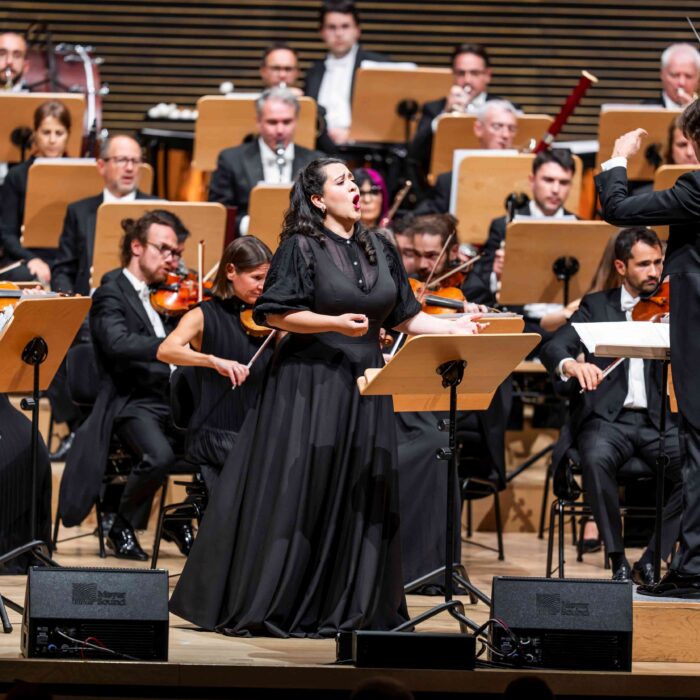
Berzhanskaya, who previously sang Adalgisa in Genova and at La Scala, had no difficulty with the coloratura of Act one’s “Casta Diva.” Often, theaters are misled into casting a coloratura soprano for the role–hopefully not too lightweight–due to the demands of the famous aria. However, lighter voices cannot convey the necessary pathos in the rest of the part, especially its pivotal final scene. Equally wrong would be the casting of a huge dramatic voice, as the coloratura in “Casta diva” would be labored. Berzhanskaya, with her impressive range, brilliant high notes and dark mezzo hue, was therefore the ideal choice for the role. She beautifully alternated from loving mother in “Dormono entrambi…Teneri figli” preceding the Act two duet with Adalgisa; to jealous lover and then loving friend in that duet; a vindictive, spurned lover in “In mia man, alfin tu sei;” and finally a noble soul in the final “Moriamo insieme.” Most impressive was Berzhanskaya’s delivery. Her diction was impeccable and her acting first rate. Her emphasis on certain words, such as “Ei tornerà,” evoked the paradoxical desperate hope of the abandoned lover. Likewise, Norma’s beseeching of her father to care for her children was heart-wrenching, thanks to her masterful emphasis of the words “Quell’innocente età!, Pensa che son tuo sangue” and “abbi di lor pietà.”
Stellar Cast
Heard in another Bellini role, Elvira in “I Puritani,” two months ago in Cremona, lyric soprano Maria Laura Iacobellis was a splendid choice for the role of Adalgisa. She was the winner of the 2018 Magda Olivero Voice Competition at age twenty‑four, which makes her thirty-two, the same age as Berzhanskaya. Iacobellis has a good stage presence and moves well on stage. The choice of a lyric soprano rather than a mezzo in this role is less conventional, but given Berzhanskaya’s timbre, it was the right one. In Bellini’s time, the distinction between soprano and mezzo was less sharp than today. The creator of the role, Giulia Grisi, was a soprano, as was the creator of Norma, Giuditta Pasta. Both also sang mezzo roles. Though Adalgisa is an important role, it mainly serves as an auxiliary to Norma’s. Vocally, the part’s main purpose is to blend harmoniously for the two duets “Mira, o Norma” and “Oh! rimembranza.” In that respect, Iacobellis was an ideal choice.
Heard last December in his first Wagnerian role (Lohengrin, in Rome), Russian tenor Dmitry Korchak is impressively versatile. A specialist in the murderous role of Arturo in “I Puritani” a decade ago, Korchak has reached a stage in his career where the coloratura of Arturo and several Rossini tenor roles are becoming harder. In recent years, he’s been more effective in non‑bel canto roles. His first act aria “Meco all’altar di Venere” was sung in a booming voice, yet stylishly. His deportment conveyed virility and his high military rank. Yet in his exchanges with Norma in the second act, such as the final duet, “Moriamo insieme,” he was truly affecting.
Bass Carlo Lepore was a surprise in the role of Oroveso. Admired for his comic turns in Rossini roles, Lepore astonished in his convincing portrayal of Oroveso, a highly tragic role. His deep, warm voice and charisma suited the role to a tee.
It’s to be noted there were some minor cuts to the score, notably the second act’s chorus “Guerra! Guerra!” Renato Palumbo showed his affinity for opera by adjusting the tempo to suit the singers’ needs, though in his attempt to emphasize Bellinian elegy, he often exaggerated the slower tempi.
With such an auspicious debut as Norma, I predict a meteoric soprano career for Berzhanskaya.