Wrocław Opera 2025-26 Review: Juliette (‘The Key to Dreams’)
By Zenaida des Aubris(Photo: Opera Wroclaw | Juliette)
What is reality, what is dream? In “Juliette,” Czech composer Bohuslav Martinů constructs an aural dreamscape in which memory dissolves almost as soon as it forms, and identity flickers with unstable voltage. Michel, a Parisian bookseller, arrives in a drab, run-down French seaside town where the inhabitants suffer from a strange affliction: they can recall no more than a few minutes of their past. Conversations loop, biographies are improvised, and reality becomes a provisional fiction. Only Michel remembers his past. He is driven by the echo of a hauntingly beautiful woman’s voice heard years before and fixed in his mind with obsessive clarity. He has been told she may be living here. Indeed, he finds her. It is Juliette. She reciprocates his sentiments. But there is no conventional happy ending.
His search moves through episodes that feel less like narrative progression than like the drifting logic of dreams: encounters repeat with slight distortions, characters reappear in altered guises, and Juliette herself hovers between presence and mirage. In the final act, Michel enters a Kafka-esque bureaucratic “Bureau of Dreams,” where such fugitive realities are catalogued and managed. Offered a return to the waking world, he instead chooses to remain within the dream, pursuing the elusive Juliette. The decision seals his fate. Martinů closes the opera not with resolution but with suspension: a man absorbed into his own longing, where memory, ironically, becomes the most dangerous illusion of all.
(Photo: Opera Wroclaw | Juliette)
Production Details
The opera, premiered in Prague in 1938 and based on a play by Georges Neveux, unfolds less as narrative than as a sequence of mental states. Encounters recur in altered form; characters slip between identities; Juliette herself hovers between presence and projection, reciprocating Michel’s longing while inventing a shared past that never existed.
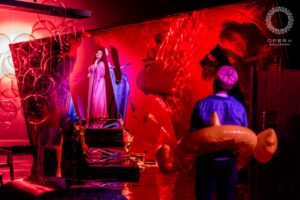
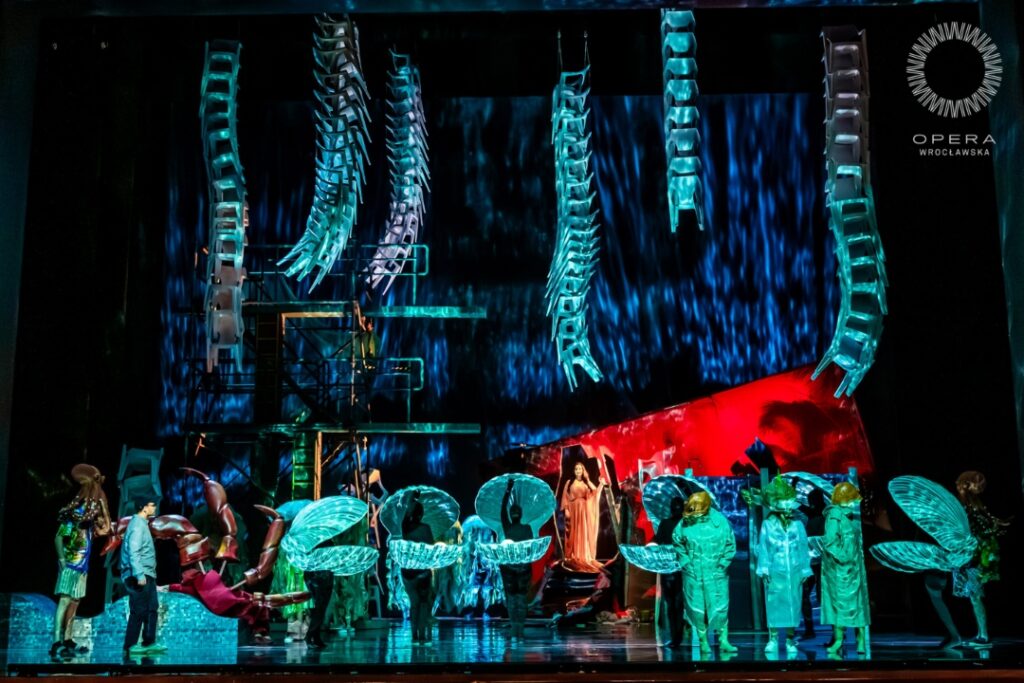
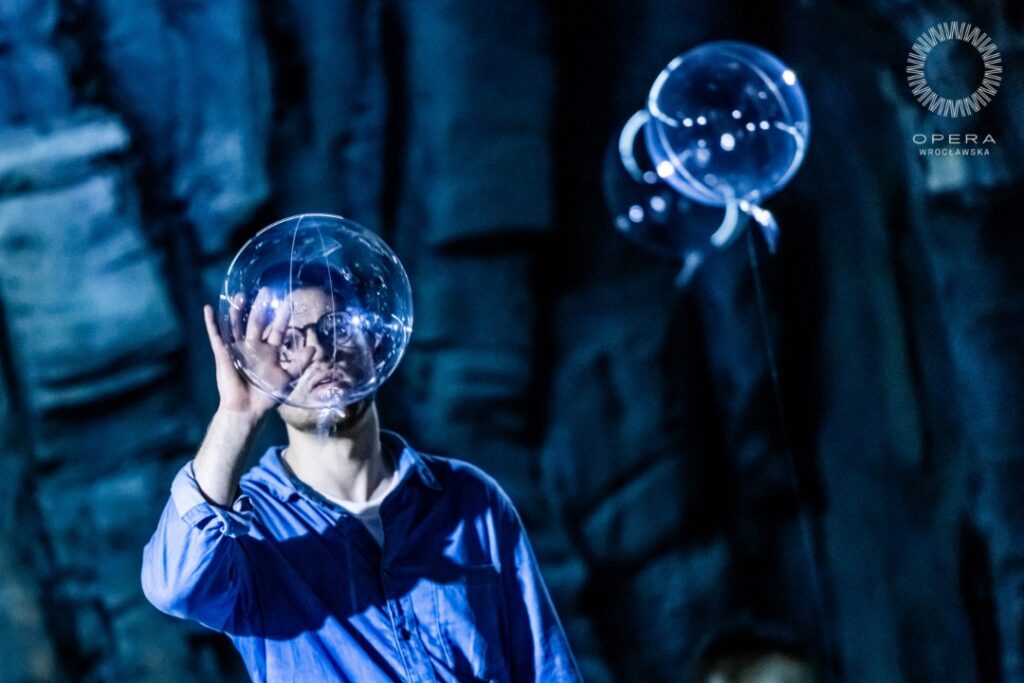
Stage director Barbara Wiśniewska’s production takes this liminal state seriously and translates it into a series of poetic visual settings situated between coastal landscape and a surreal marine biotope with a rain of green inflatable crocodiles. Natalia Kitamikado’s set design and Emil Wysocki’s costumes fill the stage with hybrid creatures – which appear thoroughly decorative, surrealistic and even symptomatic: signs of a world in which nature and imagination have become indistinguishable. Particularly in the second act, a veritable voluptuous baroque theatre of dreams unfolds, an oceanic circus of evocative scenes, at times deliberately exuberant visual power with its dancing oysters, a philosophizing red crab, long-tailed jellyfish and sea stars. It is precisely this excess that follows an inner logic: dreams are not timid. Wiśniewska structures the performance through movement repetition and subtle dislocation. Figures exchange identities, functions dissolve, contours blur. The ensemble — mostly in multiple roles — navigates these shifts with admirable precision, making palpable a world without stable centre.
(Photo: Opera Wroclaw | Juliette)
Cast & Musical Highlights
At the core, tenor Maciej Kwaśnikowski was present almost continuously on stage, shaping the role of Michel with lyrical clarity and a quiet sense of existential drift. Kamila Dutkowska as Juliette was less a fixed character than an elusive apparition, her warm soprano lent intimacy to a figure that resists definition moving from madonna to femme fatale to girl-next-door with ease. The supporting cast impressed with flexibility and alertness; notably, bass Grzegorz Szostak’s “Condemned” lent the final scene a disturbing gravity, tipping the dream toward entrapment.
Under baton of conductor Mirian Khukhunaishvili, the score emerged with notable transparency. Martinů’s idiom — hovering between Debussian iridescence and a sharper, rhythmically inflected modernity — demands balance rather than insistence. Khukhunaishvili and the orchestra of the Opera Wroclaw shaped these textures with fluid phrasing while preserving the underlying unease that characterizes the work.
With its new artistic leadership in place since the start of this season – with general director Agnieszka Franków-Żelazny, Mirian Khukhunaishvili as music diretor, and Tomasz Konieczny as artistic advisor – Wrocław Opera signals a compelling artistic direction. “Juliette” is more than a programmatic curiosity; it is a persuasive plea for repertoire beyond the familiar. Martinů, long marginalized by musical and political circumstances, emerges here as a composer of distinctive modernity, whose music, not easily categorized, arouses curiosity for more.