Bayerische Staatsoper 2025-26 Review: Der Freischütz
By Francis Muzzu(Photo: Geoffroy Schied)
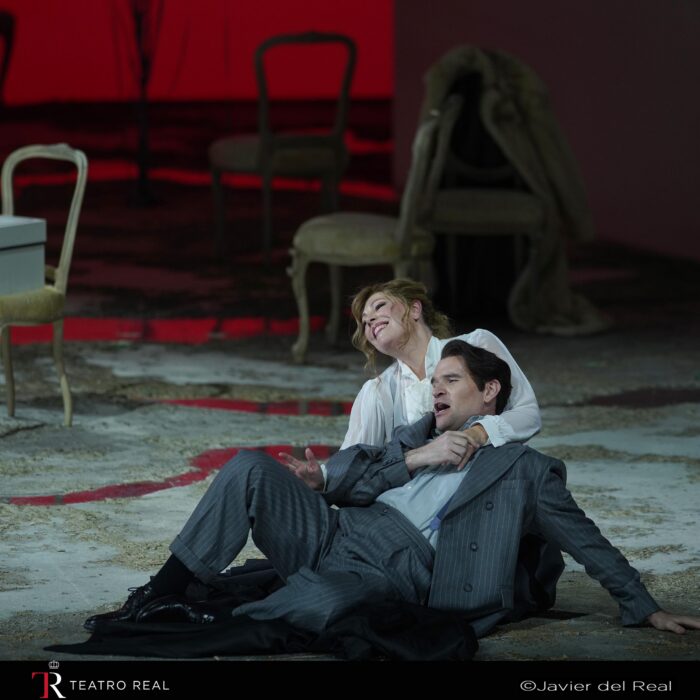
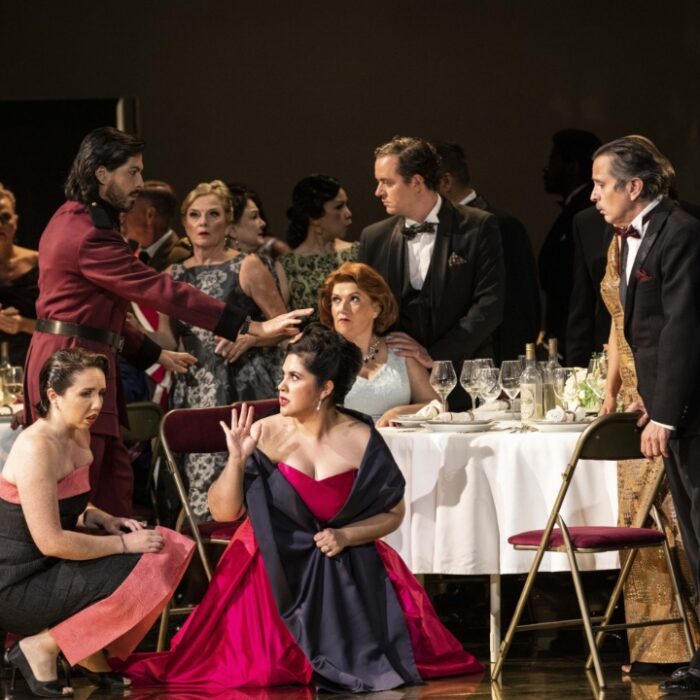
This performance proved an excellent revival of “Der Freischütz” for the summer Festival. First seen five years ago, Dmitri Tcherniakov’s production strips away any Romantic origins the piece has and replaces them with a cool and calculated tale for our time: be warned, spoiler alerts follow.
Production Details
During the Overture a film shows the main protagonists and explains that Agathe, a headstrong young woman, has turned her back on her incredibly wealthy father, business magnate Kuno, and has pinned her hopes on her suitor, Max. Agathe is encouraged by her close friend, Ännchen, a forthright young woman who views life and love with a raised eyebrow, as a sort of Zerbinetta before-her-time. Max obviously doesn’t cut the social mustard – to be blunt he is a bit of a wimp, which is highlighted by his friendship with Kaspar, the ultimate man’s man and, we soon realize, a therapist’s dream patient with severe PTSD from his army days, cleverly masked by his new corporate persona. Kaspar also fancied his chances with Agathe but lost the day, and is out for revenge.
So, having gathered the cast, we head into the opera. Tcherniakov uses a permanent set for the piece; the wood paneled penthouse suite of Kuno’s corporate headquarters – anonymous, glossy and serviced by faceless staff. Max is immediately plunged into a nightmare situation. To prove himself he has to shoot a random passerby in the street many floors below. With more film, we watch his aim as he wavers between strangers going about their daily business in innocence, and when he fails somebody else immediately takes his places and fires: the audience collectively flinched with shock as it watched a man hit the ground and people scatter in all directions in terror. At the end of Act one the audience is let in on a secret – it was all a set-up and the victim and public were all actors. Max has no idea.
Kaspar persuades Max that he can help him with forging magic bullets that can’t miss, and we reach the Wolf’s Glen scene, in its day the apogee of early Romantic imagination. Tcherniakov takes perhaps his most audacious swipe at the opera as Kaspar, in fatigues, drags a bundle of plastic sheeting into the now empty office at nighttime. The bundle turns out to be Max, who is tortured by Kaspar who has completely tipped over the edge and believes himself to be Samiel, the Black Huntsman, who will make the magic bullets that Max will use. The story progresses to the hoped-for wedding day. Max uses the bullets and accidentally shoots Agathe dead, but she miraculously revives, saved by her magic bridal wreath, and Kaspar dies in her place. A happy ending. Though, of course, Tcherniakov has one more trick up his directorial sleeve. The whole audience is briefly blinded by harsh light, collectively flinching once again, and when visibility is restored we see that Max is now deranged and really has shot Agathe, and that Kaspar stands over her body, very much alive. At some point we have slipped from reality into Max’s imagination and back again. Cue collective gasp.
So, a divisive production. I loved it but people next to me really didn’t like it at all. It keeps to the text but does play fast and loose with motivation and characterization. For a purist it might be too much, but if you are up for the ride then hang on tight and go with it. One odd niggle. Tcherniakov often continued a scene beyond the music and then ended it abruptly, confusing the audience who didn’t know whether to applaud or not.
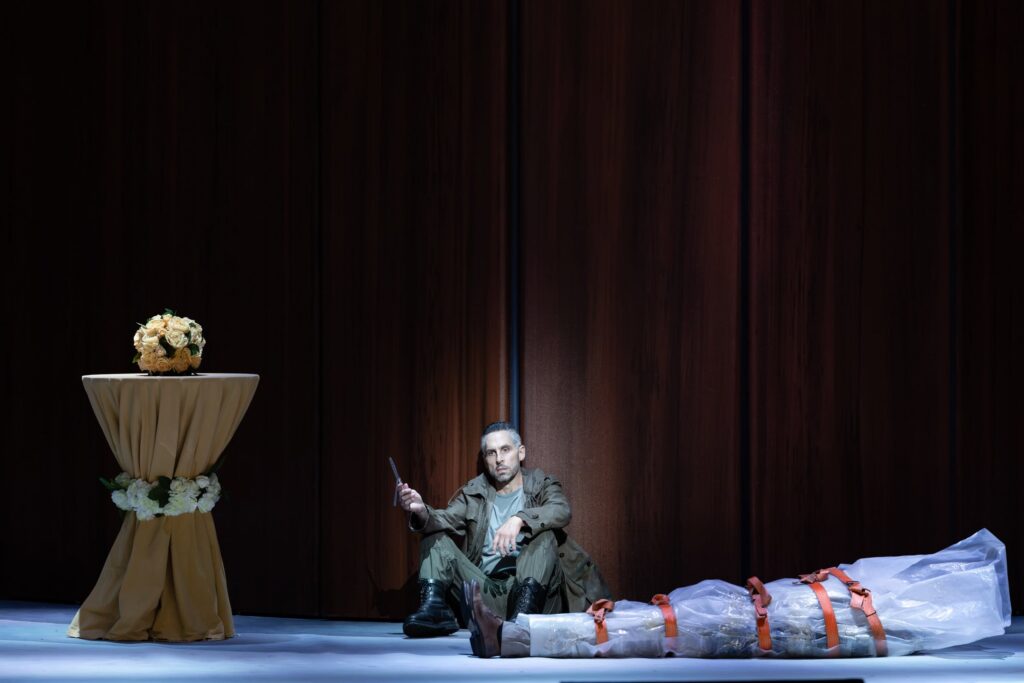
Geoffroy Schied
Musical Details
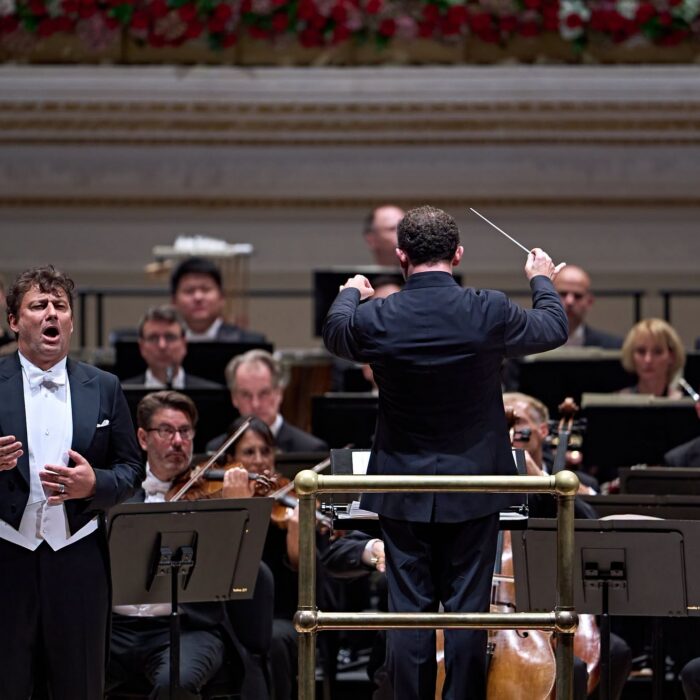
Daniele Rustioni conducted with an Italianate warmth that really sang. The Overture was well-paced and details abounded – the cello accompaniment in “Leise, liese” was luscious. The orchestra and chorus, as one comes to expect in Munich, were superb.
Max was sung by Stanislas de Barbeyrac, a bespectacled incompetent completely out of his social depth and an accident waiting to happen. His clarion tenor rang true and he acted the role to perfection.
Kyle Ketelsen’s Kaspar was only too happy to provide such an accident. Suave and polished in his corporate scenes, and completely unhinged in the Wolf’s Glen scene, a Tarantino nightmare of knives, mad voices and maniacal dance as he terrorized Max. I was petrified just watching from the safety of the stalls, it really was the most outrageous yet effective piece of acting. His bass-baritone was in fine fettle.
At the other end of the spectrum, Golda Schultz radiated calm as Agathe, even her moments of self doubt had poise. Her soprano was exquisite: smooth, unforced and with perfect phrasing. Her two arias were vocal highlights and Rustioni gave her a spacious orchestral foundation for “Leise, leise,” the jewel in her vocal crown.
Mirjam Mesak’s Ännchen provided some vocal spice and a can-do attitude, and was a perfect foil to Agathe’s quieter self-resolve.
Bálint Szabó’s Kuno held the stage as the manipulative Kuno, confident in his power. The supporting cast was strong on all accounts.