Teatro Real de Madrid 2024-25 Review: La traviata
Director Willy Decker’s Production of Verdi’s Opera Illuminates a Scandal as a Mirror of the Soul
By Galina Altman(Credit: Javier del Real / Teatro Real)
Twenty years after its triumphant—and undeniably provocative—debut at the Salzburg Festival, Willy Decker’s “La Traviata” stormed the stage of Madrid’s Teatro Real. It is striking how a production that once shocked audiences has become a recognized classic, revealing its timeless, almost metaphysical essence.
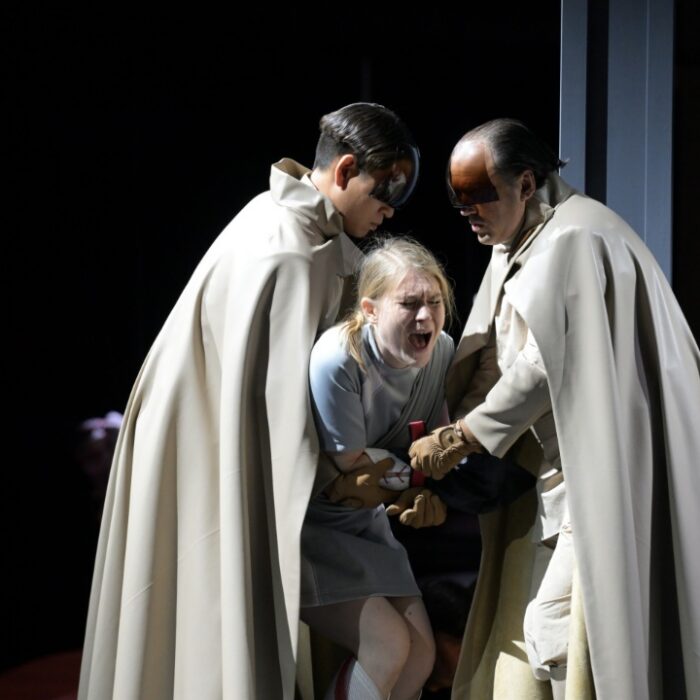
Premiered in 1853 at Venice’s Teatro La Fenice, “La Traviata” was not merely staged by Decker in 2005—he deconstructed it, stripped it to the bone, and discarded the plush conventions of the 19th century. He placed Violetta not in a Parisian boudoir but on an existentialist stage—an ice rink of sorts—where time itself, embodied in a giant, unrelenting clock, becomes complicit in her tragedy. Also ever-present on stage is the figure of Death—unseen, yet omnipresent from the first note.
This “Traviata” is not about a courtesan fading away on a chaise lounge. It is a drama of existential solitude, a testimony to the choice of freedom in the face of inevitability and the elusive nature of perfect love—something Verdi understood profoundly. Decker’s directorial genius lies precisely in this radical exposure. No lace handkerchiefs, no sacrificial heroine in frills. His Violetta collapses like a worn-out body, clad in a red dress that serves as both her weapon and her shroud. It is not a costume—it is a sentence. Armor that killed the one it was meant to protect.
And the miracle is that Verdi’s opera, weighed down by almost two centuries of clichés, regains astonishing physical force under the hands of this German minimalist—rare even in modern cinema. The brilliant stage design and hypnotic set pieces—especially the enormous clock in the final act—become the true protagonists: judge, destiny, an invisible Greek chorus. Like Balzac’s The Wild Ass’s Skin or Goethe’s Faust, they tick off the final seconds of humanity, casting aside people once they cease to be “useful.”
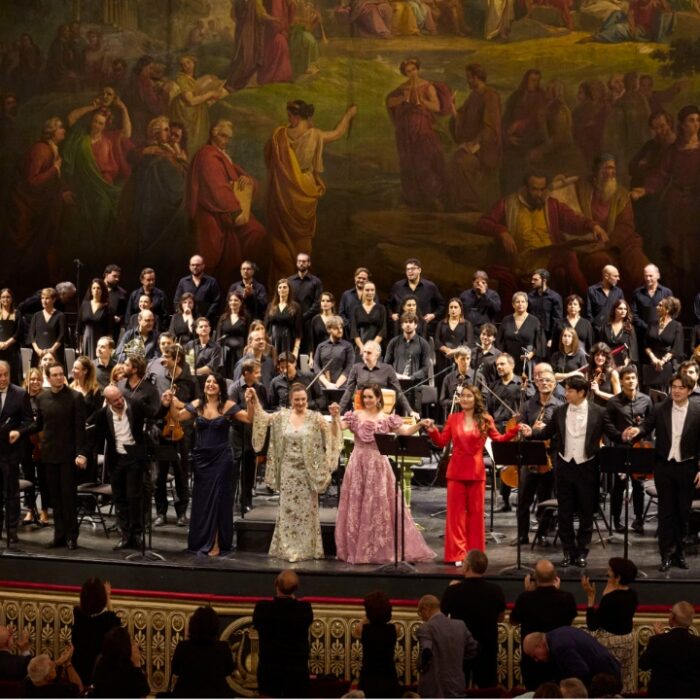
Two decades after that 2005 Salzburg staging, our consumerist society remains on the brink of catastrophe. And now the role of Violetta is sung by Nadine Sierra—an American soprano with a voice that emotionally and dramatically embodies a new generation. Sierra’s Violetta is a voice in motion: palpable, grounded, and
astonishingly flexible. She possesses the ideal voice for this role—combining power, a broad range, dazzling coloratura, exquisite pianissimo, soaring top notes, and resonant lows. Her phrasing, the flawless beauty of her tone, and her total commitment mesmerize the audience like a snake charmer’s flute. It’s as if three distinct sopranos—light, lyric, and dramatic—have fused into one. A true modern woman. Such a Violetta undoubtedly enchants, captivates, and deeply touches the soul.
Yet, this otherwise flawless brilliance lacked a profound, intimate connection with the orchestra—one that would allow the voice to merge seamlessly with the music and fully unveil the character’s essence. On stage, Sierra wasn’t simply “Violetta”—she delivered a character on the scale of a tragic Greek heroine: incredibly powerful, with striking sincerity in every note, but somewhat distant from ordinary life. The orchestra, it seemed, was overwhelmed—left in awe as if a goddess had descended upon a mortal feast, only to find herself alone with her voice and her tragedy, unsupported by a matching musical fervor.
Verdi’s music in “La Traviata” can be interpreted in many ways—even performed as “hits” in concert. But Sierra’s Violetta was precisely the kind of performance that should inspire the orchestra and conductor to pursue full dramatic expression—while still within the bounds of Verdi’s brilliant score. Regrettably, that didn’t quite happen.
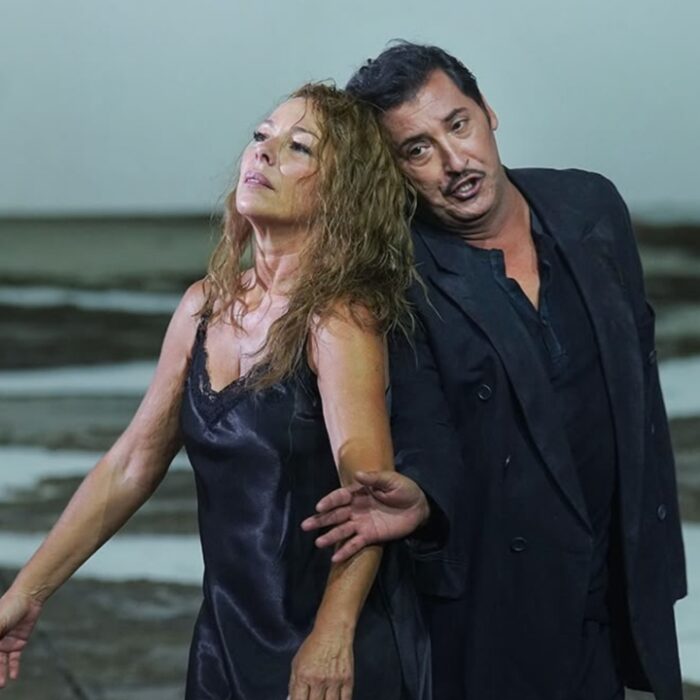
At her side was the equally remarkable Alfredo—sung by Spanish tenor Xabier Anduaga, a distinguished performer of opera and zarzuela, and winner of the prestigious Opera Award (2020)—the genre’s equivalent of an Oscar. His warm, powerful, deeply “human” voice and portrayal of a truly enamored man beautifully complemented the divine detachment of the leading lady. Together, their duet revived the searing dramatic vision Verdi himself conceived.
Thus, Decker’s “Traviata” at Teatro Real is not just a masterfully sung and staged Verdi masterpiece—it remains a piercing social critique. Like a mirror, this production reflects our human fragility and our persistent willingness to let countless Violettas die again and again—for the sake of decorum, convenience, or ideology.
The finale offers no room for sentimental tears. Only silence. Time. And that red dress, now shrouding not just a body, but an idea—a testament to the fact that true love, like humanism, does not always find its place or recognition in our world. A problem that continues to strike a deep chord with every modern audience—regardless of age or gender.