Teatro Nuovo 2025 Review: La Sonnambula
By Francisco Salazar(Credit: Steven Pisano)
For the second night in a row, Teatro Nuovo was back in City Center. This time, the company turned away from the dark and dramatic colors of Verdi’s “Macbeth” to Bellini’s melodramatic “La Sonnambula.”
Like “Macbeth,” the company semi-staged the production with projections in the backdrop and supertitles to accompany them. Unlike “Macbeth,” which saw the entire cast dressed in black, Bellini’s work saw the cast dressed in colorful attire that fit perfectly with the melodic and sunny colors of Bellini’s masterpiece.
The result was a solid evening with some standouts in an excellent reading of the score.
The never-ending criticism
“La Sonnambula” may be a musical masterpiece, but it will always be criticized for its silly story about a sleepwalking young girl who is accused of betraying her betrothed, Elvino, when she unconsciously walks into the Count’s hotel room. As presented by Teatro Nuovo, the story was shown as a tale of innocence, deception, and betrayal without any concept. But it was all the better as it provided drama and some laughs.
As I was watching the work on this evening, I was struck by the contemporary themes of how easily a whole village could be manipulated and turn away from someone they know. I was struck by how easily people could be changeable and made gullible by a lie. These themes seemed quite contemporary, especially in the times we live in. Perhaps this is digging too deeply into the story of “La Sonnambula,” but rather than see the story as a simple and foolish one, perhaps Bellini and Romani were driving at something more interesting and complex in their analysis of a small village and the emotions of its characters.
A Surprising Standout
When we think of “La Sonnambula,” we think of the famed final scene, which includes the two most famous arias of the piece. However, on this evening, it was Lisa’s character that seemed to receive the biggest ovation. In the role, Abigail Raiford showcased a sweet and full lyric sound that also allowed for flexibility in coloratura. In her second aria, “De lieti auguri,” Raiford displayed clear trills and accurate roulade phrases in the opening of the aria. Then, as she repeated the main theme, Raiford interpolated numerous runs and high notes that were crystal clear but also playful and incredibly virtuosic. What is generally seen as a secondary character, turned into a showstopping moment following the aria.
Raiford also displayed a lush legato line in her first aria, “Tutto è gioia” that opens the first act. Perhaps there were some intonation issues at the start, but as she settled into the musical phrases, her repetition was solid and showcased a mournful Lisa longing for Elvino. That was emphasized by her tasteful interpolations that never veered from Bellini’s musical line.
Raiford was also solid in the choral moments, and her stage presence played into Lisa’s jealousy and her scheming nature.

Steven Pisano
Shining Light
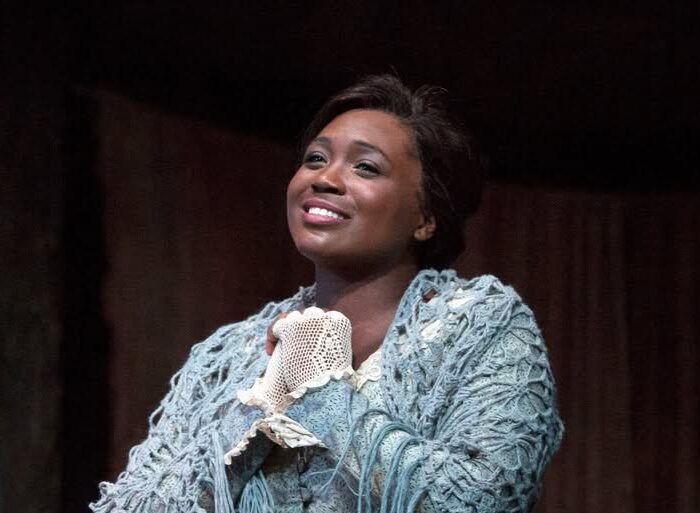
In the role of Amina, Teresa Castillo returned to Teatro Nuovo for her fourth production with the company. Castillo has a bright, silvery voice that is perfect for the innocent character. From the moment she sang her first lines, she embodied joy and happiness. That was especially clear in her opening aria, “Care compagne e voi” as she displayed fluid legato lines and velvety top notes. There were some tentative and choppy lines on occasion, but she overcame that in her cavatina, “Sovra il sen la man mi posa.” Castillo demonstrated her command of her voice with one variation after another during the first repeat and continued the variations during the second repeat. It was clear from the get-go that she is an expert in this repertoire and that her voice was up for the challenge. However, it did sometimes come off as a bit much, and the effect of the first aria was a bit cool and less emotional.
But as Castillo took control of the evening, her voice warmed up, showcasing a strong middle voice that was full and powerful as well as expressive. That was prevalent in the Act one finale, “D’un pensiero e d’un accento,” where the soprano brought the nostalgia and sadness of her timbre. Her voice also had a fuller sound that was easily heard over the ensemble.
That leathery timbre was on full display in the sleepwalking scene, as she opened the recitative “Oh! se una volta sola” with a tender sound that showcased the frailty in the character. The “Ah! non credea mirarti” was the most virtuosic singing of the night, with Castillo bringing out her most expressive qualities. She sang with a mezzo piano that could easily shift to the quietest of pianos, which emphasized Amina’s yearning. Her extensions in her higher range were exquisite, and some of the variations she added emphasized the nostalgia in the piece. In the Cadenza, Castillo took her time melding her voice with the cello solo. Sometimes the breaks in lines were a bit excessive, but it was hard to turn away from Castillo’s spell that she put the audience under.
“Ah! non giunge uman pensiero” was sung with an ardent timbre and rhythmic precision. The variations that Castillo used were originally written by Bellini, and one can understand why they aren’t used any longer, as they can be a bit too much. But under Castillo’s command, she handled the roulades with expertise, singing each run with clean and fluid line and at the same time virtuosic mastery. Castillo also ended the night off with an exception High F.
Too Many Roulades
Last season, when Teatro Nuovo did a production of “I Capuleti e i Montecchi,” the singers fell into the trap of overdecorating the cavatinas with interpolations and variations. While it may be correct for the period and the approach that Teatro Nuovo is attempting, it can sometimes distract from the music and the performer.
That was certainly true for tenor Christopher Bozeka, who opened the evening with a rich middle voice, especially in his first aria/duet, “Prendi l’anel che ti dono,” where he displayed some long legato lines that blended one into the next seamlessly. It was the epitome of an even tone with an expressive quality that could easily seduce his Amina. He could diminuendo with ease and flexibility and on the second repeat, where it turns into a duet, the two voices blended with gorgeous tones.
It was in the subsequent cavatina “Ah! vorrei trovar parole” where the tenor opted to interpolate some high notes and create a lot of scaled variations. As he reached the higher reaches of his voice, it lost that richness and instead gained hollowness and a raspy quality. It didn’t help that he attempted several high notes and the scaled variations became incredibly repetitive, as he used them for other parts of the opera.
The “Son geloso del zefiro errante” saw both Bozeka and Castillo sing with even pianissimo sound and variation of colors that provided for an intimate and introspective moment between the two lovers. However, it was hard not to ignore the number of variations that the two added. Here, however, it worked as there were more subtle roulades that added to the romantic nature of the piece. Their final “Addio! Addio!” were repeated each time decrescendoing until they ended the lines with a forte sound off stage.
Bozeka developed Elvino’s anger and betrayal well in the final scene of Act one, showcasing expressivity in his voice and singing with abandon in the ensemble. But it was in Act two that the tenor had some of his biggest hurdles to clear. The opening of “Tutto è sciolto” started with a pained pianissimo that quickly turned to anger in “Va’… ingrata!” However, here Bozeka interpolated several high notes that were rocky and seemed uncomfortable for him. Instead of concentrating on the character’s emotions and his vocal line, I wondered if he would be able to reach the next note.
Things didn’t get better in the ensuing “Ah! perché non posso odiarti,” as Bozeka started off with a quick tempo. His opening lines were shaky, but he gained control in his middle voice. However, as he started to reach the upper register, his voice lost resonance. It didn’t help that he did not slow the tempo nor use the ebb and flow of the orchestra that Bellini allows for in the piece. The second repeat was full of high notes that didn’t land and scales that felt repetitive. The tempo also moved quickly, too quickly perhaps, creating even more uncertainty for the tenor.
Strong Support
Owen Phillipson performed the role of Rodolfo, the count, with a solid bass-baritone. His first aria, “Vi ravviso,” saw the Phillipson perform with solid connected lines and rich timbre. The subsequent “Tu non sai con quei begli occhi” saw the singer showcase a commanding presence that also displayed some proficient coloratura lines. But the bass-baritone was at his best in the Act one duet with Castillo’s Amina, “Oh! ciel che tento?,” in which the two voices blended beautifully, taking on the syncopated rhythms with crispness, while also emphasizing some of the staccato lines.
In the role of Teresa, Abigail Lysinger had a booming mezzo voice, especially in the Act two ensemble “Lisa mendace anch’essa” while Vincent Grana was solid as Alessio. Xavier Flory showed some promise as the Notaro. The chorus was also notable in the ensembles helping the singers create the comic and dramatic moments. Their opening chorus in Act two was the highlight of their evening.
The orchestra played with fluidity and emphasized the brighter colors of Bellini’s score. There were some tentative moments, especially in the opening brass section of Act two that introduces Elvino’s scene as well as the cello solo in “Ah! non credea mirarti.” However, overall, the ensemble followed the singers well, leading to excellent results.
After two evenings of opera, it’s safe to say that the Teatro Nuovo only keeps getting better, and it is filling the void for opera goers’ cravings for performances in the summer.