Teatro la Fenice 2025-26 Review: Simon Boccanegra
Luca Salsi, Francesca Dotto & Francesco Meli are Compelling in Lackluster Production
By Ossama el Naggar(Credit: Michele Crosera)
Genova, Italy’s sixth largest city, where the story of “Simon Boccanegra” unfolds, is rarely featured in opera. Despite its glorious history and stunning monuments, it barely registers with tourists visiting Italy. Many know it as the birthplace of Christopher Columbus (1451‑1506) and as the origin city for the culinary magic of garlic, pine nuts, basil leaves and grated cheese, known as pesto. Yet, the blue jeans we wear were named after bleu de Gênes (Genova blue), the French appellation of a blue dye made in a nearby town and exported through Genova. The material of which jeans are made, denim (de Nîmes), is named after the French city of Nîmes. It was the Genovese who introduced the sturdy material dyed with bleu de Gênes on their ships. Another interesting fact is that it was Genovese shipbuilders who built a fleet for the English that sank the Spanish Armada in 1588.
In the Middle Ages, Genova, Amalfi, Pisa and Venice were maritime republics that controlled much of the lucrative trade with Asia and Africa. While the rival Republic of Venice was known as “la Serenissima,” Genova was known as la Superba. Both were immensely wealthy thanks to commerce, and both republics came to an end – thanks to Napoleon – in the late eighteenth century.
“Simon Boccanegra” is recognized today as one of Verdi’s most powerful works, despite having had a rough start in its original 1857 version. This was due to a cumbersome libretto by Francesco Maria Piave (1810-1876), librettist for ten of Verdi’s twenty eight operas, though many believe it was Verdi himself who wrote part of the confusing libretto. It was the brilliant Arrigo Boito (1842‑1918), a composer in his own right and librettist to Verdi’s ultimate two masterpieces, “Otello” (1887) and “Falstaff” (1893) who reworked the opera into the outstanding 1881 reconstructed masterpiece that we now enjoy.
“Simon Boccanegra” is an ingenious work combining political intrigue with paternal and romantic love. The plot concerns the pirate Boccanegra who becomes the plebeians’ choice for the position of Doge of the Genovese republic, in the hope that this political consecration will make him worthy of Maria, daughter of the patrician Giacopo Fiesco. Disapproving of his daughter’s affair with Simon Boccanegra, Fiesco sequesters Maria, who soon dies of a broken heart. Fiesco blames Boccanegra for his daughter’s death, with revenge becoming his raison d’être. Twenty‑five years later, Amelia, daughter of Boccanegra and Maria, long thought lost or dead, is revealed to be the adoptive child of the noble Grimaldis. If this weren’t enough, she is also in love with patrician Gabriele Adorno, who conspires with Fiesco and other patricians to assassinate Boccanegra. Verdi’s attachment to “Simon Boccanegra” is due to the centrality of the father/daughter love between Amelia and Boccanegra. Paternal love was a theme that haunted Verdi ever since the death of his infant children earlier in his career.
Musical Brilliance
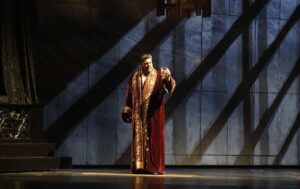
The uncontested star of this production was Italian baritone Luca Salsi, in the title role. Renowned for his powerful but dry voice, he impressed with his effective portrayal of Genova’s “pirate” Doge. Salsi is possibly today’s most prominent interpreter of “evil” baritone roles, such as Baron Scarpia in “Tosca” and Amonasro in “Aida,” roles in which I’ve enjoyed him in Parma and Verona, respectively. Though Boccanegra requires a more velvety voice, Salsi compensated thanks to his nuanced interpretation. He was at his best in Act one’s recognition scene with Amelia, “M’abbraccia, o figlia mia,” where she recognizes the portrait of her mother, his most moving and effective moment in this production. Likewise, his death scene, especially the aria, “Oh rifrigerio!…la marina brezza,” was truly affecting. As with a “Boccanegra” production seen a year ago in Rome, he was less convincing in the scenes where the Doge was at his most choleric. In those, he overacted.
Francesca Dotto is a regular at La Fenice, where I’ve enjoyed her over the years as Violetta in “La traviata;” as Leonora in “Il trovatore;” and as Donna Elvira in “Don Giovanni.” Endowed with a beautiful voice, impeccable technique and strong stage presence, she possesses a pure, ethereal yet powerful lyric soprano that’s perfectly suited to the role of Amelia. While some deem her voice too powerful to convey Amelia’s modesty and virginal quality, I don’t agree. Indeed, Dotto portrays an aristocratic lady who’s far from weak. Aware of her noble station after being adopted by a patrician family, she’s also fragile, given her traumatic childhood, marked by the death of her guardian when a small child. She never knew her mother, who died in childbirth. Aware but disapproving of Fiesco’s machinations and Gabriele Adorno’s complicity, Amelia is no ingénue, but a complex character, best portrayed by a singer with a wider vocal range than the typical lyric soprano. Dotto’s vast range enables her to portray a heftier Amelia. She deftly conveyed the different facets of Amelia: loving and hopeful in Act one’s “Come in quest’ora bruna” and her duet with Gabriele Adorno “Ti veggo alfin…Perché si tardi giungi;” defiant in the Act one aria “Nell’ora soave,” where she describes her abduction and escape; and vulnerable yet joyful in the recognition scene, also in Act one.
Francesco Meli is one of Italy’s leading lyric tenors of his generation. At La Scala, he’s sung roles from Verdi operas over the past decade: “Giovanna d’Arco,” “I due Foscari,” “Ernani,” “Macbeth,” “La traviata,” and “Don Carlo.” Like many lyric tenors, he enjoys performing heavier roles such as Radames in “Aida” and Don José in “Carmen.” Hopefully he won’t damage his beautiful voice in the process. Thankfully, the character of Gabriele Adorno is a perfect fit for his voice. A refined singer, he’s able to convey the character’s aristocratic station as well as his ardent passion in his duet with Amelia “Ti veggo alfin…Perché si tardi giungi.” In his Act two aria, “Sento avvampar nell’anima,”he expressed his jealousy vehemently, without excess or histrionics. Upon hearing Meli in this role, my appreciation of him has increased. His high notes are as brilliant as before, but his voice has acquired a more dramatic quality, and his middle register is surprisingly strong. Perhaps Meli’s slow transition into a dramatic tenor was not so misguided after all. Though Gabriele Adorno is a lesser role than Simone and even Fiesco, Meli delivered the strongest and most compelling vocal performance of the evening, as attested by the huge applause.
Italian bass-baritone Alex Esposito is amazingly versatile; his repertoire includes roles that range from Papageno in “Die Zauberflöte” to Méphistophélès in “Faust.” He portrays nobleman Jacopo, a role that requires great acting. He is enraged at the plebeian Boccanegra for his tyrannical exile of the city’s noblemen, the confiscation of their property and, most of all, the death of his daughter, who had eloped with Boccanegra. Yet he’s a dignified nobleman who, despite his desire for vengeance, remains poised. At the end of the opera, he even shows compassion for his dying enemy Boccanegra. Esposito was able to convey the various facets of the old, angry Fiesco soberly and with subtlety. His “Il lacerato spirito,” from the prologue, worked marvelously thanks to his ability to convey the utter pain and devastation of his loss without sinking into histrionics. His reconciliation scene with Boccanegra was touchingly effective, and possibly the most moving of the entire performance.
Italian baritone Simone Alberghini is well known for his bel canto comic roles, yet here, he masterfully portrayed the despicable Paolo Albiani, lusting for power and Amelia. Paolo, who orchestrated Boccanegra’s ascent to power in the hope of political influence and the ability to seduce noblewoman Amelia, exemplifies the negative effects of blind ambition. More than other singers in this role, Alberghini portrayed Paolo without excess, a tactic resorted to by lesser performers.
Italian conductor Renato Palumbo led the Orchestra del Teatro La Fenice with brio, notably the pivotal recognition scene as well as the finale, where he emphasized the pathos. Palumbo has an obvious affinity for Verdi, whose operas constitute the overwhelming majority of works he conducts.
Michele Crosera
Boito’s reworking of the opera subdued the glaring early Verdi “umpapa” rhythms of the 1857 original version. Yet, there are still remnants of that unpleasant sound in the 1881 version, notably the crowd’s jubilation scene at the end of the Prologue. Instead of underplaying those rhythms, Palumbo oddly seemed to revel in them. Though dramatically moving, it’s disconcerting that the intense Act three Boccanegra-Fiesco duet, “Come un fantasma, Fiesco t’appar,” is set to a tempo di Valzer. Mercifully, Palumbo was able to hold back the reins of the orchestra and underplayed this unfortunate waltz tempo.
Not Particularly Innovative
Much was expected of Luca Micheletti’s staging. The forty-year-old Italian is multi-talented; he’s also a baritone, a stage actor and a director. In the past three years, Micheletti impressed me as an outstanding Guglielmo in Robert Carsen’s “Così fan tutte;” as Ford in Giorgio Strehler’s “Falstaff;” and as Guido di Monforte in Hugo De Ana’s “I Vespri Siciliani,” all at La Scala. Alas, Micheletti’s staging here was not particularly innovative. Though far from offensive, neither was it insightful, offering no fresh understanding of one of Verdi’s most substantial operas. A pantomime of Boccanegra’s poisoning before the Prologue was rather fatuous. A girl, representing Boccanegra’s lost child, kept appearing throughout the performance. More distracting than illuminating, the idea of a child actor representing Boccanegra’s lost daughter has already been employed in previous productions. It was more cheesy than moving, this omnipresent girl leading the dying Doge into the light until he’s finally at peace, having found his long-lost daughter and seeing her happily married to the man she loves.
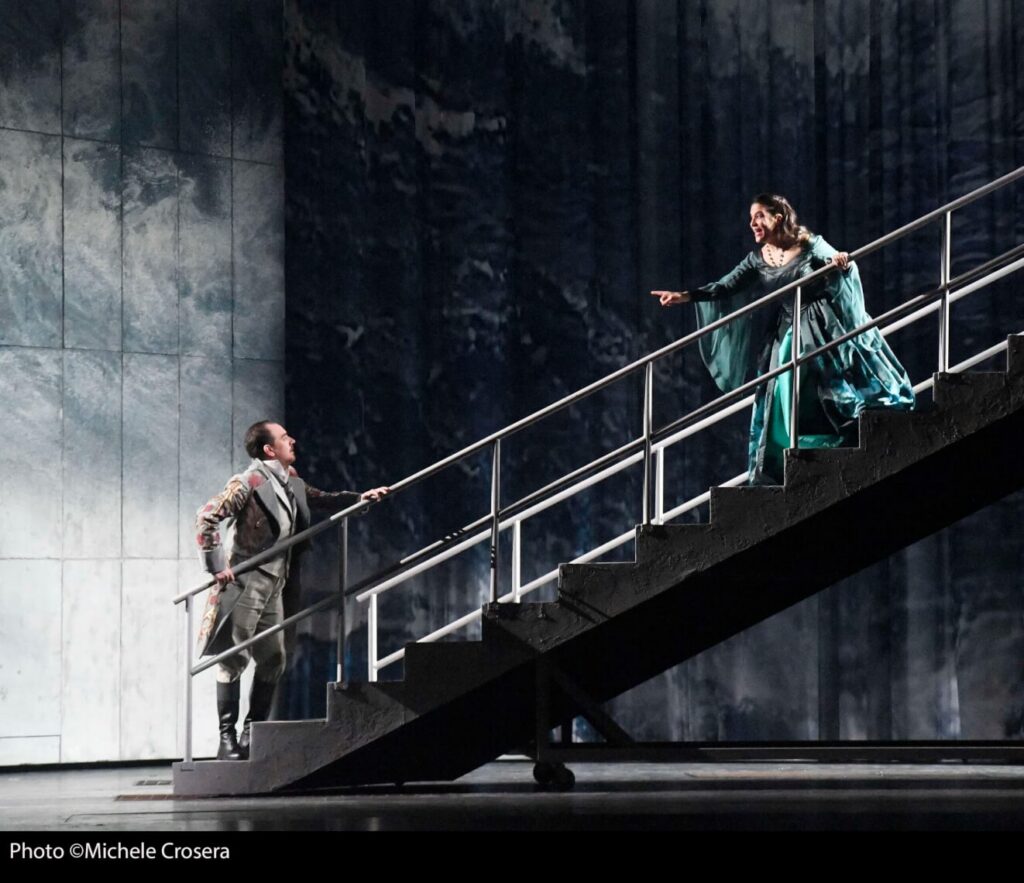
Leila Fteita’s sets were the blandest I’ve ever seen for this opera. Though neither hideous nor irrelevant, they were forgettable. A canvas of an agitated sea, an allusion to the turbulence of power, was simply boring, as it was used throughout. “Simon Boccanegra” can easily be an austere work, as the vagaries of power are its central theme. The amorous couple, Amelia Grimaldi and Gabriele Adorno, have beautiful music to sing, but their love story is secondary, which is probably why this opera never attained the popularity it deserves.
The Doge’s abode was shockingly modest to be the palace of the ruler of the affluent mercantile Ligurian republic. Luxury is not only visually appealing but necessary to convey the splendour that accompanies power. The Doge’s only furniture was a Gothic baldaquin bed and a modest throne more worthy of a village elder than a Genovese Doge. The glass of water hanging on a swing (previously used by the child actor impersonating the young Maria) looked out of place and absurd, more “Alice in the Wonderland’s” “Drink me” than a beverage in a regal dwelling.
There was an overuse of trap-doors throughout the performance. They were initially effective in setting an air of menace as the crowd poured through them to be rallied by Paolo to support Boccanegra in the Prologue and as Paolo and his accomplices penetrated into the Doge’s quarters in Act two. At first sight, the trap-doors implied the action was on a ship, an appropriate choice in the port city of Genova. But they later seemed out of place in the Doge’s palace.
Most disturbing were the anachronistic Victorian figures present at Amelia and Gabriele’s wedding. In addition, four secretaries to the Doge were clad in Victorian garb, evocative of Dickens. These four male secretaries wore black fillet veils and at times doubled as undertakers. They were an obvious reference to death, that constantly looks over Boccanegra.
What was truly effective was Giuseppe di Iorio‘s lighting, especially his use of shadows that made the power-hungry Paolo look menacing, almost terrifying, in the scene where he rallies the crowd to vote for his protégé Boccanegra. Indeed, Micheletti did one thing quite well: managing the crowds, whether in the Prologue awaiting the election of a new Doge, or Boccanegra’s councillors and the rebellious mob and at the end of Act one.
Anna Biagiotti’s costumes were beautiful and authentic, from the noblemen’s lavish robes, the Genovese plebians’ garb, Amelia’s dresses and most of all to Doge Boccanegra’s mantle, efficiently used as the symbol of power in the final scene, when the dying Boccanegra bestows it on his son-in-law and previous enemy Gabriele Adorno – a befitting end to a powerful drama about power. May present day politicians learn something from this powerful work. Alas, these musings may only be wishful thinking.