Teatro Filarmonico 2025 Review: Ernani
By Ossama el Naggar(Credit @Ennevi/Verona Arena Foundation)
“Ernani” (1844), Verdi’s fifth opera, is possibly the finest of his early period. More than any of his preceding works, it marks a drastic change from bel canto operas of the time in two respects. Firstly, the libretto, until then of secondary importance, was pivotal, as bel canto was mostly about beautiful voices, especially the soprano’s. An astute man in tune with changing public taste, Verdi was aware that a decent play had a good chance of becoming a strong opera. A sizable number of his operas were of course based on theatrical works by major playwrights: Shakespeare’s “Macbeth,” “Otello,” and “Falstaff;” Schiller’s “Giovanna d’Arco,” “Luisa Miller,” “I Masnadieri,” and “Don Carlos;” Gutiérrez’s “Il trovatore,” and “Simon Boccanegra;” Byron’s “Il corsaro,” and “I due Foscari;” Dumas’s “La traviata;” Voltaire’s “Alzira;” and Victor Hugo’s “Ernani,” and “Rigoletto.”
Secondly, aware of changes in musical taste in Paris, then the world’s musical centre, Verdi realized bel canto was being replaced by Meyerbeer’s Grand Opéra, whose founding principles called for up to six major star singers in a given opera, with each corresponding to a specific voice type. This meant a soprano and tenor as the amorous couple; a baritone and/or a mezzo as rivals; one or two basses as parents or perhaps evil conspirators. Verdi would use this formula for his most significant operas: “Il trovatore” (1853), “Les vêpres siciliennes” (1855), “Simon Boccanegra” (1857), “La forza del destino” (1862), “Don Carlos” (1867) and “Aida” (1871).
Though the concept of honor in Hugo’s “Hernani, ou l’honneur castillan” might be difficult for modern audiences to fully grasp, it was a highly-valued ideal at the time the opera was written. In Act two, Don Ruy Gomez de Silva, an older relative and Elvira’s betrothed, offers refuge to a pilgrim, who turns out to be his rival, Ernani, in disguise. When Don Carlos, the King of Spain and another suitor for Elvira’s affection, demands the capture of the bandit, Ernani, Silva refuses, honoring the code of hospitality and his sense of duty. In gratitude for saving him, Ernani gives Silva his father’s horn and swears that whenever Silva blows it, Ernani’s life will be at his command.
In Act three, when a plot to overthrow Don Carlos is foiled, the King demands the execution of the noble conspirators, while releasing the commoners involved. Ernani reveals his noble lineage and insists on dying alongside the other nobles. Moved by the sacredness of the location (Charlemagne’s grave), Don Carlos pardons Ernani and frees Elvira.
In Act four, after Ernani and Elvira are married, Silva blows the horn given to him by Ernani and orders him to take his own life as repayment for Silva’s life being saved. True to the code of honor, Ernani obeys and kills himself. While the concept of honor may seem extreme or even absurd today, the opera continues to captivate modern audiences, mostly through its unforgettable melodies and stunning ensemble singing, even if Ernani’s nobility is harder to relate to in our time.
“Ernani” soon became Verdi’s most popular work, until it was displaced by “Rigoletto” (1851) and “Il trovatore” (1853). However, it faced hurdles from the start. Victor Hugo was opposed to its adaptation, and censors in Italy were opposed to anything connected to Hugo, a revolutionary. Thus, for some productions, the name of the opera was altered, changed to either “Il proscritto” or “Elvira d’Aragona.”
Since 1972, Verona has held a special place for “Ernani,” for it was there and then that legendary tenor Franco Corelli sang it. A live recording is considered by many as the greatest recording of the work. The city’s opera lovers’ high expectations were met, especially in the voice department. However, the staging was decidedly catastrophic.
Production Details
For this production, Act one’s sets were appealing. It appeared to be the interior of a castle, with huge glass windows through which a winter landscape could be seen, incorporating clouds, horses, statues and angels, representing past history and cultural heritage. In the background, it read “La bataille d’Hernani.” A book was held by Ernani for much of the opera. Several copies of that book were seen throughout the opera, either stacked or standing as tombstones at the end of a battle. Some thought the book was the bible, but most likely it was Hugo’s “Hernani, ou l’honneur castillan,” on which the opera is based.
In contrast, the sets for Acts two and three were dark; a three-walled structure descended from above. The structure consisted of electronic motherboards with elaborate circuitry with light sporadically going through them. What might electronics that evoked the film “Tron” (1982) have to do with “Ernani?” Most likely this represents the future (in contrast with Act one’s references to the past). However, given the gloomy end of the opera, one wonders what future that might be?
Stellar Cast
Italian tenor Antonio Poli has the right voice for the title role: a spinto lyric tenor with squillo and glamorous high notes. He had an imposing presence and moved well on stage. While some may prefer a more dramatic tenor in the role, a lighter voice reflects youth and contrasts better with Don Carlo’s baritone. Thanks to his great charisma, he was convincing as the noble bandit and as Elvira’s love interest. His rendition of the opening aria, “Come rugiada al cespite” was appropriately passionate as well as sad.
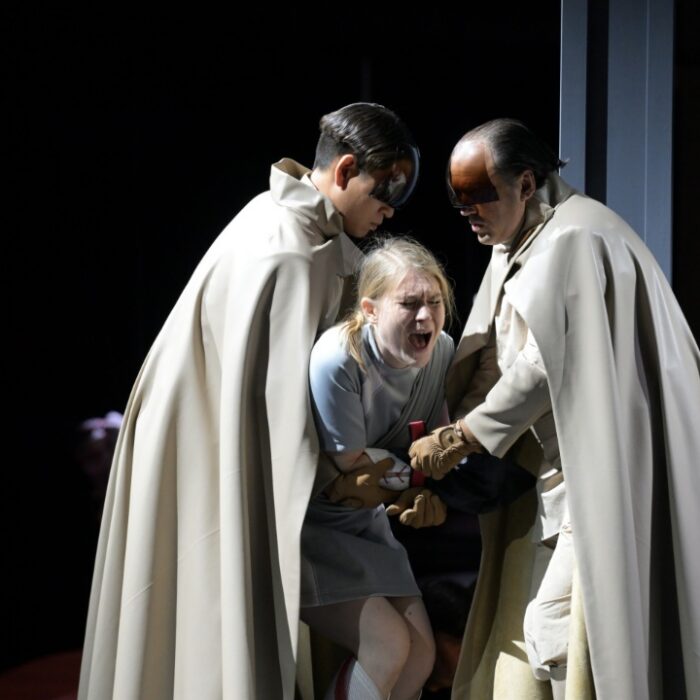
Russian soprano Olga Maslova is a vocal phenomenon; one of those rare sopranos who excels in roles as diverse as Violetta in “La traviata” and Imogene in “Il pirata” to the icy princess “Turandot.” If one had to define Maslova’s voice, spinto with facility in all registers would be the most appropriate definition. Endowed with brilliant high notes, her opening aria, “Ernani, Ernani involami,” was spectacular despite the weird staging. Elvira, dressed in white, in a similar setting, was bound to about two dozen white ropes pulled by men in white moving in circles around her thanks to the revolving stage. I soon developed a headache after all this commotion; I wonder how Maslova did not become dizzy herself. The purpose of this ludicrous contraption was to allude to Elvira’s condition: captive to her aristocratic station and forced into an unwanted marriage.
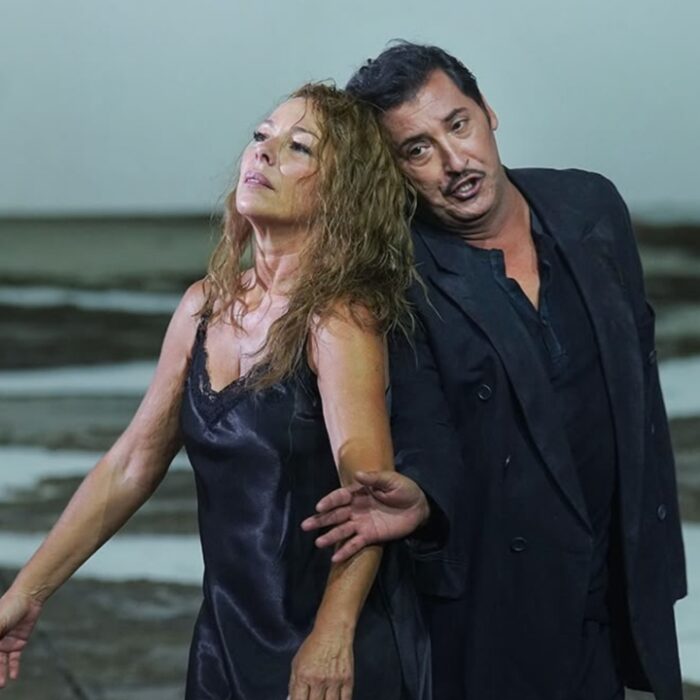
Though the baritone role of Don Carlo is eclipsed by Elvira and Ernani, Mongolian baritone Amartuvshin Enkhbat was the uncontested star of the show. His Act three aria “Gran’ Dio… Oh, de’ miei verd’anni” was the musical highlight of the evening. Conveying both disillusionment and regal solemnity, Enkhbat rendered credible his transformation from philanderer to mature monarch. According to Italian opera aficionados, Enkhbat is the best Verdi baritone in the world. Having heard him several times interpreting these great roles, I concur. Indeed, he has a magnificent voice, and it was beautiful throughout. It’s also a powerful voice, which causes problems with vocal balance, especially with the bass. Ukraine’s Vitalij Kowaljow is a reliable bass who sounded fine in his solos, such as his Act four aria, “Che mai vegg’io Infelice! E tuo credevi…Infine che un brando vindice,” but not in duos and trios with Enkhbat. Juxtaposed with the Mongolian baritone, his basso cantante sounded pale. What it seriously lacked was sufficient venom to reflect old Silva’s selfish and heinous nature. The aforementioned aria was truly affecting, despite Silva’s vengefulness. Silva was probably Verdi’s prototype for two other great bass roles: Fiesco in “Simon Boccanegra” and Philippe in “Don Carlos,” both regal yet disillusioned characters. Their respective arias, “Il lacerato spirito” and “Elle ne m’aime pas”/“Ella giammai m’amò,” evoke Silva’s aria.
The supporting roles, Elisabetta Zizzo as Giovanna, Saverio Fiore as Don Riccardo and Gabriele Sagona as Iago, were competently sung, but they had little to sing that would lead to making any particular impression.
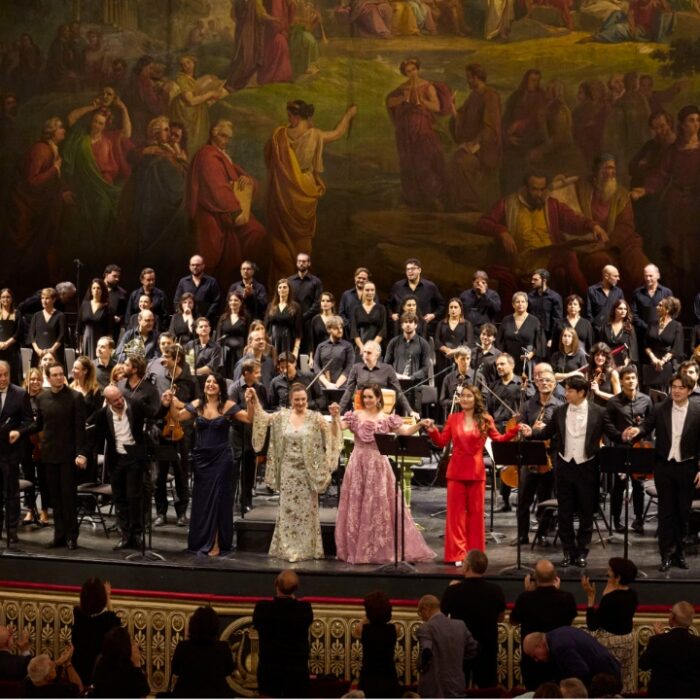
The chorus plays a pivotal role in “Ernani,” and a strong chorus greatly enhances any performance of this work. Roberto Gabbiani has clearly done a superlative job preparing the Coro della Fondazione Arena di Verona. Paolo Arrivabeni conducted the Orchestra della Fondazione Arena di Verona with brio, showing a great affinity for this composer. As this is early Verdi, it’s replete with Umpapa beats, unlike his middle-period and mature works. Arrivabeni masterfully avoided the marching band sound of early Verdi by adopting nuanced tempi. As an experienced vocal conductor, he deftly adapted his tempi to the singers’ needs with great sensitivity.
Staging Details
In recent years, Stefano Poda has staged “Aida” and “Nabucco” for Verona, and his productions were not pleasing. If they were anything like the present one, this would be more than understandable. The question is, why do opera companies continue to hire stage directors whose stagings displease the vast majority of concertgoers? This is not a tirade against modern stagings, for Damiano Michieletto, Robert Carsen and Christoph Loy are no traditionalists. They happen to be my favourites, as well as popular directors. Innovation is fine, even desirable, provided there’s a brilliant mind behind it. Poda’s staging made little sense. He may have his reasons for this convoluted vision. However, if it’s not obvious for the average spectator or requires an article in the program notes, it’s a failure.
This was a missed opportunity, given the excellence of the singers. Of the several “Ernani” productions I’ve attended, this was the best vocally. What is also certain is that it had the worst staging. It’s unfortunate I will forever associate Maslova’s “Ernani, Ernani involami” with Poda’s “wheel of fortune” and Enkhbat’s velvety baritone with electronic circuitry. Nonetheless, this was an unforgettable vocal treat.