Teatro alla Scala 2024-25 Review: Siegfried
By Vincent Lombardo(Photo Credit: Brescia e Amisano ©)
This “Siegfried”… a popular musical in myth? Given the audience’s warmly animated reactions, as one witnessed upon attending various performances of its run, it would appear so.
The lively, evocative melodic themes in this, the third of four operas of “Der Ring des Nibelungen,” are sustained by all the symbolic ingredients of a fairy tale that one needs – a dragon, a wayfarer launching riddles, a magic sword forged by incandescent heat, and a princess being awoken by a hero braving the flames that surround her. Yet, within the music, even for those still relatively unfamiliar with the outpouring of Wagner’s interwoven leitmotivs, there will follow the sonic ebb and flow of events emanating from the Prologue of “Das Rheingold” that will capture our imaginations. Then, too, in “Siegfried” we have Man’s relation to Nature – a flittering Forest-bird, Mother Earth, Murmurs of the Forest, even. As often happens when attending this sprawling epic that the Tetralogy is, whether over a week’s time as Wagger intended or daubed over a year and a half (seemingly, always a bad idea), an audience often has the uncanny sensation of witnessing a Ring Cycle together, following it through that visionary symbol of an uncontaminated wilderness, its elemental ‘gold’ resting innocently upon the River Rhine’s bed until carried away by Alberich, only to haunt us through Wagner’s ‘Wort-Ton-Dramas’ until it is restored to its origins. The obstacles to carrying out the deed presented to us right from the first evening are many, and the world’s destiny will follow its course to the pounding steps of the Giants shaking the theatre, those horrifying underground pulsations as Nibelung slave miners extract minerals, and Gods crossing a rainbow bridge into their palace of dreams. “Die Walküre” captures the essences and forces of human and divine love: a sword is victoriously pulled from a sacred ash tree, Valkyrie on horseback fly through the air, and magic fire encircles a maiden upon a high rock as her faithful steed instinctively awaits the hero who will awaken her. Thus far, we have seen two characters slain: a giant fell by his brother, and the mortal Hunding no longer useful to the God, Wotan.
“Siegfried” is, in some ways, the non-action (and thus more recited) drama of the entire Ring. Interwoven musical themes from the previous two evenings continually haunt us in a fascinating way, perhaps as only Wagner could do. Yet, too, dialogues of an often-mystical manner bring back episodes not as boring rehashing, nor pseudo-informative reflection, but more so as inner obsessive tension to be released, all as if a struggle against what has been predetermined. The kernels of the musical’s psychological impulses are modified, re-ordered, given new shape, as also the dialogues between the characters, all meeting up with each other again – Wotan and Erda, Wotan and Alberich, and when these encounters are new, the retelling is cleverly put into a game of riddles in the great scene between Mime and Wotan. The Wanderer, having lost himself and his power, can now only enter into the lives of others, yet from a distance. It is Mime who in many ways becomes the central, tragic figure of this opera, and from whose blacksmith’s hands much of the action is bent out of shape.
Episode after episode is immersed in truly impassioned rhythmic episodes: Brünnhilde’s awakening, the shimmering forest whispering, the wood-bird’s wobbling, Siegfried’s Idyll (here incorporated as Brünnhilde’s love ethic), the dragon’s penetrating sonorous echoes, the forging of the sword, and Erda’s thorough valediction prophesizing the world’s end – all this as the opera itself sweeps us along mesmerized as enveloped in symphonic rhapsody. Yet, what we witness as presented upon the stage in this production seems to take all-too-literally the essential elements of this Brothers Grimm’s macabre fable of greed and deception, “The Boy Who Set Out to Learn Fear.” All seems to center on the comic elements within Mime’s character, and Wagner indeed was attracted by the tale’s ironic characteristics, intending all as a comic opera (Young Siegfried) even before “Der Ring” was conceived. In all probability, the composer never wished to turn the Nibelung dwarf Mime into the ridiculous figure we often see. If we accept the musical characteristics of Mime, we discover enthralling motivations that attest to Wagner’s understanding of the complexities between comic and tragic. Remember, too, that in Wagner, the absurdness in quantity and quality of character is often related to the character’s inability to understand his society, as well as its rules. Thus, one such as Siegfried is initially depicted as naïve yet coarse, lacking worldly knowledge and social grace, yet possessing an inherent capacity for compassion. We can recall Wagner’s nameless Lohengrin, the pure fool Parsifal, Tannhäuser and Beckmesser, too. All, if not completely amusing, is then warmly sympathetic through naïve goodness, even when making fools out of themselves through faulty logic.
Gesture, Costuming, and the Lack Thereof
In “Siegfried,” a character’s road to oneself is illusive and torturous; it is as if they all drop their Jungian persona masks in vain attempts to face themselves through others, confessing their weaknesses and mistakes, both Gods and men. Herein, we encounter one of the two weakness of this Ring’s conception, the director’s treatment of Mime, in some ways, the central figure of this opera whose causes a great deal of the action to occur. We must remember that in Wagner’s operas, much importance must be placed on the use of pantomime. He himself took on the role of stage director for the premiere Ring of 1876, and we have a plethora of comments by witnesses of how Wagner coached his singers to represent inner emotions through gesture. McVicar seems to convey his interpretation of the libretto to the stage through stock pantomime movement, which however is not always effective in expressing an idea nor in illuminating other, deeper meanings within Wagner’s dramaturgy. May we be blindly against the use of a prologue or prelude to represent an unneeded story-within-a-story in traditionally played before the stage curtain still down, as indicated in the original by the composer? Here, the grotto of Mime in the midst of the forest is shown immediately, and, sadly, we need little imagination to grasp the dwarf’s mind-set. The action has him with a short ‘toy’ sword in hand, swishing through the air in heroic gestures … perhaps telling us that Siegfried will soon slay the dragon Fafner, wherein he himself will take possession of the all-powerful ring. Or is there more to it; who can know? Mime is exaggerated in emotion, here all-too-stereotypical gay with his own ‘prêt-à-porter’ rack of bizarre, outlandishly-colored clothes (see the leopard bath-robe); here, in the midst of a forest, an odd quirkiness. Wagner tells us instead that Mime… “is in the grip of uncontrollable forces with which he cannot deal, and thus his mind is in a painful state of doubt and turmoil.” In the kitchen of his dwelling, he appears to be an overly-busy pizza chef, farina flying through the air, distracting us from Siegfried’s actions as he seeks to understand his connection to the sword of destiny, Nortung.
Other aspects of gesture relate to the animals portrayed in “Siegfried.” Whatever solution a director seeks, our anticipations must not be deluded. Here, the invention rests upon Chinese New Year’s Day parade celebrations – with a group of human figures hoisting up a figure and moving to animate it. Thus, we have Siegfried’s wild pet bear guided by three men, but sadly, the animal seems to be a slain bear turned into a living-room rug; hardly menacing. Wotan’s spy ravens are attached to strings, and pulled up out of sight, flapping off-balance as if in a puppet theater. The dragon is scorpion-like, with a giant human skull, the same skull that became the door leading to Mime’s under-ground Nibelheim (that mythical home of dense mists) in “Das Rheingold,” as representing greed, blood and guilt. Oddly, the monster is closer to that of Fritz Lang’s 1873 film “Siegfried” with its alligator-like reptile. With the Forest-bird, representing freedom and intuition as it does, we have perhaps the best images of Nature captured on three levels. An acrobatic, nude-torso man, with a long, fragile fishing-pole-like rod with a colorful open-feathered creature in flight is doubled by a singer, Iroquois-punk hairdo, carrying a small bird in hand. When she walks it along the ground, the effect is lost, and the bird becomes a child’s simple toy.
As to the staging, one might feel that Siegfried’s wild-boy relation to the dwarf who brought him up is a bit over-exaggerated. True, there is comedy in the music and text, but here all swerves towards more than ‘commedia dell’arte’ slapstick routines; we approach the Three Stooges – a pan banged on the head, pulling noses, and on and on. Mime’s cooking is too intricate, distracting us from what is Siegfried’s well-represented sword smelting process. The Wanderer moves well, and is, yes, on stage for long periods. His costume, though, has him come off more as Dicken’s “Ghost of Christman Past” gliding about in a sinister manner, as if not of this Earth. This iconic figure of a universal nomad appear also in Wagner as one who seeks truth, a philosopher attempting to phrase the world, and thus we have seen him upon the opera stage with cape, hat and spear of Teutonic, Symbolist, Post-Industrial, or Space-age overtones. Yet, it seems fundamental that the weariness and frustrations of endless journeying must take their toll…changed are the walking paces than those as seen in “Das Rheingold,” a beard to touch the earth, worn-out garments, and an empty pouch. Imposing as Michael Volle is as the Wanderer, acting with conviction, he appears more as a monk of little character, not even assuming the appearance of a Romantic archetype, as might appear in a Caspar David Friedrich painting. Erda appears from behind a revolving six-foot globe yet initially crawls almost mermaid-like in a somewhat ghoulish long gown; much of her movement is not all in synthesis with the music and her noble erudition. The other main characters were dressed as of a motley sort: Brünnhilde in a Renaissance wedding gown, Siegfried, part grunge, Alberich in a red circus-ringmaster coat. The variety makes it almost impossible to define a historical time slot, or to create something novel. Though of merit, wherein the intracity of detail committed to each costume was commendable, much was lost given the distance from stage to public. In “Siegfried,” we had less variety, less characters to clothe, yet we had already seen perhaps an all-too-vast array – Shakespearean, Victorian, Shamanistic, Modernist. A desired ‘look’ seemed to command the need to wrap Wagner’s tale in either a mythical or historical moment. Emma Kingsbury, the costumer, is not at fault here.
Psychology of Scenic Space
A subtle use of space through use of lighting and representational objects, whether shifted or immobile, is the keystone to any theatrical event. The stage curtain, the depth of the back panoramic wall, doors, the side walls giving way to exeunt wings, and too the expanse above and out of sight all reveal the psychology of space with which to delimit all the audience may see. Though this sounds obvious, its is the single most essential consideration upon which to base a production. “Der Ring” might seem to offer a treasure chest of possibilities, yet it also remains a great challenge to unite all the elements into a single ‘vision’ that declares what the meaning of this legendary fable is. Oddly, once established, every moment of stage action should fall into place. The director, then, must make a decision that establishes this, and ‘voilà!!’ In La Scala’s program, we find David McVicar’s three-page article, “In the Mirror of Myth.” He finishes up by stating that the problem of resolving the inevitability of our own deaths is the main dilemma in “Der Ring.” He quotes Schopenhauer in telling us that only by seeking power alone may we save ourselves, yet willing our own destruction at the same time. This is true, however, for the evil and unknowing characters, steeped in socio-political existences. Yet, the others that represent Wagner’s will are forces battling against the pitfalls of human nature, striving to live free embraced by the bonds of love. Brünnhilde, the God turned human, demonstrates in the end that all must be worthwhile. The true values of “Der Ring” are to be found in the Romantic and Spiritual values of Wagner’s other operas.
Are we then lost to all that is myth? Hinged then upon that concept possibly no longer within us, McVicar goes on to say that in relation to any idea related to myth as now sensed within our lives, we no longer sense it through our spiritual side. As stage director, and also set designer, his attempts at ‘Theatricalism’ and non-Realism fail. Much upon the stage consents to the grandeur of “Der Ring,” yet while there are no signs of radicalism, all-too-sterile stage blocking either exaggerates for effect or bogs the action down. Wotan’s long monologues and duo confrontations place him center-stage all too often. One need not move about in continuation, as Wagner asks for psychological reflections within his character’s dramatic struggles, wherein the music envelops the words. Yet one needs to have the actor’s Gestalt reflections bear witness to crisis and bitter defeat; expressions and angered gestures become summer stock when lost in an abundance of space, and too much is left to our imaginations to fill in. One thinks of Siegfried on top of the Valkyrie’s Brünnhilde’s rock, as the original stage directions call for, but here peering about as he’s lost his way until looking down (and not up) to Brünnhilde, sheepishly lost in thought. Or, the horse Grane seated to the side, back to us, only to exit painfully, slowly, upstaging the God instilled with human love as she wakes, here, popping up with a start as if late for work.
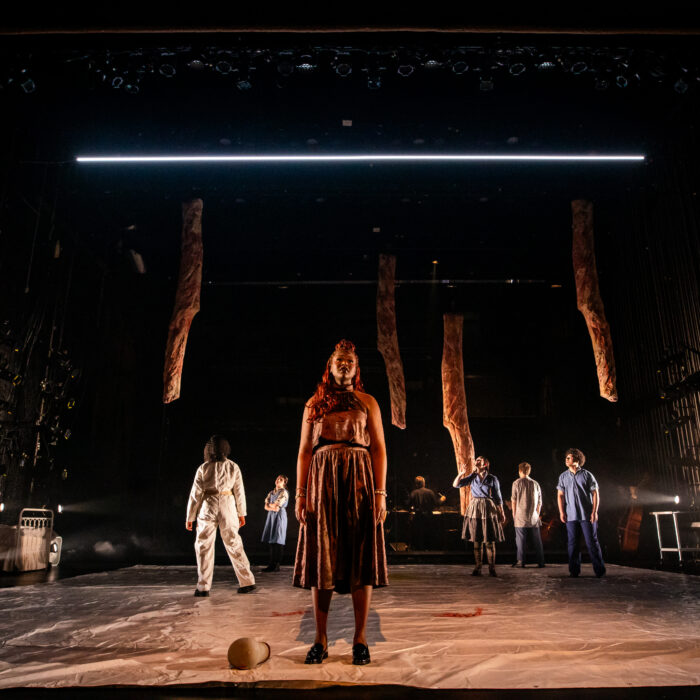
At times, the scenery made its effect, in this drama as in “Das Rheingold” and “Die Walküre.” McVicar dwells upon the themes of Man’s greed and successive guilt. La Scala’s theatre curtain was substituted by painted drops, central all, but at times moved into the background. The ominous open hand of “Das Rheingold” here becomes the head of a dragon within a circle, almost a prehistoric cave drawing, blood in its eyes, teeth as nails, aggressive, yet reduced as if a snarling, frightened dog. Yet, this has nothing to do with the stage dragon Siegfried wakes, with its gigantic human skull. Yes, human – it is the giant Fafner who, mortally wounded, will alleviate his guilt by revealing Mime’s assassination plans to Siegfried. Moving and exciting as the scene is, it was not convincing here. Might the dragon’s lair have sunk into the Earth instead of hidden behind sliding doors? Or, too, was the depth of the forest, three revolving dead tree trunks in fossilized half-human form, a representative graveyard for those having committed ghoulish deeds? All is conjecture as truly one heard audience guesses, believe it or not as to who the figures were: Siegfried’s family, the Norns, the Rhine-maidens? On paper, the sketches held their fascination, but in three-dimensional presence they were not as novel as wished for perhaps, and misleading in not creating the ambiance wherein ‘myth’ is physically iconic, but often not truly symbolic.
Song and Self-Discovery
“Siegfried” brings eight characters before us, just about as in all the other operas of “Der Ring,” but chamber-like as it is the only one without a group as the Rhine-maidens, Norns, Valkyries, or mythical Gods or tribes. All have been seen before, with the exception of young Siegfried (this production’s Siegmund also), meticulously portrayed by Klaus Florian Vogt. Once again, he fascinates us by exploring the dramatic and musical nuances of this still-blossoming hero. His youthful gestures belie his immaturity, and the light ‘heldentenor’ rings stentorian in character. Best of all, he changes tone and weight as he leaves the burly boy’s maltreating his ‘father’ Mime to expressing profound empathy in discovering a sleeping Brunhilde. The phrasing of Vogt that follows is truly illuminating, sifting through the complicated emotions of Wagner’s text and changing texture. We learn that it is not a ‘kiss’ that awakens the Valkyrie, but Siegfried’s renewed fear – of himself, of love. A woman’s presence before him brings the sensation of a woman’s care, and he calls out for help from his Mother, whom he never knew. The tension, panic even, rises, and Siegfried only instinctively desires to take life from her lips, even at the risk of his own life through emotion. The conducting, singing and staging here made this the high emotional-point of the entire evening, with Wagner demonstrating his dramaturgical skills in pulling off surprises by inverting a character’s understanding of himself – Siegfried’s newfound sensation of fear.
The multifaceted role of Mime was carried out convincingly by Wolfgang Ablinger-Sperrhacke, though one may differ with moments of over-wrought staging. Recalling that the dwarf is both foster father and mother to Siegfried, he here almost changes sex to accommodate both roles, and in an all-too-physical way; we see him dressing up as a woman seemingly pregnant, using overt feminine gesturing. Not effectively, we admit, and this is why perhaps Siegfried bangs a frying pan on his head. The range of communication was vast as brought out through the phrasing of each sentence, though it is true that much of this is already in the music. Deep is his understanding of the maleficent objectives he has in mind in order to gain power through re-possessing the ring. In the diabolical riddle scene with Wotan, he was remarkably fresh in his probing Wotan’s meanings, all in the name of saving his head, as too was his delusion and frustration in not knowing who would eventually forge the sword Nortung.
Michael Volle, the star of “Die Walküre,” takes no back seat here. His power is reduced, true, and this may have him appear less as a protagonist; yet he is a listener, even when speaking. Is this wisdom? Erda reveals more to him, he tells Alberich that he is out of the power game for regaining the ring, In a way, we may consider him to be Wagner the Wanderer, still attempting to control the destiny of the world, as too, in shaping the composition of “Der Ring.” Volle is a master at shaping these dialogues, wherein the musical tapestry of the entire Ring cycle, before and after, is hung before our eyes. The voice is rich, expressive, sounding out the psychological Earth upon which he travels. As mentioned before, his Lieder performance skills are apparent, and thus, there is much that is poetic, even in his anguished outbursts. A magnificent portrayal of a suffering God, facing his defeat within an all-too-human world.
Camilla Nylund’s Brünnhilde is well-paced, as it was needs be for the one great 30-minute duet. She truly looks the part of Wagnerian heroines, and her Isolde in last year’s new Tristan und Isolde at Bayreuth was a true success. We must remember this as Isolde is on stage for almost all the opera, while here, in “Siegfreid,” only for the last 30 minutes. Coming to know this soprano, one has the feeling that she needs a bit to vocally grow as the evening progresses, and this can happen regarding other roles, and not only Wagnerian. Subtle was her physicality in leaving her Goddess state for that of a tender, human nature. As predicted, the final vocal outbursts were roaring, her ecstatic feelings for Siegfried genuine, receiving the most moving applause of the evening.
Alberich the dwarf, whose theft of the gold set the action of the entire Ring in motion (Ólafur Sigurdarson) and the Giant-turned-dragon hoarding the gold after felling his brother (Ain Anger) belong to the slimy greed category of humans. Both sang convincingly well in portraying their inner motivations; Wagner total performers we may think. Moving was Fafner’s change of character after being slain by Siegfried, and now, no longer a monster, revealing Siegfried’s death by Mime’s hand as a dying gesture. The amplified cave-dwelling Giant came off well sonically yet made the performance chilling through his menacing voice. Alberich, here a sort of dethroned King Lear or Richard III, pulls a child’s wagon behind him, and from which he pulls a crown that, once upon his head, only manifests his fall from grace. His voice gave depth to his ugly, mischievous, greedy appearance, now a lost soldier, or perhaps circus-master as his coat suggests.
As for the elements of Nature in contact with humans and Gods, Erda (Christa Mayer) and the Forest-bird (Francesca Aspromonte), we are led to believe even more in Wagner’s genius. Erda’s music (as in “Das Rheingold”) is deeply moving, measured in wisdom and the mysterious, and was sung thus – mellow, pensive. The staging did her little justice, and, as often happens in Ring productions, she tended to ramble about mumbling runes of protective, healing properties. The Forest-bird rightly tended to lean towards the naive, the childish. The voice was well-placed and characteristic of innocence, perhaps a bit too soubrettish, but this was due in part to the conducting or staging.
Alexander Soddy, sharing the conducting duties with Simone Young (some of us have heard both of them on different occasions) offered a sprightly version of this chapter in the Ring saga. Actually, his pacing was roughly 10 minutes longer than most versions, yet the music never seemed to drag. His rendition of the Forest Murmurs and Brünnhilde’s love melody (taken from “Siegfried’s Idyll,” an orchestral piece by Wagner composed for chamber orchestra for his wife Cosima’s birthday) were extremely well-balanced; one sensed that his balancing of the woodwinds was the key. To state also: the orchestra, in its complexity, especially when playing together, was somehow divided, and thus every department of instruments remained autonomous, yet blended. Credit to Maestro Soddy for obtaining this great detail in highlighting all the elements in Wagner’s score.
The scenery was created by Hannah Postlethwaite, along with McVicar, thus credit or non must go principally to the stage director. The costumes by Emma Kingsbury were interesting but not uniform as there was little specific flavor and character to the setting of this drama, not the other two previous operas in this Ring. David Finn’s lighting, S. Katy Tucker’s videos, Gareth Mole’s choreography and David Greeves’ martial art movement were all presented with great subtlety, but to little effect in a production that never established its own uniqueness, nor a sense of imagination that this philosophical fable calls for. There was a welcomed measure of success over-all, and this is justified.
Might it be, though, that “Der Ring des Nibelungen” is impossible to stage? Was Wagner’s original production at the Festspielhaus Bayreuth of 1878 perhaps the best to date?