Teatro alla Scala 2025-26 Review: L’Elisir d’Amore
By Bernardo Gaitan(Photo: Brescia e Amisano © Teatro alla Scala)
Composed in 1832, “L’Elisir d’Amore” was born under particularly rushed circumstances. The impresario Alessandro Lanari, who had taken over the management of Milan’s Teatro della Canobbiana, asked Gaetano Donizetti to compose a new comic opera for the current season and, faced with a shortage of time, suggested that he work from an already existing French libretto: “Le Philtre” by Eugène Scribe, written for an opéra-comique by Daniel Auber that had recently enjoyed great success in Paris.
Donizetti composed the score with the speed that characterized his working method and, on May 12, 1832, “The Elixir of Love” reached the Milanese stage with a success that surprised even the composer himself. Its triumph is particularly significant when considering the context of those years. The success of Bellini’s “Il pirata” at La Scala in 1827 had helped establish a taste for tragic subjects and the heightened passions of emerging Romanticism. Yet, as musicologist Claudio Toscano points out, “Elisir” shares with “La sonnambula,” which had enjoyed a triumphant premiere in Milan only eleven months earlier, a particularly felicitous melodic vein and a conception of the Romantic idyll far removed from any Arcadian stylization. Just as Bellini’s work transcends the serious genre, Donizetti’s comedy transcends the comic genre.
Following the traditional summer break, a new production of “L’Elisir d’Amore” reopened Teatro alla Scala’s 2025-2026 season as part of the traditional Progetto Accademia, an initiative that allows the young artists of the theatre’s academy to confront directly the reality of the great Milanese stage. The choice of the title is particularly significant for a project of an educational nature. However, although this is a work of irresistible comic appeal, the production under review ultimately proved boring and excessively school-like in its approach.
Production Details
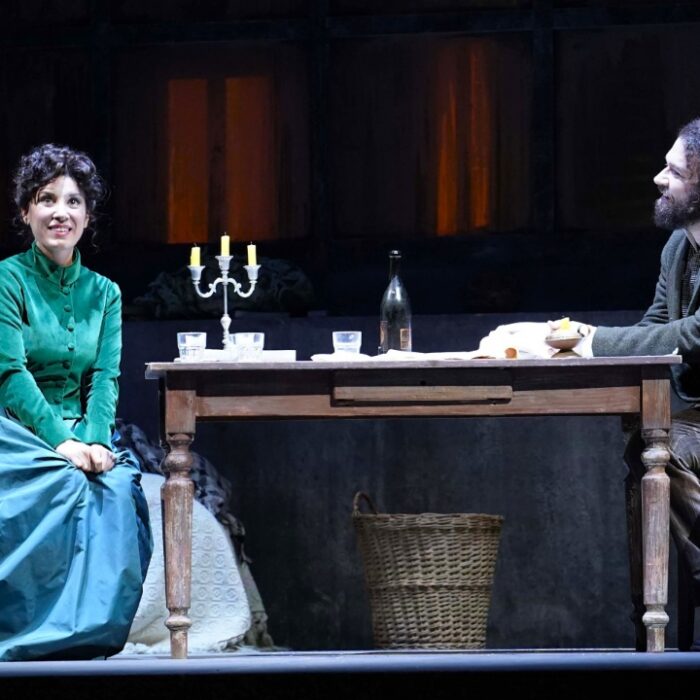
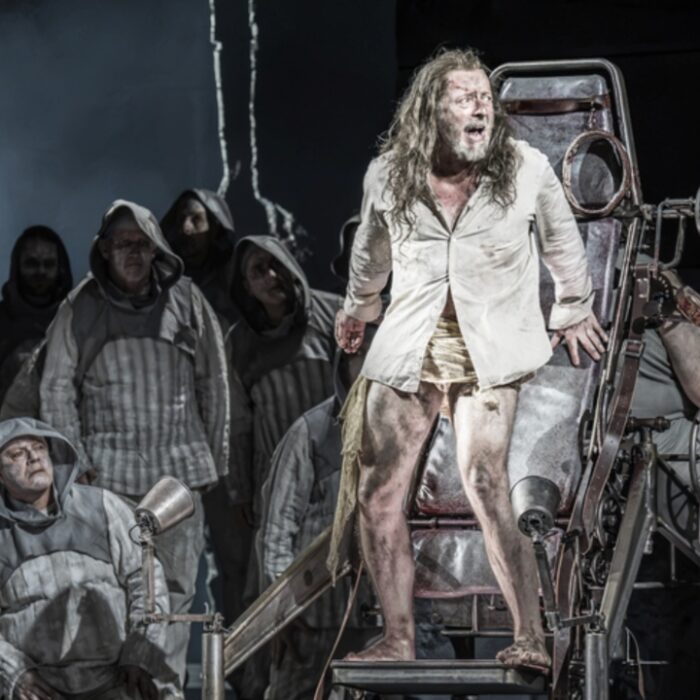
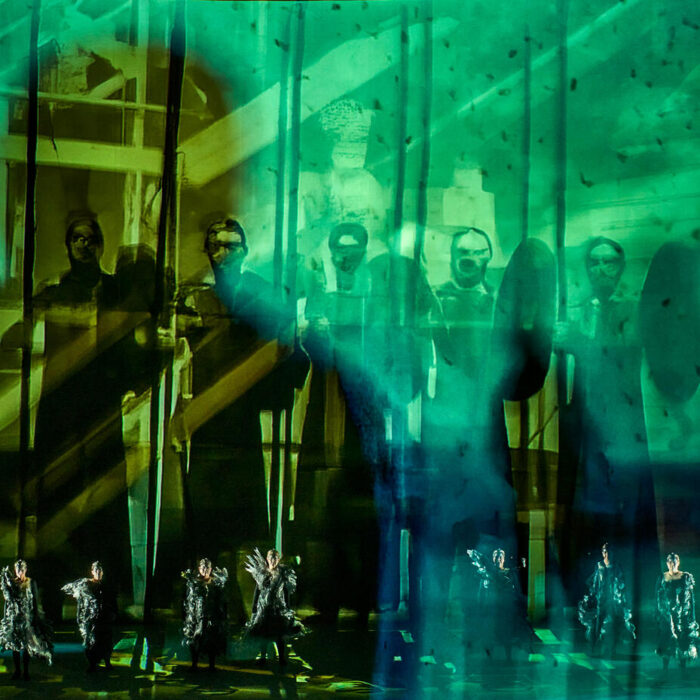
The production, directed by Maria Mauti, revealed itself to be inconsequential. Almost obsessed with the use of space and with creating a visually spectacular production – something it achieves thanks to the work of the rest of her team – it nevertheless seems to forget what matters most: the acting and the dramatic intentions of the characters. The production concentrates on presenting symbolic elements laden with semiology: an apple; the fact that, at the beginning and end of the opera, some of the performers appear dressed in theatrical work clothes rather than in the characteristic costumes; gasoline lamps, among other elements. Yet it consistently neglects the singers’ dramatic intentions.
The young students – because it is worth remembering that this is, at the end of the day, an academic project – were placed in serious difficulty. They frequently limited themselves to singing in a static manner, remaining onstage without a clear dramatic intention or a defined theatrical objective. The result was a performance that was more than merely boring, ironic and almost offensive to what is surely Donizetti’s most successful comedy. Moreover, the stage direction fell into the practice of failing to show some of the elements explicitly mentioned in the libretto – one can only hope deliberately, rather than through omission or lack of knowledge. Dulcamara speaks of an elixir, yet throughout his famous aria the celebrated bottle of wine never appears; the contract that Belcore asks to be signed with a cross is never seen and, consequently, Adina cannot return it to him in her final aria. And so continues a long and sad etcetera.
(Photo: Brescia e Amisano © Teatro alla Scala)
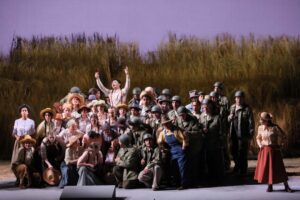
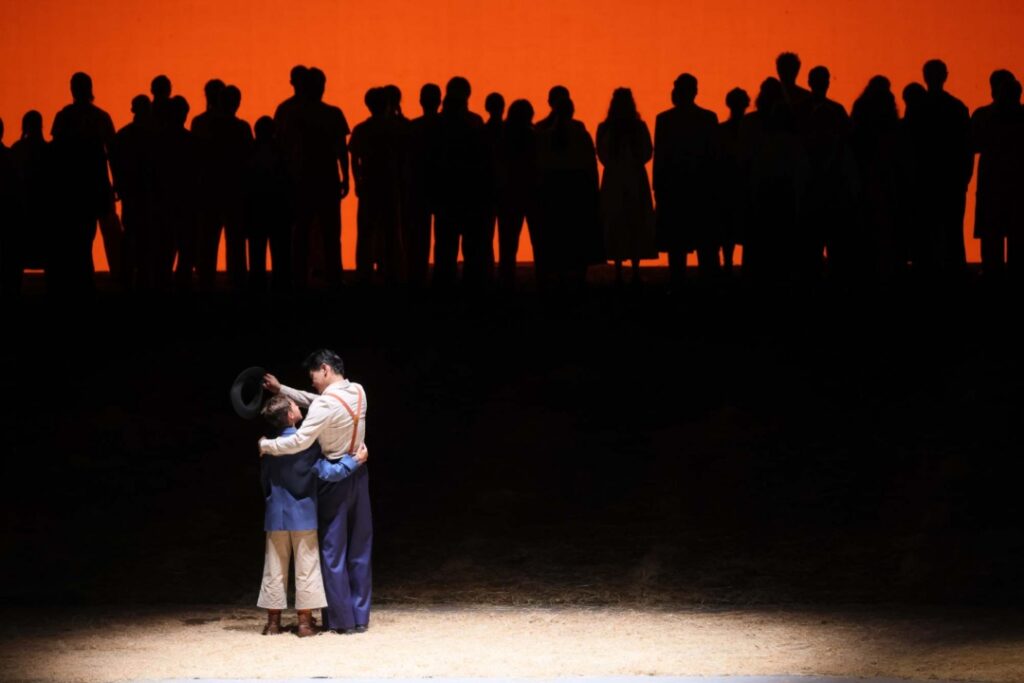
The visual side, on the other hand, is impeccable and worthy of admiration. Mauti develops the first Act in a space dominated by an immense wheat field designed by Marco Rossi. The staging places the action in a kind of deliberately undefined Wild West. The sky in the opening scene, designed by Peter Van Praet, effectively accompanies the progression of the day. The costumes by Nicoletta Ceccolini integrate coherently into this visual universe, with a poetic conception and particularly meticulous execution. The choreographic movements by Stefania Ballone, by contrast, almost always fall into caricature and attempt, rather unsuccessfully, to introduce a comic dimension that frequently ends up feeling uncomfortable and forced. The presence of the mimes helps animate the stage, while Giannetta and the chorus’s intervention in the second Act, built around a pole adorned with colored ribbons in the middle of the night, proves effective and possesses a charming aesthetic. Particularly successful, too, is the wonderful ending, in which Nemorino, accompanied by his child alter ego, watches as the stage closes.
Musical Highlights
Marco Alibrando’s musical direction was competent. The Sicilian conductor offered a serious reading, rigorous in its tempi and highly academic in character. Alibrando succeeded in building a clear and flexible interpretation without introducing major changes beyond some very brisk tempi and several dramatic pauses, always remaining faithful to the score. The melodic lines were dynamic, and there was constant attention to the relationship between word and music. Particularly effective was his handling of the ensembles, always attentive to balance and rhythmic precision.
The expressive depth of the more intense moments, as well as the energetic vitality of the finales, found in Alibrando a musical realization faithful to the style. The Orchestra dell’Accademia Teatro alla Scala responded with precision and maturity to the conductor’s demands. In some moments, such as the great final ensembles, a greater sonic presence might have been welcome, although there was nothing particularly concerning. The Coro dell’Accademia, prepared by Salvo Sgrò, also stood out: compact and precise, and capable of participating with energy and flexibility in the vitality of the score.
The cast brought together young performers who were committed from a vocal standpoint, although it was evident that, scenically, they still have a long way to go. All possessed interesting vocal material and different areas for improvement. Curiously, among the productions of the past five years, this is the one that displays the greatest shortcomings, both scenically and vocally. It is difficult not to recall, by contrast, titles such as “La Cenerentola” in 2025 or “Il cappello di paglia di Firenze” in 2024.
(Photo: Brescia e Amisano © Teatro alla Scala)
Illuminating Cast
Chilean tenor Cristóbal Campos Marin possessed a clear and pleasant timbre and interesting vocal material, which he employed in his portrayal of Nemorino. After a stiff beginning, his nervousness gradually subsided and his phrasing gained greater freedom. Vocally capable, he nevertheless became rigid at precisely those moments when the character’s theatrical vein should emerge more naturally. Given that this is a comedy, he appeared almost constantly cold and without a particularly intense connection with Adina. His performance of “Una furtiva lagrima” was approached in style, with a beautiful legato in the second part on the B-flat and a very elegant cadenza. The interpretation frequently remained on a uniform expressive plane; nevertheless, interpretative qualities and greater stage freedom are aspects that can certainly be developed further.
Sabrina Sanza offered an Adina with a pleasant timbre rich in harmonics, generous volume and precision in the uppermost notes. The legato was well sustained, the diction correct, the projection adequate, and the high register was handled with assurance. The Neapolitan soprano did not particularly stand out for her stage presence either, as there was a considerable lack of connection with Nemorino in the duet “Chiedi all’aura lusinghiera” and a certain immobility in the aria “Benedette queste carte,” where an important opportunity was lost to build a more convincing relationship between the theatrical and musical dimensions. From a vocal standpoint, Sanza was solid and secure, even allowing herself some charming variations in her arias; although the final acrobatics of “Prendi, per me sei libero” revealed several aspects that still need to be consolidated.
Geunhwa Lee as Belcore displayed a beautiful voice, particularly an exceptionally elegant lower register, appreciable vocal material and a presence that suggested interesting possibilities. His projection did not always manage to assert itself fully, although his volume and the clarity of his Italian pronunciation deserve praise. His acting, however, frequently remained on a single expressive plane, without the variety of colors and inflections necessary to create a fuller and more comic characterization of the role. Aigerim Altynbek as Giannetta was competent. Her voice enjoys good projection and presence and, despite the brevity of the role, she delivered a good performance both vocally and dramatically.
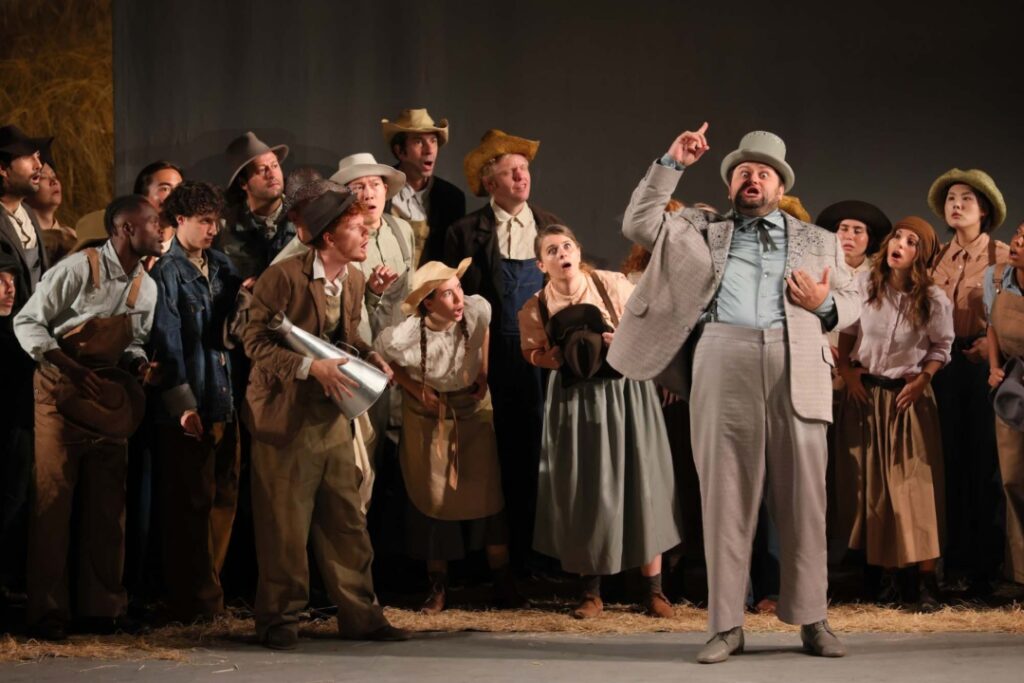
Special mention must be made of the performer who completely dominated the stage: undoubtedly, Misha Kiria as Dulcamara. A former student of the Academy and now an artist with solid international experience, the Georgian baritone placed at the service of the younger performers not only a secure voice, but also a complete awareness of buffo style and taste. His Dulcamara was sympathetic and engaging without needing to exaggerate the theatrical effect. Indeed, his vis comica was so accomplished that it highlighted the lack of experience of his younger colleagues. His voice was beautiful and full, always present in the hall; the sillabati in his aria “Udite, udite” and in the duet with Adina were secure, while the details of the phrasing were carefully handled and the declamation controlled.
Despite the mediocre stage direction and the scenic shortcomings of some of the performers, the cast ultimately received a warm ovation from an auditorium filled with foreign audience members, with especially enthusiastic applause for Kiria and Alibrando.