Teatro alla Scala 2025-26 Review: Götterdämmerung
By Vincent Lombardo(© Teatro alla Scala)
A Wagnerian friend spoke of a dream where he is visited by the composer himself. Wagner tells him, “The entire Tetralogy is a stream of images, nothing more. I think back to that day by the Mediterranean when, in a dream, the melody of my Rhine-maidens that was to begin my entire Tetralogy came to me. And, too, “Götterdämmerung” is not truly the end of my Nibelungen cycle. You see, once Brünnhilde throws the cursed golden ring back into its true resting place within the bosom of the Rhine, a sense of an ‘eternal return’ must overwhelm us as would a giant wave. Music itself symbolizes the ensuing chaos, while harmonious melody tunes the skies. Destruction’s darkness gives way to beams of light, representing more than the victory of human love over greed, corruption, and obsessive power struggles. In the silence that ensues, the world will find itself with a chance to create a new social order. We perceive that there is hope, but also that we will again make the same mistakes and thus can only accept this rebirth. Yet the true tragedy of these doomed gods is that they cannot face their defects. To this end, my music promotes this, emulating the values of antique Greek tragedy, and so serving the highest order of Drama wherein distorted social order must be replaced. But I have sunk deeply into doubt; yes, yearning for ideals and a reunion with Nature encompasses my spirit, but I must ask if Man will indeed overcome himself, accepting all that his destiny brings by not seeking to escape it, whether through guilt or enforced suffering, but by taking control of himself in going on to higher things.”
In its scenic representation through the staging, this La Scala Ring production lets us down in various ways, even though it does not go against the primal aspirations that Wagner strove for. Instead, it succumbs to the stage director’s interventions, his wish to provide sensorially direct solutions to those moments of phantasmagoria, surrealism, and post-structuralism that dwell within this mythical fairy tale.
Wagner’s art takes refuge within the reality of the theater, distancing itself from the constrictions of society and its norms, creating dramatic conflict at every turn. There, the Romantic sentiments and yearnings of Wagner the artist roam freely, and those of us who follow him into that realm will encounter emotional strife in a passive and contemplative manner. That is, until what we are witnessing perturbs us. Though certain scenes, actions, and gestures may be acceptable, we are then no longer able to suspend the reality of that invented world projected upon the stage. Any assessment of “Götterdämmerung” would likely benefit from analogous references to the other operas of the cycle.
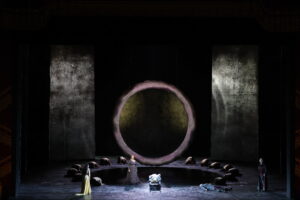
Director David McVicar has also designed the scenery: an arduous task by any measure. Though his experience in staging opera comes to fruition over the four evenings, much is left to be questioned. It must be state that the lighting was well-designed, and through pure simplicity and a deft “mélanger les teintes,” a bare wall not only changed textures but also allowed us to sense Destiny moving along imperceptibly — something pertinent to Wagner’s music and psychology of space. This dimension of a mythological “illo tempore” embraced the beauty and the remoteness of the text. Another moment of great spatial effect capable of arousing a state of emotional participation within us was the sense of tragedy just before the final scene. Brünnhilde is standing stage center beside Siegfried’s death stretcher as a great ring-circle curtain lowers itself to the stage and another ring, a shadow alone, covers center stage. A cold sensation of death grips us as touches of Adolphe Appia’s (once rejected) studies in greys and blacks — pioneering attempts at defining space for Bayreuth productions — are apparent.
Last Piece of a Jigsaw Puzzle
The complexities of “Götterdämmerung” are increased by the fact that new characters, and thus new musical leitmotifs, are introduced — not forgetting that the Dwarf, Alberich, and Brünnhilde’s Valkyrie sister, Waltraute, are reintroduced. The opera itself is a sweeping testimony to Time as it inexorably follows its own steps towards an end. In coming to know Wagner deeper, we will surprise ourselves in identifying musical snips, variations, and cross references from earlier operas of the cycle. We notice weavings that hint not only at the composer’s craftmanship but also bear witness to his consummate originality. “Weaving” it will be, for we are faced with the three Norns of the opening scene tending to the rope of destiny made from the threads of the world’s past, present, and future. The music and text of this opening scene, where we will slowly begin to enter their world of cryptic revelations, sensing the end of the gods’ reign, is charged with dramatic tension: that same stress that will forcibly break the rope, ending the Norn’s soothsaying. In this production, the red rope of Fate itself is thick, frayed, readied as if to be fastened to an ship’s anchor, and does not give any impression of fragility. The Norns, too, move about aimlessly, not convincing in their anxieties and involvement in world history. There is no unravelling of the threads that should lead to the tragedy of the rope breaking. It is clever that McVicar adorns the three Norns with prominent fairy tale braids, linking them to that twisted rope. As their 20-minute awakening encounter evolves, there is great tension and greater frustration in their asking one-another what the future will bring while little physical action takes place. It is a difficult scene to visually render interesting, and one again wonders if Wagner at times wrote music that cannot be staged.
Regarding this, and in connection with La Scala’s “Ring” that began in November 2024, one may believe that “Der Ring” must absolutely be staged within a week’s span, respecting Wagner’s express desire. The work’s origins lay in his admiration for the communal, sacred art festivals of Athens, wherein the dramatist was asked to create a trilogy — hence Wagner’s three-episode structure with a prologue. Those who often go to Bayreuth understand that it is not simply the time and space that separates the performances, but the mental concentration of the spectators that must remain undistracted. Wagner’s masterpiece is sewn together musically, and the effect of his tonal themes must remain in one’s mind as he passes from one opera to another. How can one chance upon an isolated “Siegfried” and sense what came before and what may follow? This also goes for “Die Walküre,” an installment often performed by itself. Most of all, the Tetralogy is not meant to be witnessed in a concert version, with or without costumes and amalgamated film images. It simply does not work and can never truly involve the spectator in Wagner’s depiction of a “total art form.” It is a delicate balancing act — as many flawed productions have shown, even a seven-day theatrical “Ring” may not draw us into understanding what Wagner initially projected as a social commentary upon the various phases of the Industrial Revolution.
Jejune Imagery
La Scala’s “Ring” is enjoyable, as far as Wagner’s monumental folklore tale may be enjoyable, and also moving, as great tragedy should be moving. Yet, as the spectator begins to delve deeper and participate more in the emotions seen upon the stage, one may feel that “all in” has only gone halfway. One is not being drawn into a theatrical action, nor feels compelled to suspend reality so as to participate in the uniqueness of an intense experience. This should be fundamental in Wagner, more-so perhaps than with any other composer. McVicar’s “Ring” claims to dwell in mythical times dominated by runes. There is something of this represented through the scenery, yet nearly every phantasmagorical aspect encountered is either déjà-vu or simply (and sadly) unimaginative.
The presence of animals is hardly ever impressive. Wotan’s ravens are out of a Batman comic, hoisted up to fly away in Halloween fashion. Is it necessary for Wotan to physically order them out into the world to gather information? Fricka’s rams are two men clad in ballet tights and crowned by horns who remain onstage throughout her scene, distracting us as they gossip, change position, and, substituting a chariot, prance off with the god. The snake-like dragon that is Alberich transformed (“Das Rheingold”) looks as if it were pulled from a Chinese New Year’s parade, with a handful of people beneath holding the body aloft with sticks and opening and closing its mouth unmenacingly. In “Siegfried,” the forest dragon Fafner transformed is a huge human skull on a wheeled cart maneuvered by a dozen men in an all too mechanical manner. The Forest Bird (“Siegfried”) is identified by a crest of post-Punk dimensions. The most unconvincing creature of all remains Grane, Brünnhilde’s faithful horse. He is given to Siegfried to accompany the hero through the world, only to return and remain onstage, distracting us by changing positions at times, almost always as if listening. At the end of the opera, Grane’s metallic horse head is removed, and he (all-too humanly) is immolated alongside Brünnhilde and Siegfried. Grane’s physical presence was gratuitous and unmoving, and the feigned neighing and bolting childish.
The gods and human presences formed a colorful conglomeration. The giants (“Das Rheingold”) were purely symbolic, sporting enormous hands and a head-mask dangling above their own heads. They walked about gingerly upon cone springs a foot high and used tall canes to balance them. Less than boulder-busters, they seemed to be walking on eggs. Both the Rhine-maidens and Norns were far too realistic and did not seem to be dwelling in other worlds. The Valkyries, punkish and flippant, went through their choreographed movements, very often huddling together as if for a cute cheerleader photo. Erda was draped in a long, white dress, close to being a bridal gown of another epoch. In today’s opera-theater, the Gold itself, precious yet also a symbol of uncontaminated Nature, has been turned into anything but gold. Here, it is a ballet dancer in cream-colored tights, donning a golden mask.
“Götterdämmerung,” considered by some to be the best installment of the Tetralogy, may be so for two extraordinary episodes: Siegfried’s “Funeral March”and Brünnhilde’s “Immolation,” which closes the “Ring.” And it is within these two scenes, in this production, that we must come to grips with what disappoints us. The elegiac procession celebrating Siegfried is one of the most monumental and magnificent epitaphs ever created. It recreates, in music, the defunct hero’s life experiences: his relationship with his mother, his love for Brünnhilde, his own theme as that of his sword. Much was praised in McVicar’s staging here, especially with reference to the fact that all took place on a bare stage, with no pall bearers to carry Siegfried’s body away. Sadly, however, it immediately recalled that most famous of all moments in Harry Kupfer’s 1991 Bayreuth RING (with Barenboim). Coincidence it may be, but the action here is almost identical, with the emphasis on those close to the victim showing their guilt. Siegfried’s body on a huge, bare stage is approached by two characters. Sieglinde is one of them — it has to be her, because we hear her music. However, this does not justify her presence, unless it is somehow surreal — perchance a dream? She places a long white shroud over the body and, kneeling, cries for the rest of the scene. Then Wotan — or his spirit — arrives, and faints in exhaustion. Yes, this staging visualized what is in the music, and those who commemorate the hero Siegfried onstage are mere ‘physical’ leitmotifs. Unfortunately, an experienced Wagnerian will find their mind wandering back to that Bayreuth of 1991, and perhaps find themselves unmoved by much of this production’s treatment.
Contrary to this minimalistic approach to Siegfried’s farewell, we have a finale scene that is an over-loaded catharsis of superfluous detail. Brünnhilde’s self-sacrificial immolation turns into a kermess upon a increasingly bare stage. Before a customary backdrop bearing a ring image, the Valkyrie removes Siegfried’s gold ring from his hand, throwing it to the Rhine-maidens. Then with a spear, touches the backdrop, which flames up. She calls Grane, asking her steed if he knows where she will take him. They hug, unite, and kneel by Siegfried’s body upon the bier. A curtain closes in on them as they will be purified by the flames. Hagen should now dive into the waters, searching to repossess the ring. Valhalla may be seen burning in the distance. Yet here, McVicar chooses to show us too much, mostly unneeded and slightly confusing. All fades away to darkness, and Hagen appears in search of the ring. Then, the returned gold (ballet dancer) surfaces from the depths. He (the Gold) whirls about, and pushes Hagen down to the “floor,” symbolically drowning him. Wotan appears on the steps to Valhalla, and rolls down, dead. The Rhine-maidens flitter about in the currents. Alberich surprises us by appearing to approach the ever-pirouetting Gold. The Gold caresses the Dwarf, soothing him, assured that his soul is now pure, and in harmony with Nature. The music ends, and for 20 seconds the Gold whirls about freely in its natural state. Beams of light in the manner of Arthur Rackham (historic illustrator of “Der Ring”) shine through a backdrop that now bears an open palm pushing towards us as a symbol of Man’s greed. This is all invented, a bit superfluous, and unjustified — story-telling for its own sake, taking liberties at the wrong time.
“Gesamtkunstwerk” Singer-Actors
The entire cast of singers was similar to those of the earlier performances given over these last one and a half years. All were truly excellent and graced the staged production with their dexterity and elegance. Though at times they were not helped by their costumes, nor the demands of the stage director, they uniquely embodied their character’s inner and outer dramatic motivations, bringing Wagner’s theatrical essences to fruit — something truly rare. We must also state that they made the physical enactment of these mythic personages — something strenuously demanding — look easy.
The Norns (Olga Bezsmertna, Christa Mayer, Szilvia Vörös) and the Rhine-maidens (Woglinde/Lea-ann Dunbar, Wellgunde/Svetlina Stoyanova, Flosshilde/Virginie Verrez) synchronised beautifully, giving space to their somewhat human individuality and sensibilities. The Norns had little to do and were hampered by excessive repetitions of dealing with the cord of destiny in their hands. The Rhine-maidens fared better in the staging. They were set free by the fluidity and gracefulness of their underwater motions, while also emphasizing their character differences, both through naïvety and sense of fun.
The Gibichungs here were the family Wagner might have had in mind: King Gunther (Russell Braun), Gutrune (Olga Bezsmertna) and Hagen, the Dwarf Alberich’s son (Günther Groissböck). Groissböck’s bass was consistently probing and perturbing, an excellent use of vocal prowess to portray this frustrated, threatening, yet insecure man. This was aided by his physical evil-character presence. Gutrune captured the delicate weakness of a woman betrayed and deceived. The scene before Siegfried’s corpse, where she realizes that Siegfried’s love for her was under the influence of the potion and that Brünnhilde was his true bride, was most moving — a dramatic standstill of a moment such as Wagner often creates. King Gunther, a complex character, ably manifested his confusion in going along with Hagen’s plot to kill Siegfried, and deceive both his sister and Brünnhilde. His vocal portrayal was well-characterized thanks to deep psychological entrenchment.
The Dwarf Alberich (Johannes Martin Kränzle) returned as the “common man” who, mocked and refused in love, seeks vengeance upon the entire world. His “dream” encounter with Hagen was resonant and explored the guilt he feels, as his theft of the ring in “Das Rheingold” has brought so many difficulties into the world. The Valkyrie Waltraute (Nina Stemme) was as genuine as a sister could be when pleading with Brünnhilde to remove the curse of the ring by letting go. The pacing of her discourse was perfectly pitched in intensity, heart-felt, and a sensitive reckoning.
We were offered many of the best Wagnerian singers performing today. Siegfried (Klaus Florian Vogt) and Brünnhilde (Camilla Nylund) did indeed render this “Götterdämmerung” memorable. They were harmoniously matched in voice and stage presence. This may sound trite, but it is not always to be expected, given the sheer super-human force of energy required for these roles. Vogt’s tenor has convinced us in many roles, and not only those Wagnerian. There were no signs of reaching out for notes: all seemed effortless, yet dramatic. His stage appearance easily lends itself to Romantic heroic roles. His death scene contained all the emotions of a man, happy to have loved, facing his death. Nylund, throughout the entire “Ring,” proved to be every part the demigoddess Brünnhilde: an immortal shieldmaiden leading her sister warriors through their heroic duties. Her voice suits Brünnhilde in many ways — register, energy, volume. Her acting reflects deep inner sentiments, and consequently she is entrenched in Wagner’s most moving portrayal of the woman who will allow love to rule the world again.
Maestro Alexander Soddy, as mentioned in reference to the preceding operas of the cycle, brought off what is dramatically gripping in the music. This entails pacing and a sense of Wagner’s theatrical instincts. The brass snared and lamented when needed, the strings led us through true glissando and moving pianissimo. All told, it was consistent and brought us Soddy’s version of the “Ring’s” meanings and messages. The La Scala chorus, led by Alberto Malazzi were true to standard as one of the best in the world. Yet, their brief presence in this final opera of “Der Ring,” lacked that ping and zest that one is so accustomed to.
As stated, the scenery was interesting. The costumes (Emma Kingsbury) were too motley, ranging from the Shakespearean to the post-Punk (the stage director’s will, one imagines). The lighting (David Finn) was well done. The video effects (Katy Tucker) were less impressive, though the flames and nuclear explosion as the world seemed to end was impressive. The mimes, actors and dancers indeed put their best foot forward in executing their
at times difficult personified routines. The horses, ravens, and rams were sources of disturbance, wrapped
into the implausible, yet through no fault of their own.
So concludes Wagner’s testament to existence and to our modern world. His achievement has been known to stir emotions in children as it does within adults. Myth belongs not only to gods and men, but also upon the stage, where Wagner’s artistic aspirations are reunited. He has once again shown us Man’s weaknesses, offering us every possibility to improve our world. Let us not, as Hagen does, foolishly drown ourselves in egoistic ventures in search of power.