Glyndebourne Festival Opera 2026 Review: Billy Budd
Striking role debuts from Mole and Clayton in revival of Michael Grandage’s production
By Benjamin Poore(© Glyndebourne Productions Ltd. Photo: Tristram Kenton)
Lash your picnic baskets to the deck: Benjamin Britten’s “Billy Budd” — the tangled morality tale of innocence and cruelty aboard a Napoleonic-era Man-of-War with words by E.M. Forster and Eric Crozier — has set sail once again at the Glyndebourne Festival. Michael Grandage’s production from 2010 was the company’s first staging of Britten’s largest-scale opera, whose grand opera dimensions make it a partner to “Peter Grimes,” albeit with an all-male cast. This year saw its second revival for the Festival, which has a distinguished history with Britten’s work, having commissioned “Albert Herring” and “The Rape of Lucretia,” which both came in the years immediately preceding “Billy Budd.” Nicholas Carter conducted the London Philharmonic Orchestra, back for their regular patch in Sussex, alongside a cast that saw Allan Clayton make his latest Britten role debut as Captain Vere and Thomas Mole in the title role.
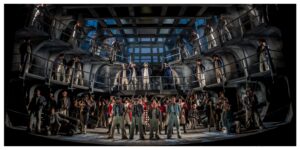
Billy Budd may be a foretopman, but we seldom experienced the light and air of life up in the mizzen: Christopher Oram’s set was a glowering, claustrophobic cross-section of the HMS Indomitable’s lower decks. Its curvature not only forced officers and sailors into unimaginably close quarters, but reflected the shape of the wood-panelled auditorium, pressing the audience into service too. The shape also implied the fish-eyed gaze of the telescope, as if we were surveilling the crew from our seats, watching for signs of dissent and disturbance. It could have been a prison as much as a ship, and its overhanging balconies also reminded one of Jeremy Bentham’s Panopticon, the model eighteenth-century prison where inmates can be unknowingly watched at all times.
The atmosphere was heightened by Paule Constable’s lighting — a murky world occasionally punctuated by shafts of light, as if suggesting the distant manifestation of something angelic. Otherwise it was a purgatorial world of shadows and eerie slow fades, with the many nooks and corners of the wooden decks shrouded in forbidding darkness — the perfect place to watch unseen or hatch whispered plots.
The production was a superb example of what a naturalist slant can achieve, with period costumes that reflected the teeming detail of Melville’s original story and the meticulous research that Forster and Crozier put into their libretto. Its world was built convincingly and unselfconsciously so that we were wholly immersed in the setting, leaving room for the rich psychological detailing and moral and ethical tangles of the work to play themselves out. The worldbuilding encompassed tight movement — the only conceivable way to move below decks — and concentrated, brusque choreography, not least in the sea shanty sequence and fight scene towards the end of the first half. The darting energies and fisticuffs were handsomely done, as Claggart might put it. Beatings, dolled out by the bullying lower brass, whip cracks, and the snarling fanfares of Britten’s score, were dished out summarily and unsentimentally as red-coated marines used the points of their bayonets and barrels of their muskets to keep the crew huddled and compliant.
The realist illusion only broke around the dreamlike prologue and epilogue, when Vere framed the whole opera as an especially vivid recollection. In the penultimate scene, at Billy’s hanging, he appeared softly illuminated, stripped of wig and uniform in a ragged shirt, as if, perhaps, he was the inmate of Bedlam. His vulnerability in these moments was an understated masterstroke from the production. If less homoerotic than the last outing of the piece in 2013 and rendering this theme with less power — Forster felt strongly that Claggart’s motivation is “a sexual discharge gone evil” — then its central dilemma, revolving around the question “what if what is legal is not the same as what is right?” resonated with the simplicity and force of Greek drama: an “Antigone” at sea.
Thomas Mole played the title role with beguiling sincerity. A burnished, rounded voice, he radiated quiet strength and human warmth, less boyish than some other characterisations of the role, but one whose goodness seemed an extension of the fine aura created by the sound. His drowsing in the hammock was an especially fine moment of soft-focus dreaminess, showcasing a delicately-fringed baritonal head voice. In “Billy in the Darbies” we were treated to artful simplicity, with singing of richness and immediacy suffused with wounded dignity. Mole’s grasp of the role’s nuances will surely grow in stature as he explores different productions — but this was an utterly convincing debut.
Allan Clayton continues his revelatory march through Britten’s music. This was his first Vere; he will give his first Aschenbach in “Death in Venice” next summer at the Bayerische Staatsoper. Vere was a more philosophical, understated character than some of the more extreme, on-the-verge-of-collapse figures with whom the singer has made his name (Grimes, Hamlet, Christian in “Festen”), with Clayton vocally and dramatically leaning into the starry-eyed fragility and tenderness of the character. There were flashes of despair and anger that burned through, though — “Oh, what have I done?’” in the Prologue, given in anguished, full-throttle chest voice, and the searing scene after Budd killed Claggart in the second half. Elsewhere, there was a fluting, haunted sound, such as his terrified, breathless reverie on the mutiny at the Nore in Act one.
Sam Carl’s Claggart was in inky-black voice throughout, relentlessly dark, with clipped, parade-ground diction. It was a stark and powerful bass-baritone, especially ferocious in the top, though some of the very lowest notes lacked the definition and raw power we have heard from lower-voiced exponents of the role — Brindley Sherratt’s cavernous performance for Deborah Warner springs to mind. It was pitilessly black and forbidding, with some outbursts of lyrical lushness, not least in his Credo — a terrifying and enigmatic account of the role that sat well with the tenebrous character of the production.
There were plenty of standouts in the work’s large ensemble cast. Clive Bayley put in a stalwart turn as Dansker, bluffness giving way to something more limpid and vulnerable in his extraordinary prison cell scene with Budd. Dingle Yandell as Mr. Redburn and William Thomas as Mr. Flint sang with stentorian resolve, the voices lean, bronzed and shipshape. Daniel Norman’s Squeak was taut and pitiful while Lawrence Kilsby’s Novice extracted maximum pathos after his flogging.
As one of the great chorus operas of the repertoire, the Glyndebourne choristers brimmed with their usual youthful power; offstage passages were especially atmospheric and haunting, with quality of tone unsurpassed. The penultimate scene, after Billy’s execution, showed off a dazzling range of choral effects, with rough grunts and moans giving way to a raw wail of anger. The complex choral tableaux that opens Act two came to a monumental climax, built on their exacting sense of ensemble and unanimity of utterance. Children’s voices — as Powder Monkeys and Midshipmen, with a solo spot for Gabriel Elliott Rous as Vere’s Cabin Boy — were taut and tough, pleasingly un-angelic, made hard by life onboard ship. They come respectively from the Glyndebourne Youth Chorus and Trinity Boys Choir.
The score, much of which is recitative-like and conversational, unfolded at pace under Nicholas Carter’s baton, with dialogue almost becoming crosstalk at points. It was brilliantly effective in communicating the urgent plotting and chaotic machinations of Claggart and his cronies. There was the impression of a powder-keg set to blow, the text burning away like a fuse. The London Philharmonic Orchestra’s playing was thunderous in the great Act two opening, with woodwind solos of flute and saxophone especially fine elsewhere in the opera. A new Glyndebourne classic, it is surely set to run and run.