Sofia Opera 2026 Review: Der Ring des Nibelungen
Director Plamen Kartaloff’s Production Cultivates Local Community in Sofia, Bulgaria
By Jennifer E. Pyron(Photo: Sofia Opera press)
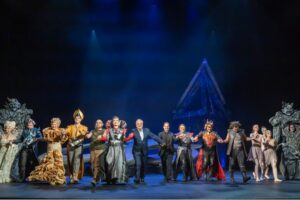
Sofia Opera’s annual Wagner Festival 2026 illuminates Professor and Director Plamen Kartaloff’s legacy as the pioneering initiator celebrating Wagner’s music to a high standard with creative teams and cast members of local Bulgarian artists that continues to inspire audiences today. The full production of this year’s “Der Ring des Nibelungen” featured Conductor Constantin Trinks, Set Designer Hans Kudlich, Costumes Designer Hristiana Mihaleva-Zorbalieva, Lighting Designer Andrej Hajdinjak, Multimedia Artist Elena Shopova, Constructive Development by Georgi Georgiev, Assistant Director Julia Krasteva, Head of Production Christian Stoyanov, Choreographer Riolina Topalova, design and sculptural work by Boryan Belchev, Stage Managers Gabriela Marinova and Elena Snidero, Co-repetiteur Yolanta Smolyanova, translations by Velizar Genchev, and subtitle projections by Antoineta Alexsova. This production first debuted in 2023 and has made a lasting impression.
While the 150th anniversary of Bayreuth Festival in Germany will utilize artificial intelligence and live coding for its “Ring Cycle” to highlight the evolution of Wagner’s masterpiece, Sofia Opera remains focused on cultivating a production of local creatives and singers that dedicate their lives to interpreting the soul of Wagner’s music, one voice at a time.
(Photo: Sofia Opera press)
“Das Rheingold”
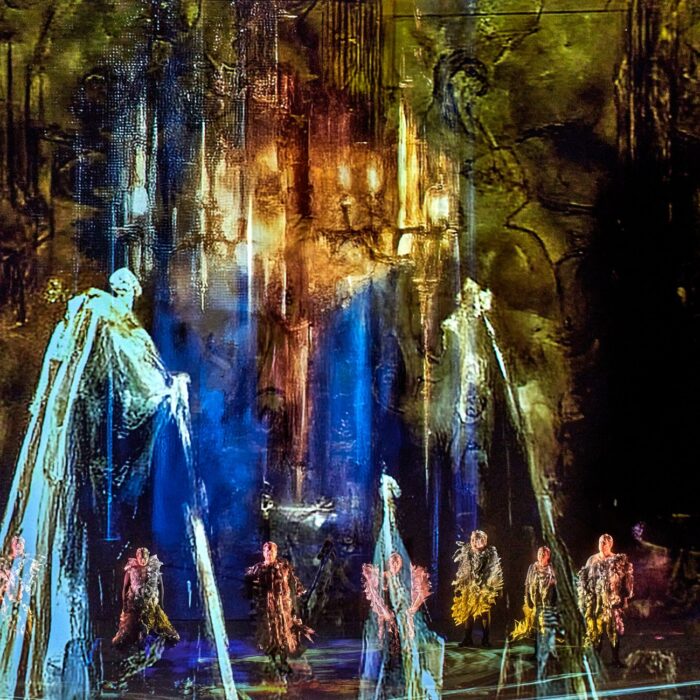
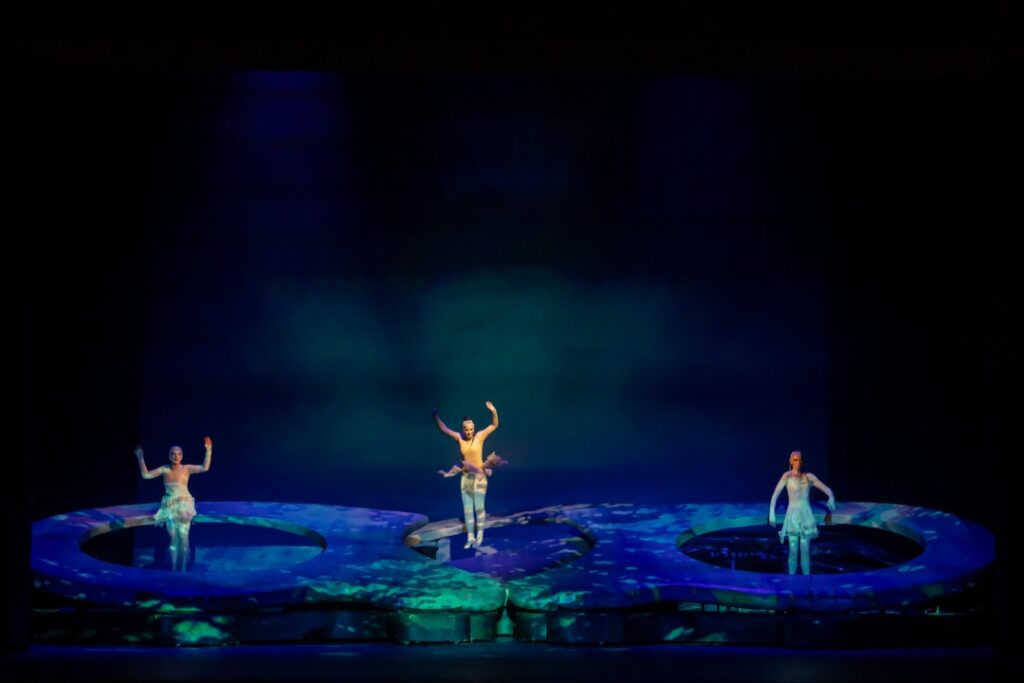
The three Rheinmaidens, Stanislava Momekova as Woglinde, Ina Petrova as Wellgunde, and Alexandrina Stoyanova-Andreeva as Flosshilde, were discovered in the depths of the Rhein as the opera began. The river nymphs bathed in the rippled light as it reflected on their bodies in a magical wash of projections by Shopova. There were three circular structures by Kudlich that housed a layer of mesh in their centers — here the maidens lay, writhing in the simplicity of this minimal, abstract setting. Their costumes by Mihaleva-Zorbalieva captured the silvery effect of the projections, their limbs becoming undulations in the body of water that held them. This moment felt peaceful, undisturbed, and allowed Wagner’s music, conducted by Trinks, to be the main focus as it rose from the orchestra pit, seeping into every corner of the theater’s main hall.
This opening sets the tone for everything that is yet to come, effectively instilling in the observer an idea of what life was like before the ring was forged. It allows Wagner’s score to speak for itself and for humanity to take its course. The importance of this level of plainness cannot be stressed enough, as it is what creates the clarity that drives the four operas of this cycle forward – the tenderness of careful thought and intelligence in a production that lets Wagner’s massive musical undertaking take shape and form.
(Photo: Sofia Opera press)
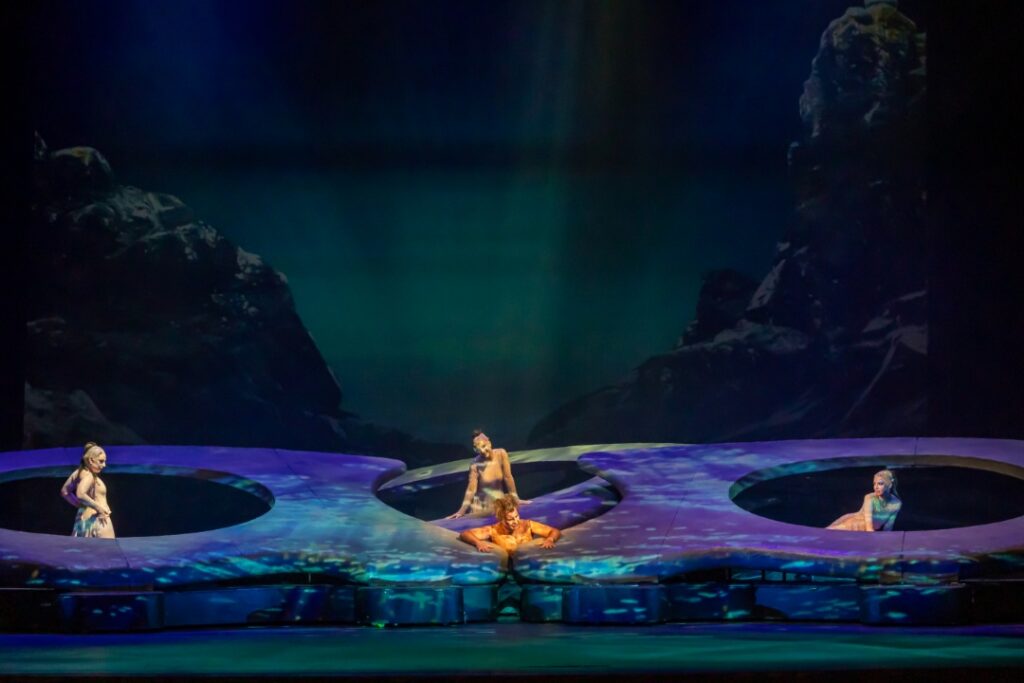
Plamen Dimitrov as Alberich entered the stage in awe and wonder of the Rheinmaidens’ lair. They were surprised to see him but ready to welcome him with their cunningness. They guard the gold at the bottom of the Rhein with their lives and warn that whomsoever takes the gold and forges a ring will gain power over the world – but do to this one must first renounce love.
Dimitrov’s interpretation of Alberich came across as natural and very personal. His physical expressions and voice were aligned with exactly what one might imagine Alberich to look and sound like. He is central to this cycle, especially when he decides to steal the gold and make the ring. The emotions that Dimitrov embodied through his acting and singing consistently brought the listener back to Wagner’s music, which was exactly the point. The physicality of his role was the other half that made this production feel engaging, exciting, and ultimately revolutionary. Every scene embodied Wagner’s music, realizing the libretto in its purest form.
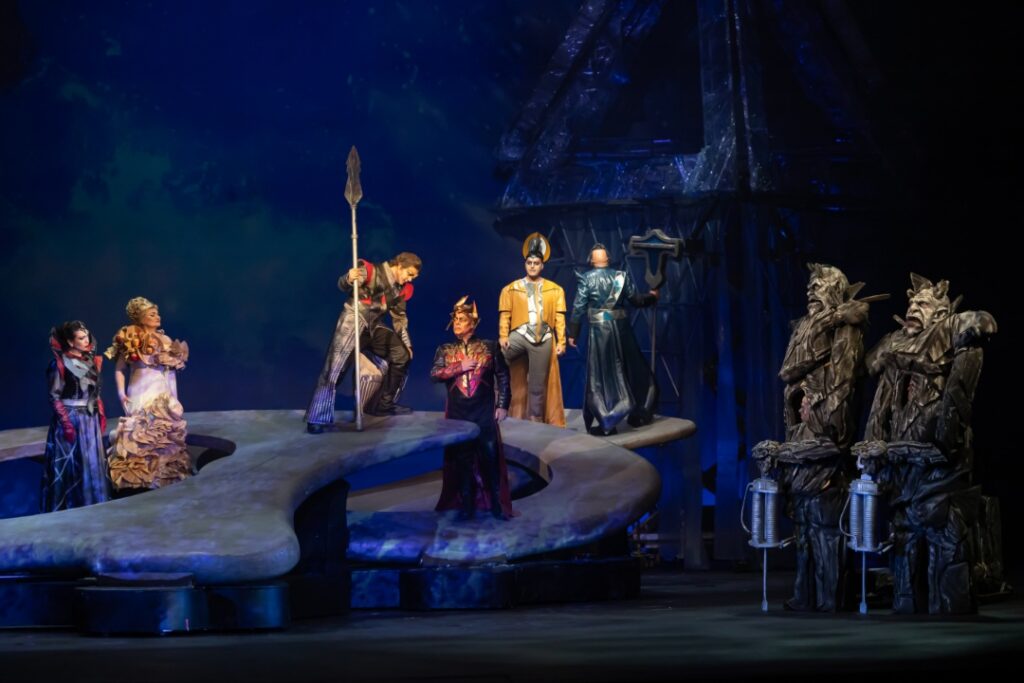
In the following scene, Vesselin Mihaylov as Wotan and Vesela Yaneva as Fricka argued atop the circular set designs, symbolically highlighting human cycles and how history repeats itself. Their argument was about their daughter, Freia, the goddess of youth, and how Wotan had promised her to two giants, Fasolt and Fafner, as a reward for their construction of Valhalla, fortress of the gods.
The fantastical costumes really came to life in this scene. They made the idea of selling one’s own daughter to giants in order to have a idolatrous monument constructed fall flat, its obvious patriarchal, narcissistic grandeur laid bare. The grand delusion of “The Ring” was exposed from this moment onward and the production became that much more engaging.
(Photo: Sofia Opera press)
Silvana Pravcheva as Freia, Petar Buchkov as Fafner, and Stefan Vladimirov as Fasolt were excellent in their roles. The giants’ costumes were a bit of comic relief, the singers’ faces popping out from just below their exaggerated “giant faces.” Wotan’s silver costume with blue and red details, including his cape and staff, were reminiscent of a god-like traveler from another world – a new age colonizer. Subtle details in the costume design like this made the production timeless, its location ambiguous, and allowed Wagner’s music to be the key focus.
Daniel Ostretsov as Loge, the god of fire, was solid in his portrayal. Loge suggests Wotan steal the ring for the giants, and thus the journey to acquire more power is set in motion.
Krasimir Dinev as Mime, Alberich’s brother, was a masterclass. As also seen in previous performances, Dinev’s acting and vocal stamina were superb in their complexity and subtleties, conveying Mime’s truest form. Mime tells Wotan and Loge how Alberich has enslaved the Nibelungs.
(Photo: Sofia Opera press)
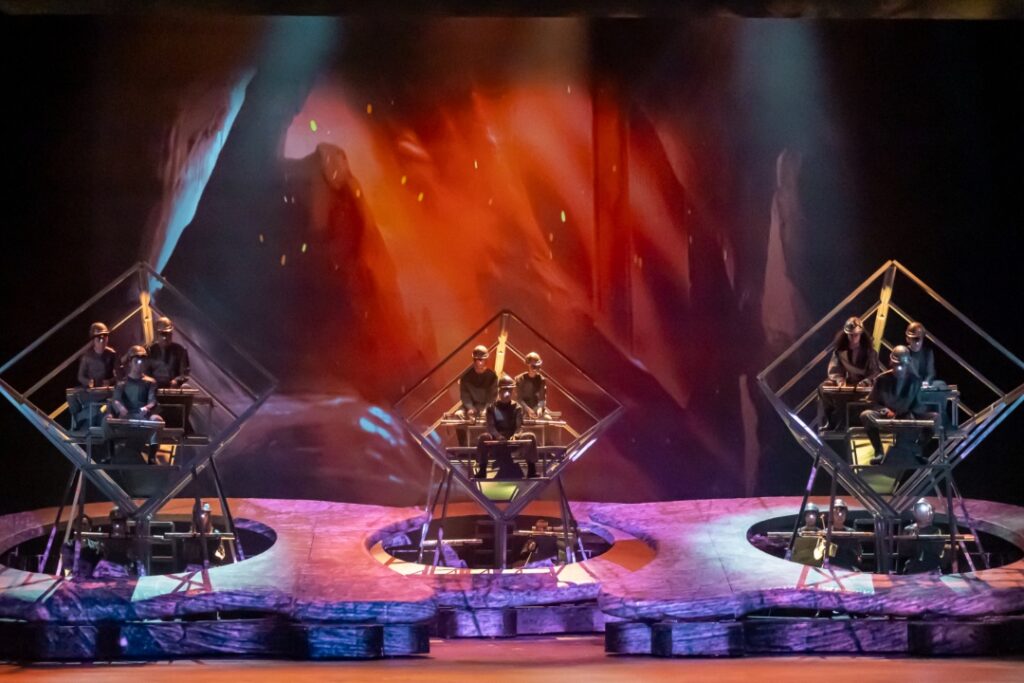
The set design featured multilayered metal pipes and platforms where young people were seen doing hard labor in a makeshift factory. In its intensity the percussion of the metal clashing mirrored the orchestra’s wave of sound. The uneasy sensation of being underground in place of enslavement was palpable. The lighting was a sharp red and the projections were minimal. The placement of everything and everyone onstage had a purpose and the intention of this chaotic moment never overwhelmed.
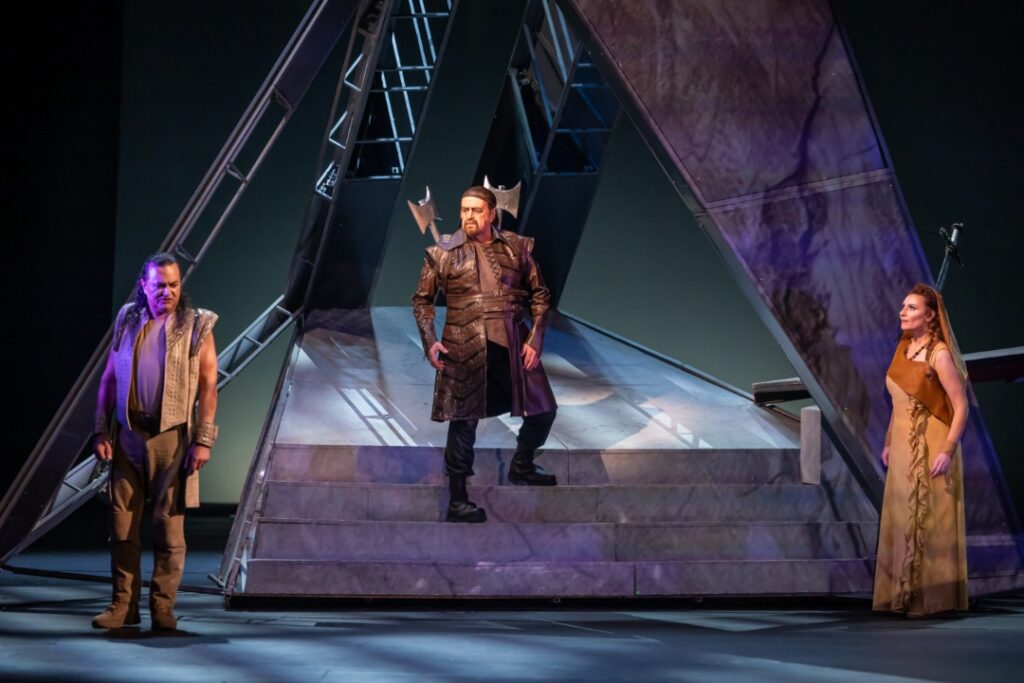
Once Alberich is tricked and captured by Wotan and Loge, the ring is stolen by Wotan and destiny is set by the tragic spiralling of a power-hungry patriarch. Alberich’s curse upon the ring endures. When the gods deliver the ring to the giants, Fafner murders his own brother and the three Rheinmaidens can be heard singing their lamentations as Wotan looks to Valhalla.
(Photo: Sofia Opera press)
“Die Walküre”
In Act one Martin Iliev as Siegmund entered the stage pursued by his enemies as a storm raged on. He arrived depleted in an unfamiliar home where Alma-Lisa Bandalovska as Sieglinde approached him. Iliev and Bandalovska’s natural chemistry made this staging legendary. Last year’s “Tannhäuser” highlighted both of their outstanding acting skills and vocal technique. “Die Walküre” lays bare a landscape of Wagner’s music designed to evoke a wide array of emotional colors and intensities. The moment Kurt Rydl as Hunding instilled fear in Sieglinde and Siegmund for joining forces against him made their bond that much more unbreakable.
Iliev’s unique gift for portraying his roles as a living human being is unmatched. Every movement, facial expression, and note transformed into the body of Siegmund. Director Kartaloff is known to work directly with singers during rehearsals and this is a clear example why he does. Iliev’s voice resonated with immense vulnerability and honesty. His performance inspired Bandalovska as she allowed her character to fall in love with him (knowingly her own twin brother).
When Hunding challenges Siegmund to explain why he is not carrying a sword to defend himself, Sieglinde gestures to a hidden sword that she has discovered. Together they drug Hunding, Siegmund retrieves the secret sword (his father once promised that he would find it at the hour of his greatest need) and together they escape into the night.
(Photo: Sofia Opera press)
In Act two Aris Argiris as Wotan instructed Gergana Rusekova as Brünnhilde to ensure Siegmund wins his fight with Hunding. Rusekova’s voice resonated with warmth and a pure tone. Her vocal clarity and German diction were solid throughout her performance.
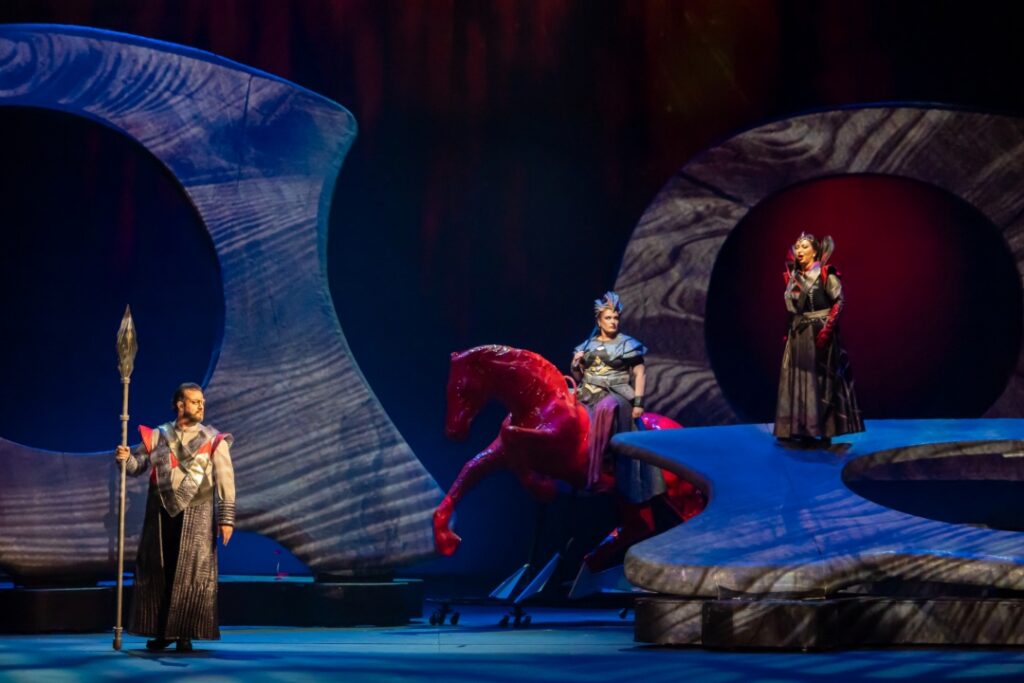
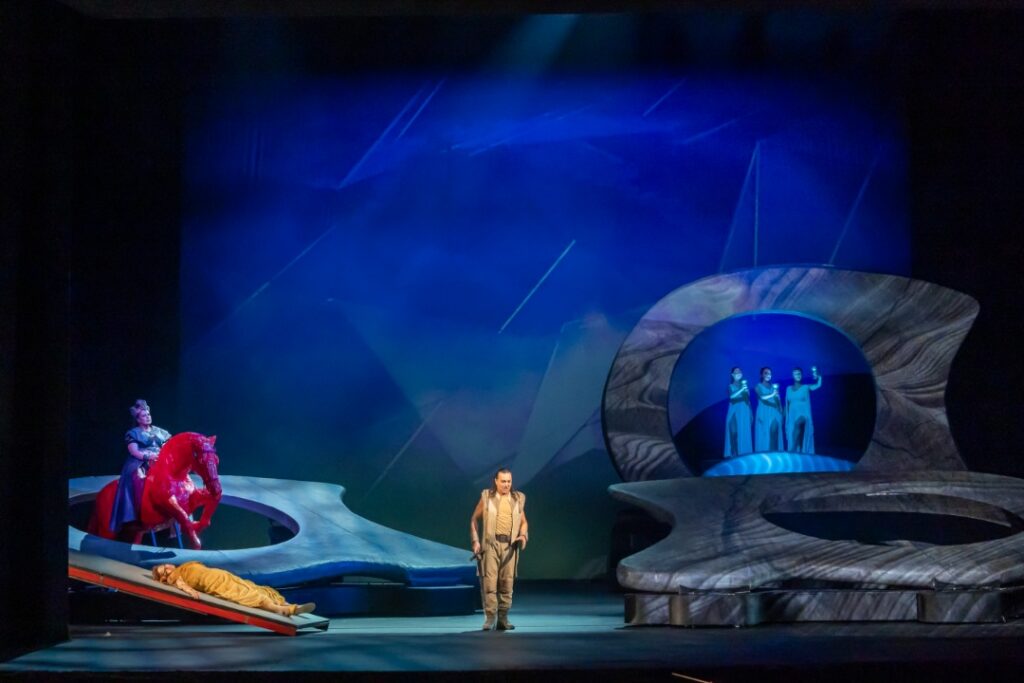
The set design consisted of the same circular platforms as seen in “Das Rheingold.” The platforms rose in elevation as both Siegmund and Sieglinde traversed in anguish, now fugitives on the run from both Hunding and their growing list of enemies. Sieglinde faints in exhaustion and Siegmund is confronted by Brünnhilde on a bright red horse.
(Photo: Sofia Opera press)
Both Iliev and Rusekova’s performances were spectacular. Their voices expressed desperation, solidarity, and astonishment. “Siegmund sieh auf mich” was especially moving as Rusekova’s vocal palette knew no bounds.
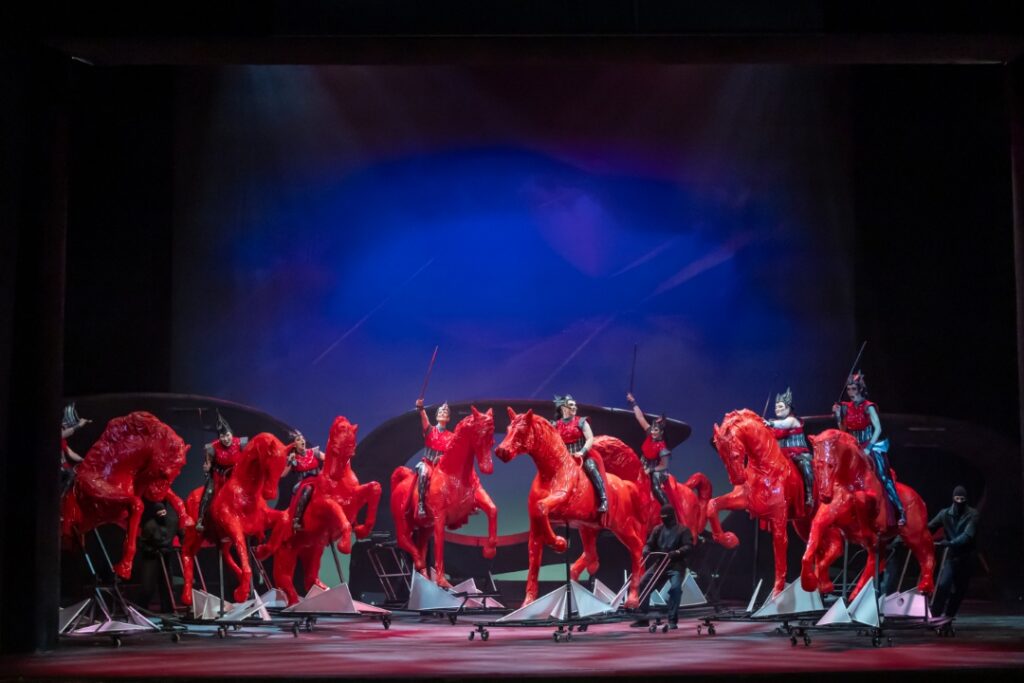
Act three was the most visually striking moment of the opera as life-sized fluorescent red horses with the Valkyries riding atop arrived onstage. They were accompanied by choreographed handlers dressed in black who painstakingly positioned the horses, maintained their rocking motion, moved them across the stage, and jutted forward whichever Valkyrie was singing in that exact moment. It was an amazing and thrilling action-packed moment to witness live and the audience was on the edge of their seats, taking it all in.
(Photo: Sofia Opera press)
Vesela Yaneva as Schwertleite, Stanislava Momekova as Helmwige, Silvia Teneva as Ortlinde, Lyubov Metodieva as Gerhilde, Ina Petrova as Waltraute, Micaela di Catalano as Siegrune, Tsveta Sarambelieva as Rossweisse, Alexsandrina Stoyanova-Andreeva as Grimgerde, and the Ballet Soloists/Horsehandlers displayed their mastery bringing this scene to life. “The Ride of the Valkyries” was a historical moment indeed.
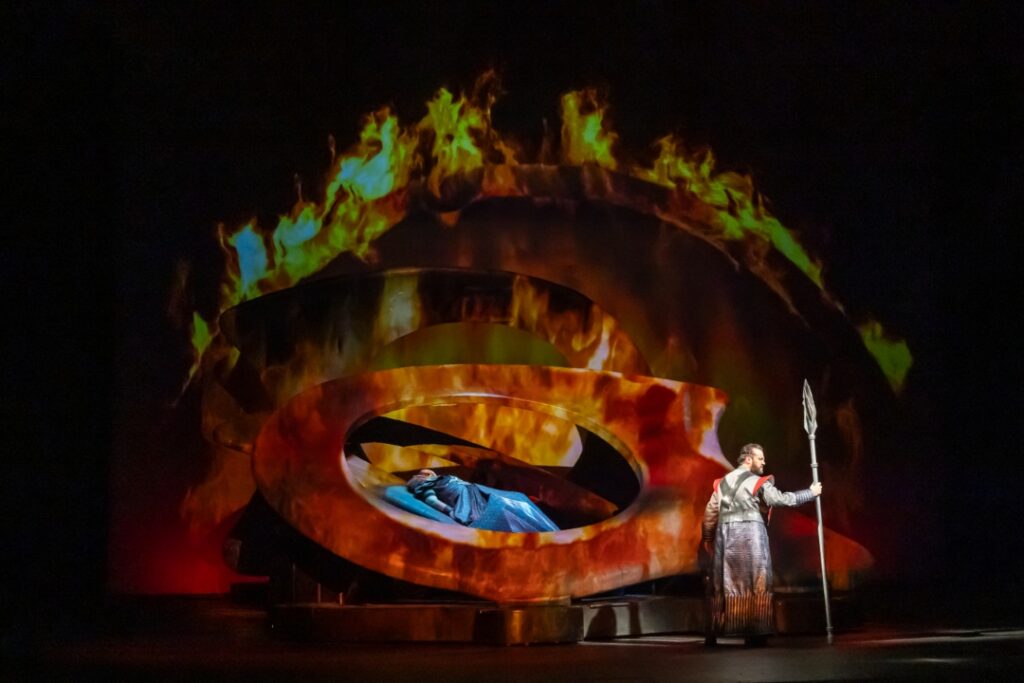
Wotan arrives and the Valkyries attempt to hide Brünnhilde as she failed her father and allowed Siegfried, the future son of Sieglinde and Siegmund, to be born. Argiris sang “Leb wohl du kühnes herrliches Kind” with immense feeling as he banished his daughter to the god of fire and encircled her with flames.
The opera concluded with flames projected over Brünnhilde’s body and the curtain slowly lowering to reveal a circular flame burning infinitely. The symbolism of cyclical human behavior and the abuse of power was laid bare as the audience fell silent for a moment before applauding the performers.
(Photo: Sofia Opera press)
“Siegfried”
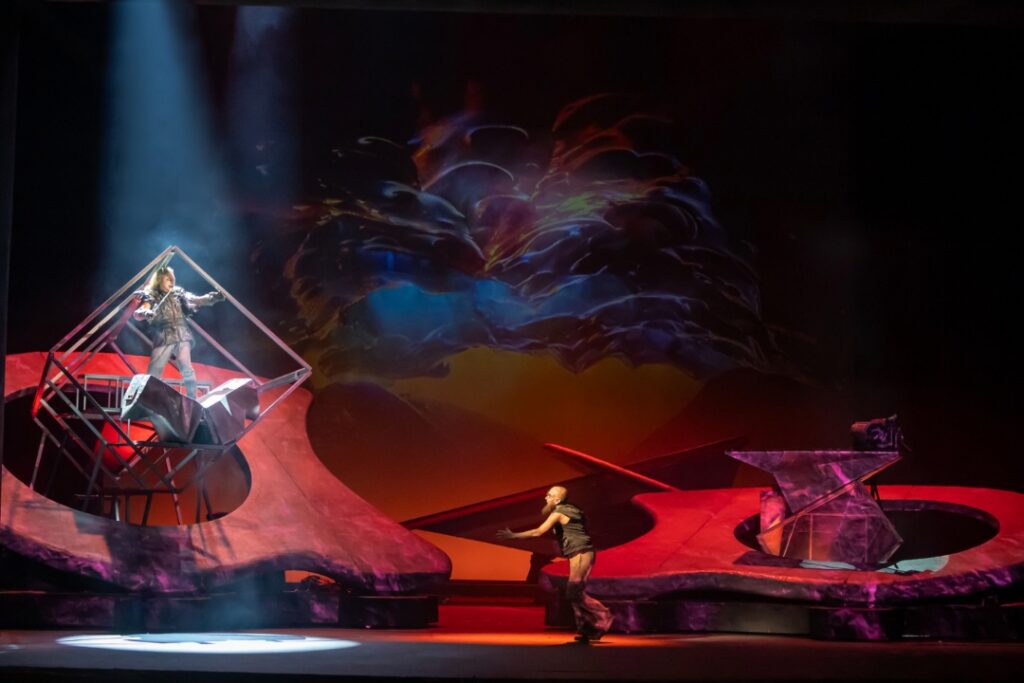
Martin Iliev as Siegfried was triumphant in his performance. His aria “Nothung nothung neidliches Schwert” was the highlight of the opera. Iliev’s voice resonated over the wielding of Nothung, his beloved sword. The orchestra’s sound was captivating as Trinks drove the tempi. The set design included the now-familiar circular platforms where Iliev stood at the top and Dinev as Mime watched from below. Dinev’s interpretation of a weary father raising Siegfried after his mother, Sieglinde, died during childbirth was comical and physically demanding. Dinev’s acting came across as natural and in real time with Wagner’s libretto and music. He is one of the greatest interpreters of this role and the audience gave him generous applause to show their admiration.
(Photo: Sofia Opera press)
Krisztián Cser as Wanderer appeared to Mime and informed him that Siegfried would fulfill the prophecy of forging the sword and kill Fafner, as he is without fear. Cser’s voice boomed from the back of the stage and he maneuvered a bouncy globe ball while Mime balanced between listening and being skeptical of his appearance. The choreography between the two was engaging and physically timed with the music, similar to a dance. Dinev’s multitasking was spectacular and his cadences really made this scene work faultlessly.
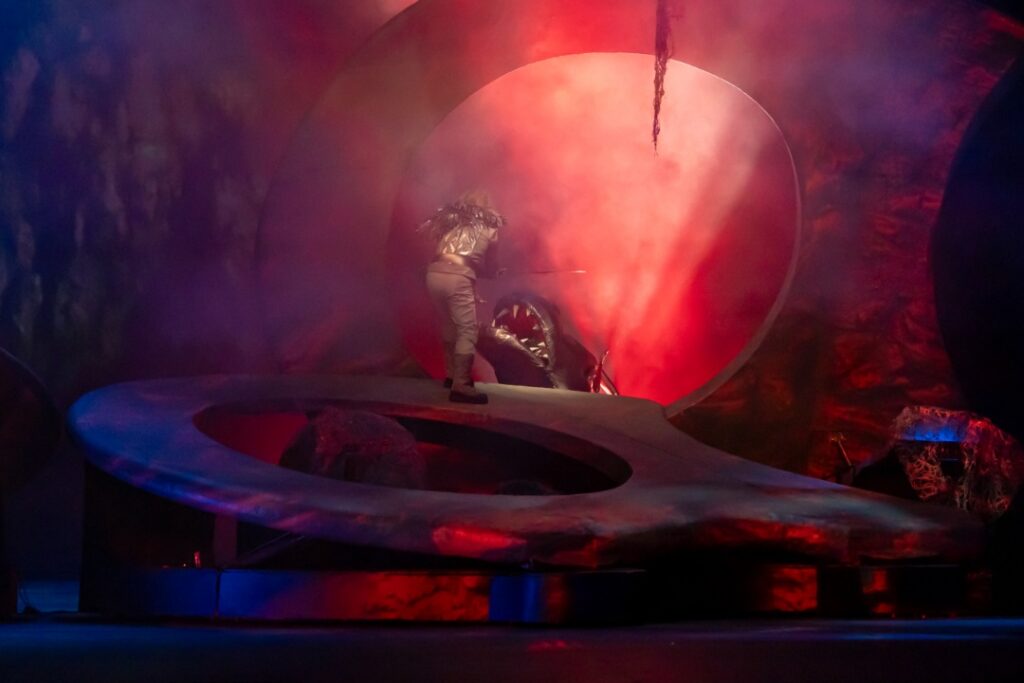
Petar Buchkov as Fafner (who has turned himself into a dragon) guards the ring and Siegfried, with his new sword, is curious about why Mime is hellbent on stealing it. Iliev portrays Siegfried as curious and unafraid as he approaches the dragon and slays him with Nothung. In this moment he brings his thumb to his lips and tastes the blood of Fafner, forever changing his own conscience.
(Photo: Sofia Opera press)
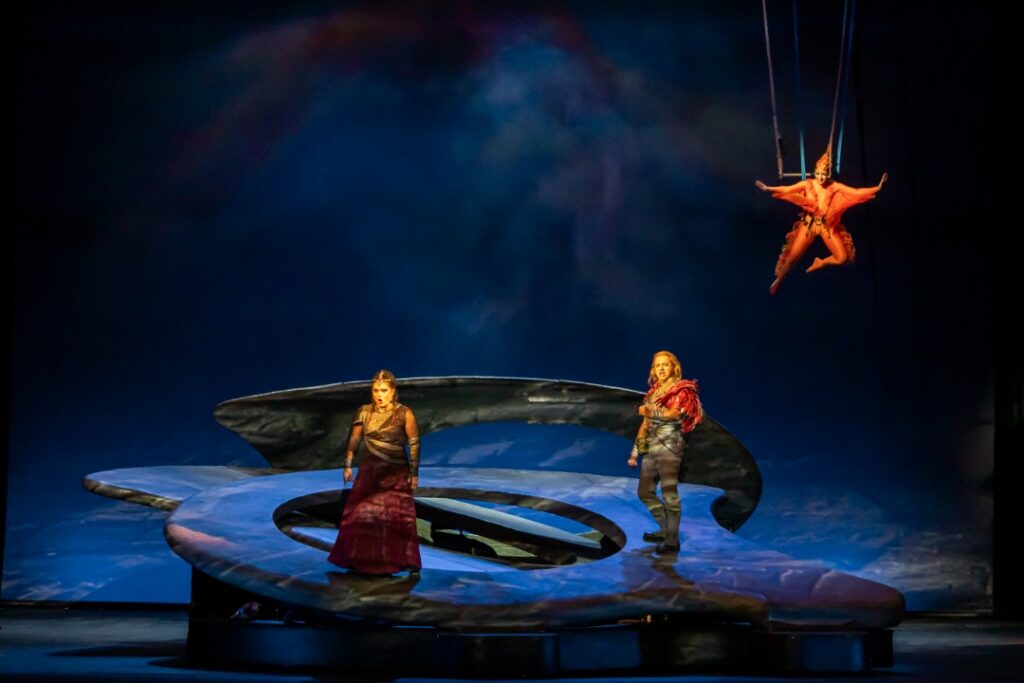
Maria Pavlova as The Woodbird appeared and gave a remarkable performance as she entered the stage suspended in the air, dressed as a radiant bird. Her vocal projection during her aria was unaffected by her jumping off the swing she sat on, her body bouncing up and down, secured by a bungee cord. She directs her attention towards Siegfried as she warns him about Mime and advises Siegfried to kill him because of his ill intentions. Iliev and Pavlova acted as companions and their strategy saves Siegfried’s life, for Mime is planning on poisoning him.
Siegfried murders Mime and tells him about Brünnhilde and his ultimate quest to find her within the flames. Vesela Yaneva as Erda heralds the twilight of the gods. Siegfried discovers Brünnhilde and awakens her with a kiss. Radostina Nikolaeva as Brünnhilde raised her body above the projected flames and stood up from within one of the circular structures. The symbolism was reminiscent of one waking up from their own unconsciousness.
(Photo: Sofia Opera press)
The “Love Duet” (“Heil dir, Sonne! Heil dir, Licht!”) was beautiful and inspiring. Nikolaeva and Iliev’s voices spun into the hall with a passionate wonder. The flames encircled them as they continued to sing and embrace one another.
“Götterdämmerung”
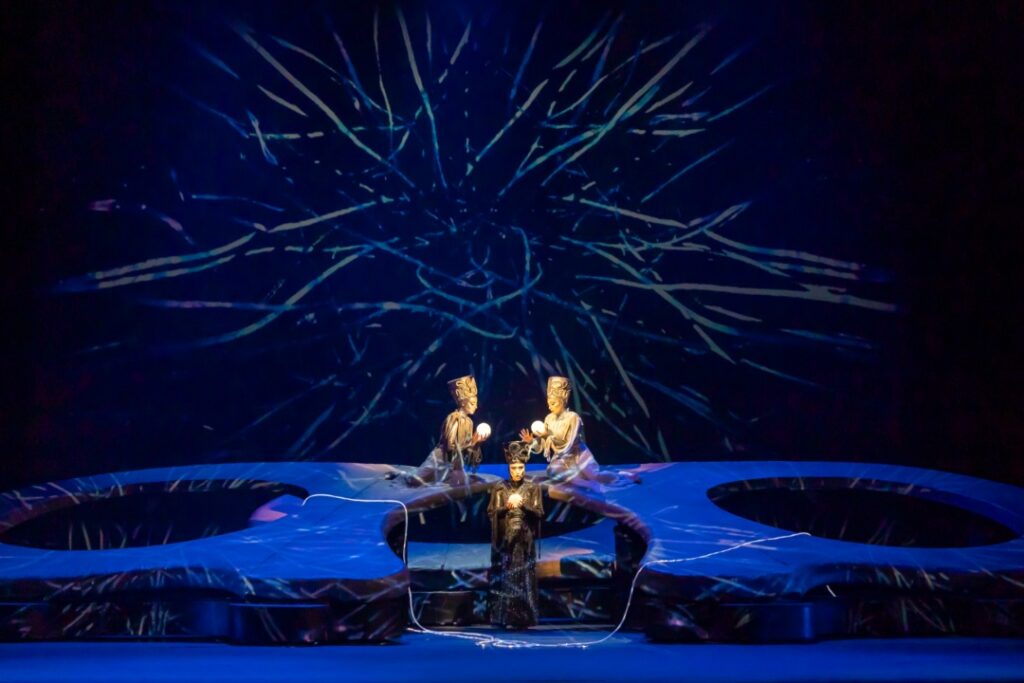
Tsveta Sarambelieva as First Norn, Ina Petrova as Second Norn, and Silvia Teneva as Third Norn, opened the opera, appearing onstage with the projection of the Ash Tree and the rope of destiny. The set design is ephemeral and otherworldly, creating a sense of suspended time. The simplicity in its presentation allows the three Norns’ voices to be center stage alongside the libretto. Trinks led the orchestra with precision and the sound was glorious. The Wagnerian horns and wind instruments cast a spell over the audience, making this opera feel especially climactic from its start.
(Photo: Sofia Opera press)
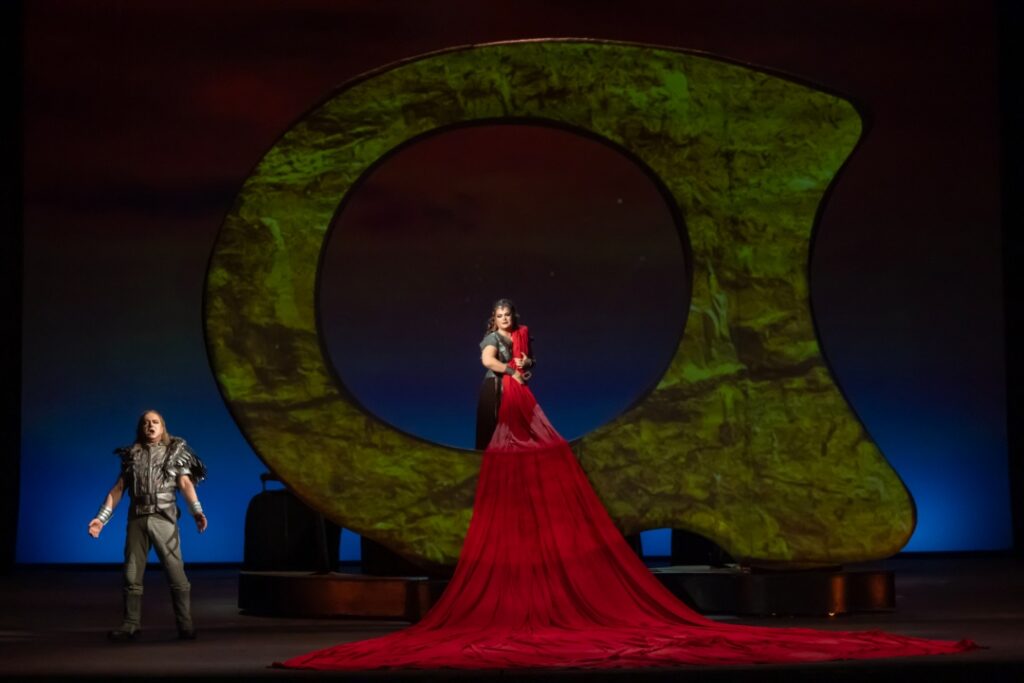
Dawn breaks on Martin Iliev as Siegfried and Radostina Nikolaeva as Brünnhilde. They are seen together in their loving bond and Brünnhilde casts protective spells over him. Nikolaeva’s passion for her role was her greatest asset, making her acting and emotions feel natural. Her dedication to Brünnhilde’s very challenging and devastating journey left a lasting impression on the entire production.
Iliev’s voice was consistent with his previous performances and his innate connection to Wagner’s music and libretto made him the backbone of this cycle. His acting in disguise when under Hagen’s love potion, made to trick Siegfried into falling madely in love with Gutrune, was exactly how one might imagine the tragic scene to unfold. Iliev made his performance about the discovery of Siegfried’s vulnerability and denouncement of his ego, especially in his final scene when he is given the potion’s antidote by Hagen and remembers his love for Brünnhilde with his dying breath. His underlying intent was to always direct his eternal love from the very core of his being towards to Brünnhilde. Iliev’s Siegfried was a breath of fresh air in the dramatic ending of Wagner’s “Ring.”
(Photo: Sofia Opera press)
Atanas Mladenov as Gunther was another highlight of this opera. Mladenov’s voice projected clearly throughout the hall and was never overpowered by the orchestra. His vocal range was supported by his excellent vocal technique and stamina. His acting skills were well studied and Gunther’s interactions with Siegfried felt brotherly in their portrayal, making his role supportive towards Iliev’s endeavors and actions.
Petar Buchkov as Hagen was the quintessential villain. His presence felt dark and sinister as he sang about his cold bloodedness. His aria “Hier sitz ich zur Wacht” was especially thrilling.
Alma-Lisa Bandalovska as Gutrune proved to be the perfect match for Iliev’s Siegfried. Their chemistry was consistently on point, as it was in the previous operas they shared. Bandalovska’s grace is what made her stand apart from other sopranos in these roles. She exudes a beautiful natural essence in her vocal delivery and transforms Wagner’s music into something so much more.
(Photo: Sofia Opera press)
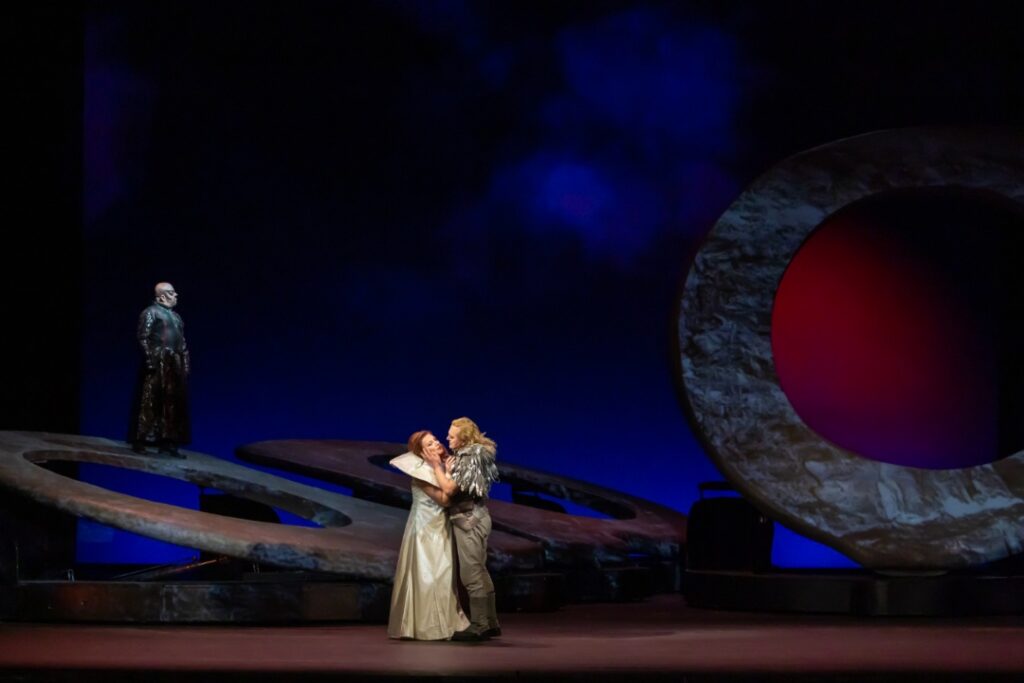
The ending of “Gotterdämmerung” is a final example of how Kartaloff’s production utilizes every action, voice, set design, and musical instrument to honor Wagner’s composition. The entire team of creatives and performers in all four productions remained focused on being a community and not an assortment of individuals interpreting their own versions of Wagner. Sofia Opera’s “Ring” cultivates humanity and embodies the soul of music as a universal language meant to be shared.