(Photo: Cory Weaver/San Francisco Opera)
The titular heroine of Jules Massenet’s iconic opera was San Francisco Opera’s third production of the Fall season. Manon shines. She enchants. She endures. She also puzzles. One moment she is devoted to love, the next to money, status, and pleasure. What are we to make of her as she dies in the arms of her lover, Des Grieux? We become absorbed in her flight from the convent, her rendezvous with her French beloved, her debauchery, her Parisian dreams, and her death. The question of who is Manon haunts us long after the curtain has fallen. The San Francisco Opera Orchestra, under the baton of Music Director Eun Sun Kim, alongside a talented cast, gave us an opening night that alternated between “right on” and “still working out the kinks.” I nevertheless came away humming bars from the lovely soundscape and pondering numerous “what ifs” from the life of Manon.
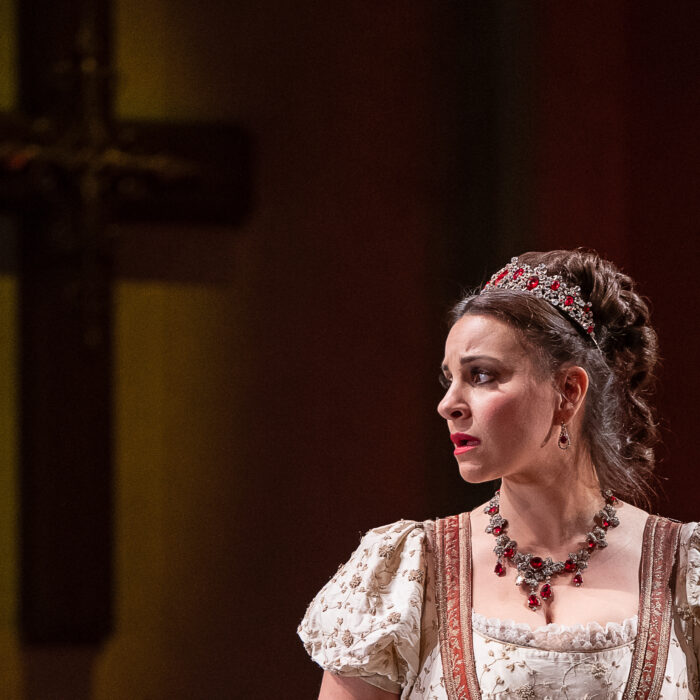
Soprano Amina Edris was Manon. Her voice soars and dips, her moods shift, her acting ranges. Just when we think she has reached her apogee, she pulls out another stop and goes even farther. Thrills came and went. Her Act two “Adieu, le Petit Table,” sung from her attic bed while staring at a distant table, was nuanced and touching. In contrast to the over-excited coquette arriving at Amiens in Act one, here Edris took us into her genuine grief, providing some thoughtful self-recognition. Her vocal color matched the mood, creating the sense of fragility without being fragile. But Manon did not dwell in this place of contemplation. In the next instant, while gathering her belongings to run away and leave the very same beloved about whom she had just sung, she showed her ecstatic anticipation for a new life of extravagance and sensuous pleasure in Paris. The visual contrast was clear onstage – Manon’s extraordinary gown, her prancing gavotte, her flirtatious mannerisms. The vocals were also clear. Yet Manon will not settle onto either side of this spectrum. She cannot truly commit to either face of her personality. Despite being conscientiously aware of the differences within herself, she weighs them more than embodies them. For a performer, portraying such nuance of character is hard to accomplish, yet Edris appears to be on the cusp of doing so. She spelled it out wonderfully, and one feels she is ready to sing more deeply into the subtleties of the role as well.
Edris’ partner in this onstage love affair, and real-life husband, is tenor Pene Pati as Des Grieux. His luminous voice, rising and spilling into splendor, coupled well with Edris’. They loved, they surrendered, they exuded adoration from their first spontaneous exchange at the coach station, and while believable largely only in operatic worlds, the shimmering light of their romance unfolded as the opera progressed and ultimately convinced the audience, opera-reality or not. By the time we arrived at the seminary scene in Act three, Pati’s “Fuyez douce image,” after Manon has abandoned him, is heartbreaking and filled with pathos. His voice emerged as if from another universe, yellow and fragrant as if sprinkling golden water. He started in a very soft piano, sometimes slightly blurred for its softness, aiming at introspective reflection. Pati made the perfect choice. It created a pronounced contrast as he filled with volume, power, and color, and the pain he contained emerged full bore. Pati and Edris sang their duets with tenderness and aching color, one voice blending and joining with the other as they moved forward, creating a shimmering whole. Their quartets, set on either side of the stage, were more than deft.
Le Comte des Grieux, the father of Pati’s Des Grieux the “chevalier,” was sung by bass James Creswell in rich and resonant tones. Creswell served his role with aplomb in the tradition of French moralistic fathers. So too did Manon’s cousin Lescaut, sung by baritone Vitor Bispo in his San Francisco Opera debut. Bispo definitely made the most of his time onstage not only vocally but dramatically. He inveigled himself into many moments with the chorus members – here presented as dames and hommes of society – and one definitely believed his character’s portrayal.
The three women – Javotte, sung by mezzo-soprano Laura Krumm, Pousette, sung by soprano Sofia Gotch, and Rosette, sung by mezzo-soprano Taylor Raven – performed with piquancy and vitality, accenting the flavor of the 19th century French milieu. The three men – Guillot de Morfontaine, sung by tenor Steven Cole, Monsieur de Brétigny, sung by baritone Stephen Gaertner, and the Innkeeper, sung by baritone Olivier Zerouali – added unique vocal and acting charms that kept the love story front and center. They also carried the chauvinistic attitude dominant at the time, adding the essential salt to the wound playing out before our eyes. The chorus, under the direction of John Keene, did a fine job, transforming into the populations of Amiens and Paris, singing while cavorting as gamblers, nuns, and passersby in front of the mirrors and chairs that contributed to the scenic variety.
(Photo: Cory Weaver/San Francisco Opera)
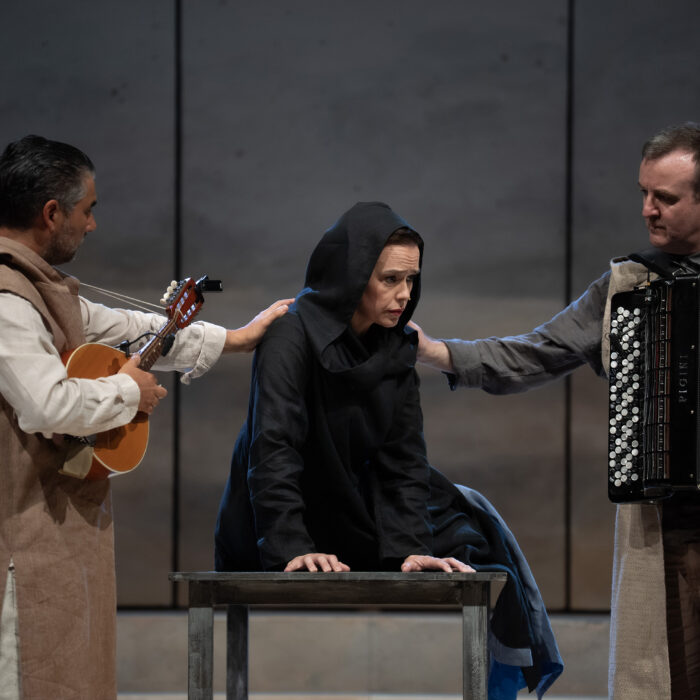
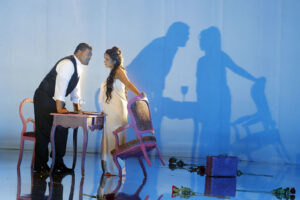
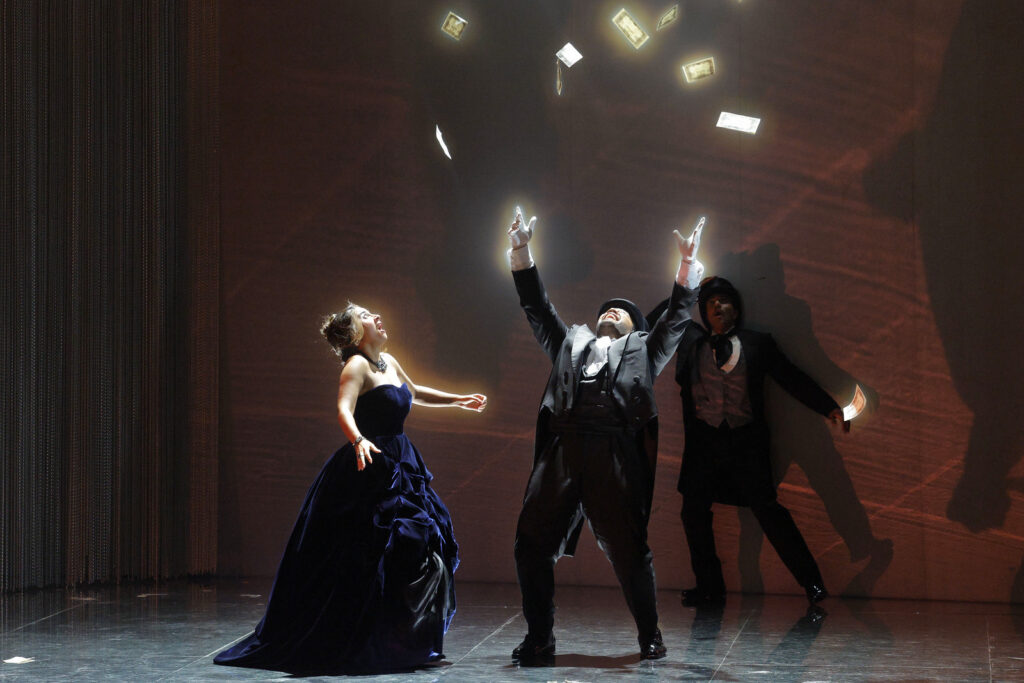
The production was directed by Vincent Boussard, who also did the costumes. These were colorful, original, fitting, flashy, Hollywood-esque, and showcased shades of meaning of the world in which the story unfolds and determines so many of the characters’ choices. The use of multicolored balloons and a descending chair for Manon contributed to the carnivalesque atmosphere, providing apt contrast to the stark black and white of the seminary. The use of a diagonal wall as a base for the shifting scenes worked well, creating varying places and perspectives, giving us a sense of the larger context as it moved between acts. The stagecraft, however, also “over-staged” some less than major moments. An example was the gorgeous chandelier, which looked beautiful as it descended, but felt somewhat superfluous for the point it made. The same goes for a woman dangling from a rope upstage right for an entire scene. Her moderate gestures only added a small accent that did not require her to hang like that for over 20 minutes. The cord-like curtains, through which the Folies Bergère-style chorus girls and guys appeared, seemed to withdraw before the impact of the set could be felt. Certainly decorative, but perhaps a bit too much. The staging of the seminary scene, with nuns in elaborate net-like headdresses and a Christ statue, was perhaps too much to simply contrast against Des Grieux prostrating himself. Were such strong images necessary for accents? Perhaps these choices arose from the modern tendency in production design to opt for more rather than less, extravagance rather than support. All of these choices diluted the focus rather than highlighted it. The lighting design by Gary Marder did a great deal to highlight the narrative turning points of the story, though in some moments over-accented them. Technology sometimes seduces us with its tools – we need not use them just because they exist.
Massenet’s score mastered the story with an array of sounds that rarely faltered. The music was not only amply present and constant, but often soaring and moving in accessible color and tunefulness. Overheard in the audience was the question of the difference between “this Manon and the other one.” By this the querent referred to Puccini’s “Manon Lescaut,” as both composers used the 18th century story by Abbé Prévost for their libretti. “One is French, the other Italian” was the answer. Massenet’s remains elegant, eloquent, lyrical, and sculpted with just the right degree of restraint. Puccini’s is intense, erotic, and filled with dramatic contrasts that threaten to break barriers just as the lovers did. These are naturally contrived distinctions, but they do reflect the tone of the two versions of the story.
No doubt aspects of the production will smooth over in the next performances. The already beauteous singing will grow even more rich. Opening nights are exciting and often replete with awkwardness that further performances invariably adjust for the better. In any case, San Francisco’s lead singers reminded us yet again of the urgent need to keep opera alive and available to all of us – those who already love it and those who are soon to do so.