San Francisco Opera 2025-26 Review: Il Barbiere di Siviglia
By Lois SilversteinSan Francisco Opera kicked off its Summer Season with Rossini’s popular “Il Barbier di Siviglia.” With nine principals, 36 choristers, and eight dancers, the production was a revival of the 2013 staging by Emilio Sagi and is a co-production between San Francisco and Lithuanian National Opera.
Sagi aimed to bring the past into the present, emphasizing this by moving progressively from black and white to color in sets by Llorenç Corbella. The production accomplished this, eliciting laughs from the audience with several contemporary objects and references while not distracting too much from the lines of the plot. When distraction did manifest it was forgivable, not only for possible opening night jitters but because the spirit of the production was upbeat, familiar, and friendly.
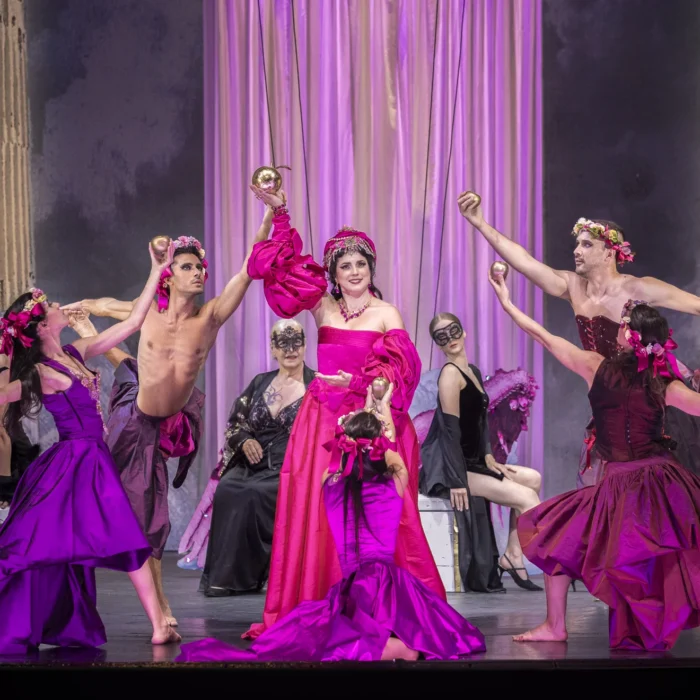
Benjamin Manis conducted the San Francisco Opera Orchestra. Overall, Manis did the job, supporting the singers and dancers and driving the story forward. The Overture did not, however, do more. At moments it wobbled and lacked luster. But because we know the music well and savor it, we went along with it as dancing and singing villagers entered, adorned in Spanish-style costumes created by Pepa Ojanguren. The dancers aimed to enhance the Hispanic atmosphere but their initial movements were tentative and uneven and they became a distraction from furthering the comic elements that are key. Manis conducted the singers in the two lovely sextets in Act One and Act Two, making it clear how collaboration in these musical pieces roused each singer and enabled them to give us fine harmony and beauty. They appeared in a nice tableau at the end.
Once place and time was established things began to seem more at home. This sense of settling into comfort manifested physically within the production. The “closed” house unfolded diagonally across the stage; the bust of Rossini moved into a niche; people took their places. This was a relief, as till now no-one onstage had seemed “settled.” Now the audience could keep their eyes glued on who was doing what and what was about to happen. We were eager for the charm of the story and its music to begin. And then it did.
The production attempted to bring new vistas to an old chestnut. While it aimed high, several aspects distracted from what is natively beautiful in the “Barbier” we love. The emphasis on the Spanish influences in costuming, as well as the use of bicycles, a car, an unfolding house, the unexplained bust of Rossini, guitar music with castanets and flowers à la “Carmen,” rainfall and snow-hail, and blue lighting were all clearly additions, but to what end? Larger, more exaggerated movements might have enriched the comedy and our enthusiasm. Emotions could have become three-dimensional through action and embodiment rather than hijinks and contemporary flourishes like a standing exercise bicycle, wheelie-suitcase, smoking housemaid, and a car. These ended up bring clash and conflict to the production. There was less reliance on objects to create new energy to get us invested in an old story. A more stylized approach, rather than “making references,” may have enhanced the story and the music, enlivening the whole.
These issues were felt in the singing and the narrative. The singers began with a bit of uncertainty, despite the good spirit of the cast trying to arouse curiosity regarding the carriage arriving onstage with the “disguised” Count Almaviva in tow. Figaro and “Lindoro,” and the other chorus members, took their time “trying to find and establish their places in Seville” and fix their location within the script and score — something that enables us to identify and enjoy their characters. Rossini was a genius when it came to writing fun scenes peppered with quality humor. Through these antics he aimed to show human nature.
Volume was a problem at first and again intermittently as the opera unfolded. Figaro, sung by baritone Joshua Hopkins, looked the part for sure and aimed to convey charm and cleverness. While his intention was clear, his conviction only sporadically took hold. His voice projection remained low and somewhat thin. It was as if he were donning his role but not fully embodying it. Of course, Figaro has a lot of role to inhabit and Hopkins aimed to do so. However, he seemed to rely more on the role rather than fully inhabiting it. His “Largo al Factotum,” in rich and well-done patter, came and went before we knew it. Was it our familiarity with the aria, or the character unexpectedly showing a shyer side?
Lindoro (the alter ego of Count Almaviva), was sung by tenor Levy Sekgapane. He reached for a lot. His disguises and role changes were carried out with care and fun. His early singing was done with sweetness but, despite ardent sincerity, an uneven legato, occasional sharpness, and rasping upper register. Throughout the two acts Sekgapane sang with deliberation and clear intention and committed himself to loving and gaining his bride.
Dr. Bartolo, sung by baritone Renato Girolami, began also with effort, but as the opera progressed the smoother and more comfortable he became, moving deftly around the stage.
Mezzo-soprano Maria Kataeva, making her US and San Francisco debut, embodied Rosina with vivacity. She moved with ease, comfort, and grace, and sang with a winsome and melodic energy. We could easily see why Lindoro/Almaviva was enchanted by her. Everyone savored her voice and her free-wheeling movement. She naturally became the hub of the wheel of action around which the entire opera revolved. Her “Una Voce Poco Fa” was more than pleasant, her range clearly mastered, illustrating her vivacity. Kataeva gave forth her enthusiasm and élan with fine energy.