Monteverdi Festival Cremona 2026 Review: Dido and Æneas
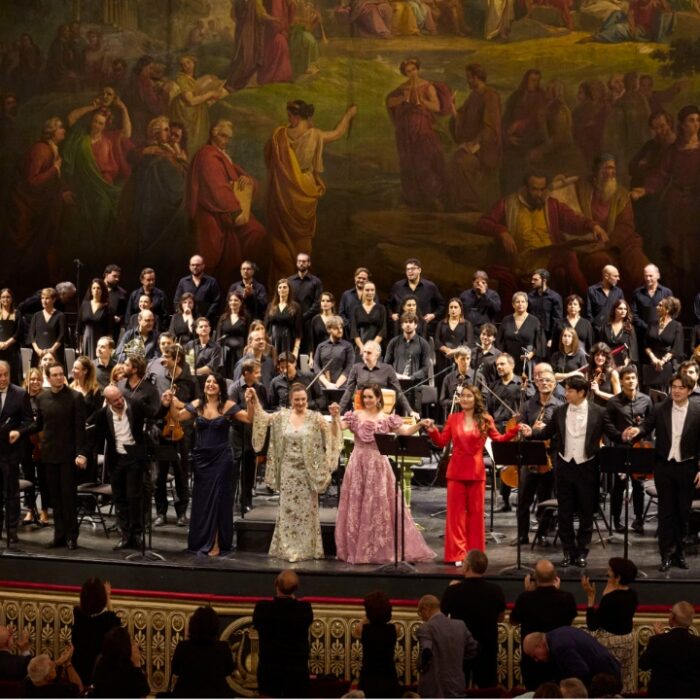
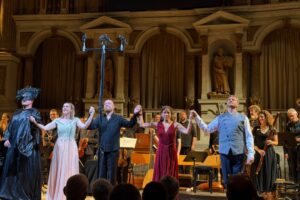
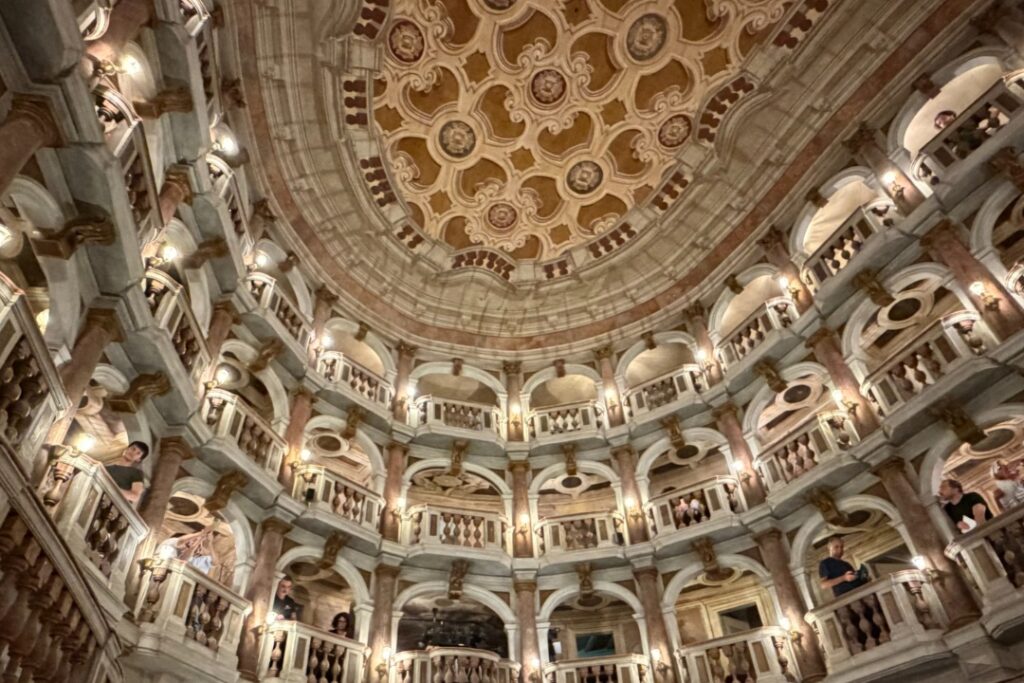
By Jennifer E. PyronThis year’s Monteverdi Festival showcased a special performance in the heart of Mantua, Italy, in the 18th-century Teatro Bibiena di Mantova (Scientific Theater of Mantua), where a (nearly) 14-year-old Mozart gave his first Italian concert (alongside his father). The theater’s bell-shaped layout and ornate tiers of wooden boxes with painted frescos were designed by Antonio Galli da Bibiena to host scientific gatherings, while also serving as a venue for live concerts and performances. Da Bibiena painted the frescos of the theater boxes with monochromatic figures, and one cannot forget the statue of Virgil that looms house left, keeping watch over the audience. Performers have a platform at the back of the hall with boxes behind them, allowing for either a more intimate listening space for the audience or more room for performers — the latter being the exciting case on this night! The curtains that cover the boxes along the back wall also contribute to the very clean acoustics, such as one would expect from a well procured symphony hall. The bell-shaped cavity of the high ceiling hosts the sound’s warmth and rich timbre, making this a unique listening experience.
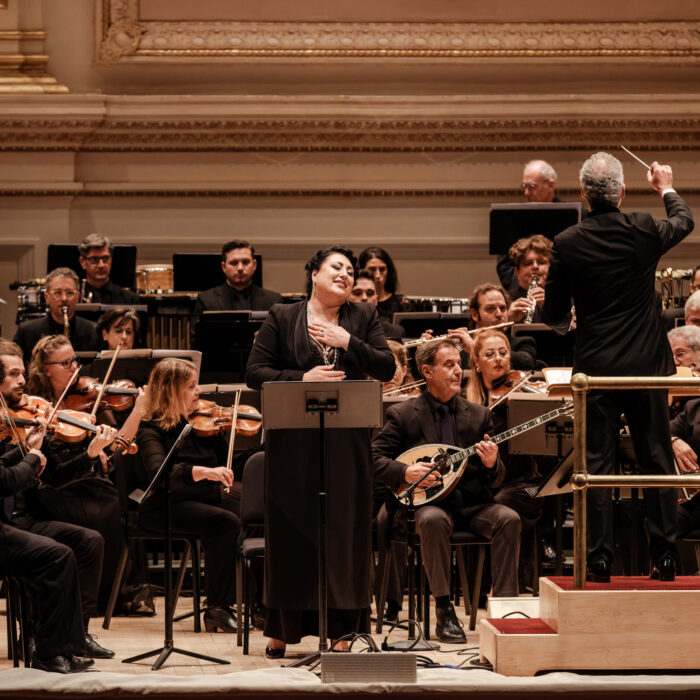
The evening’s setting was unique and the program, including performances by Michele Pasotti with the La Fonte Musica’s Orchestra and Choir, and soloists mezzo-soprano Luciana Mancini (Dido), baritone Mauro Borgioni (Aeneas), soprano Carlotta Colombo (Belinda), and countertenor Alex Potter (Sorceress), proved to be the jewel of this year’s festival!
“The Instrumental Musick Used in The Tempest” by Matthew Locke (1621–1677)
Pasotti featured instrumental music by Matthew Locke from Shakespeare’s “The Tempest” as the prelude to “Dido and Æneas.” This decision was insightful and complimented the opera very well.
“The First Musick” (Introduction, Galliard and Gavot) and “The Second Musick” (Sarabrand, Lilk, and Curtain tune) built a climactic arc, especially as the sounds of the storm raged violently and the musicians played with fervor. The large sheet of metal suspended at the back also made the scenery dramatic as a member of the choir struck it, creating a thunderous wave of sound.
La Fonte Musica includes musicians Stefano Barneschi, Ayako Watanabe, Lathika Vithanage (first violin), Gabriele Pro, Anna Maddalena Ghielmi, Valentina Mattiussi (second violin), Gianni de Rosa, Efix Puleo (viol), Vanni Moretto (bass violin), Riccardo Coelati Rama (violone), Federica Bianchi (harpsichord and organ), Giulia Genini (dulciana and flute), and Michele Pasotti featuring Stan Geudens (theorbo).
(Photo: Francesca Faelutti)
“Dido and Æneas” by Henry Purcell (1659-1695)
Purcell’s 17th century semi-staged opera, “Dido and Æneas,” is a popular work. However, the actual manuscript did not survive and, according to Pasotti’s program notes, the versions performed today are based on Nahum Tate’s libretto (the subject of which was the fourth book of Virgil’s “Aeneid”), whose 1689 printed copy represents the earliest version of it.
The music for “Dido and Æneas” was championed by Holst and the manuscript used for this evening’s performance was by Tatton Park, copied by Philip Hayes. Pasotti notes that, “as a Purcell enthusiast, Hayes was keen on copying the English composer’s works from authoritative sources. Other sources, by contrast, heavily intervene in the opera, altering Purcell’s musical language to adapt it to contemporary times and tastes.”
Act one (The Palace) began just as La Fonte Musica concluded Locke’s stormy instrumental music in C minor, revealing soprano Carlotta Colombo as Belinda singing “Shake the cloud from off your brow.” Colombo’s voice resonated clearly into the hall with energy. Her vocal agility was supported by her solid technique and her high notes soared. The chorus also sounded excellent as they supported her.
(Photo: Francesca Faelutti)
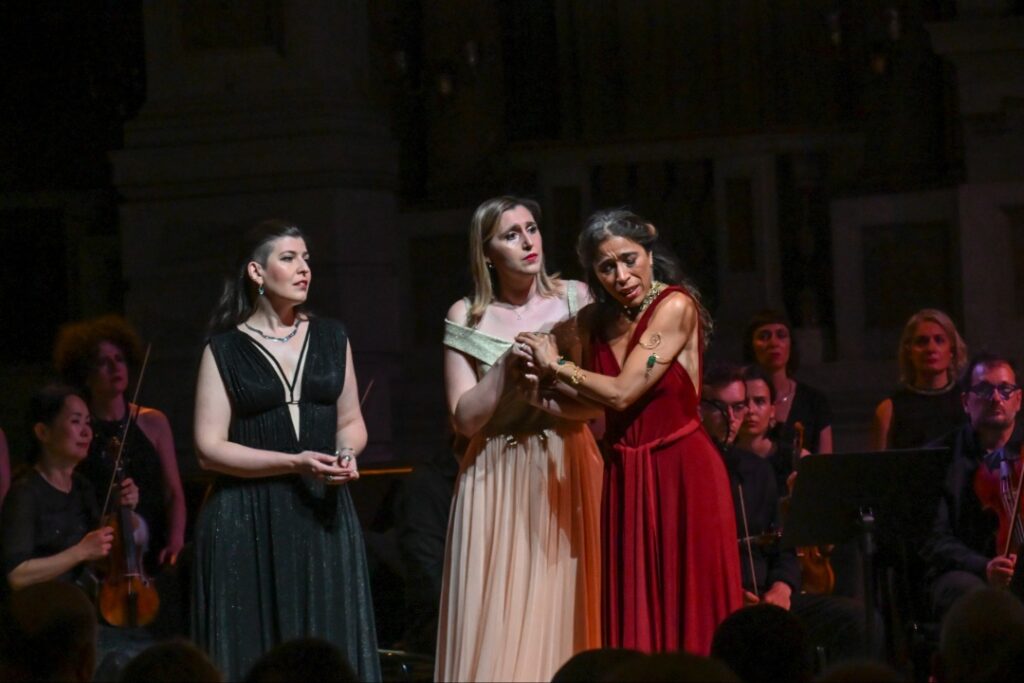
Mancini as Dido sang her opening aria, “Ah! Belinda I am prest” with sorrow. Mancini’s voice sounded dark and full of lament and her acting was heavily laden. “Grief increases by concealing” included Mancini, Colombo, and the chorus. This was a beautiful moment of solidarity surrounding Dido’s concealed grief.
La Fonte Musica played the instrumental version of “Fear no danger to ensue” with joy and lightness. The flute solo by Genini was exquisite.
“See our royal guest appears” welcomed Borgioni as Aeneas to the stage and the chorus sang “Cupid only throws the dart” in response. Their voices sounded delightful in the hall and the acoustics were absolutely perfect.
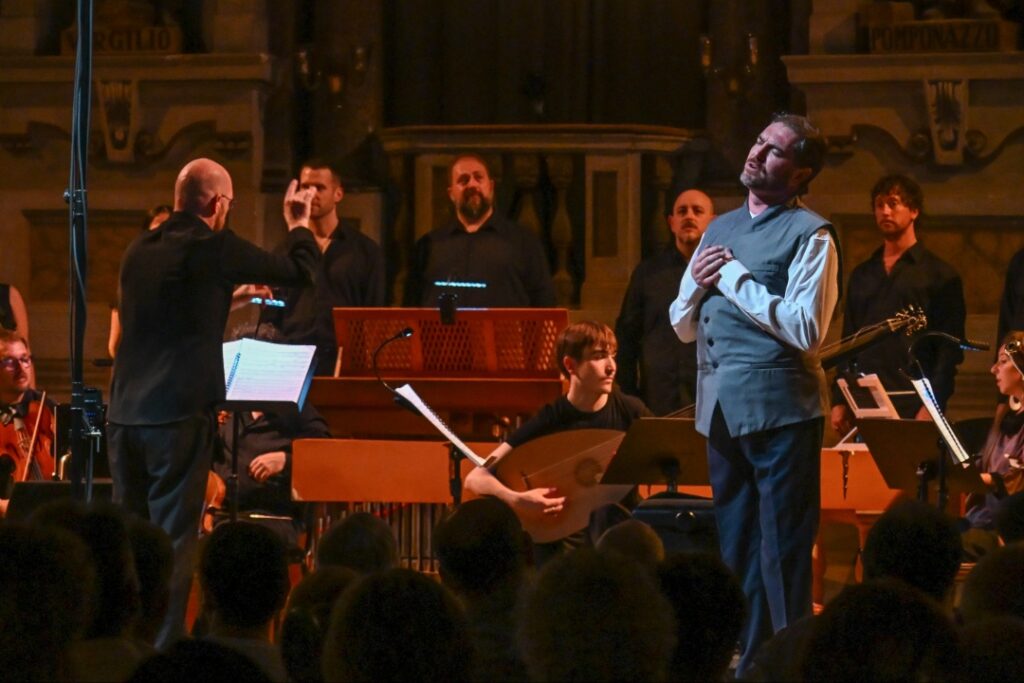
Borgioni’s aria “If not for mine for Empire’s sake” showed how his baritone’s timbre aligned with Purcell’s music. His voice resonated comfortably and openly as he sang. His stage presence really invigorated everyone around him. He was a true prince charming on this night.
Colombo’s aria “Pursue thy conquest love” was quick paced and exercised her vocal agility on the fly. Her jaw remained relaxed and her coloratura was aligned. “To the hills and the vales” highlighted another special moment of the chorus singing. Their diction and enthusiasm was outstanding. They really made this night extra special.
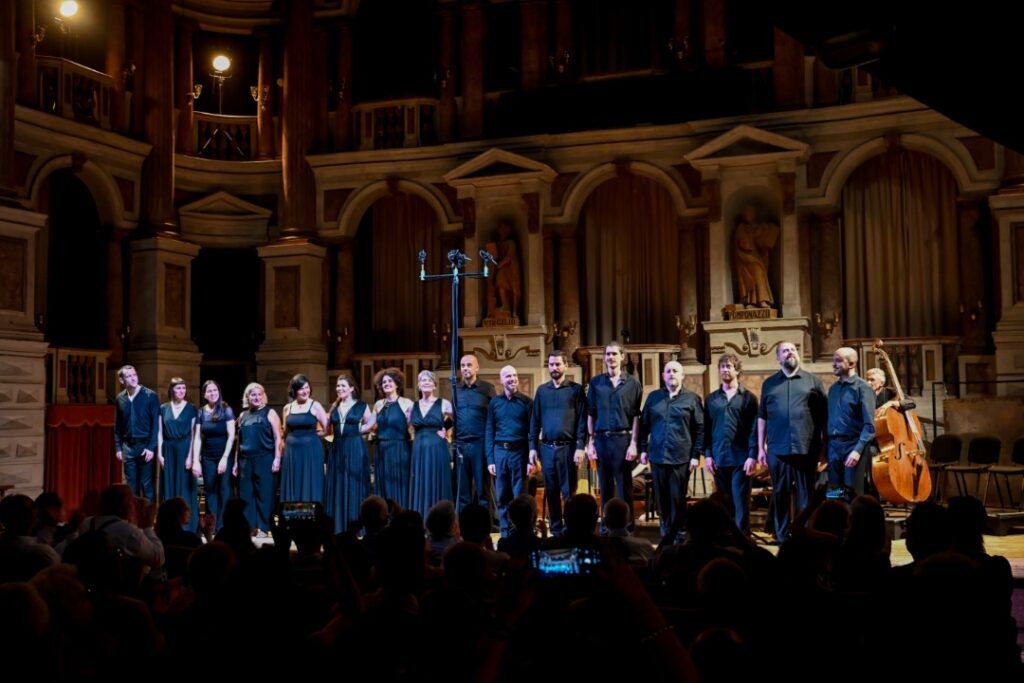
Chorus members included Francesca Cassinari, Alena Dantcheva, Cristina Fanelli, Anna Piroli (sopranos), Elena Carzaniga, Giulia Beatini, Daniel Brittain, Maria Chiara Gallo (altos), Massimo Altieri, Tom Kelly, Massimo Lombardi, Roberto Rilievi (tenors), Alessandro Ravasio, Matteo Bellotto, Renato Cadel, and Lorenzo Tosi (basses).
(Photo: Francesca Faelutti)
More Musical Highlights
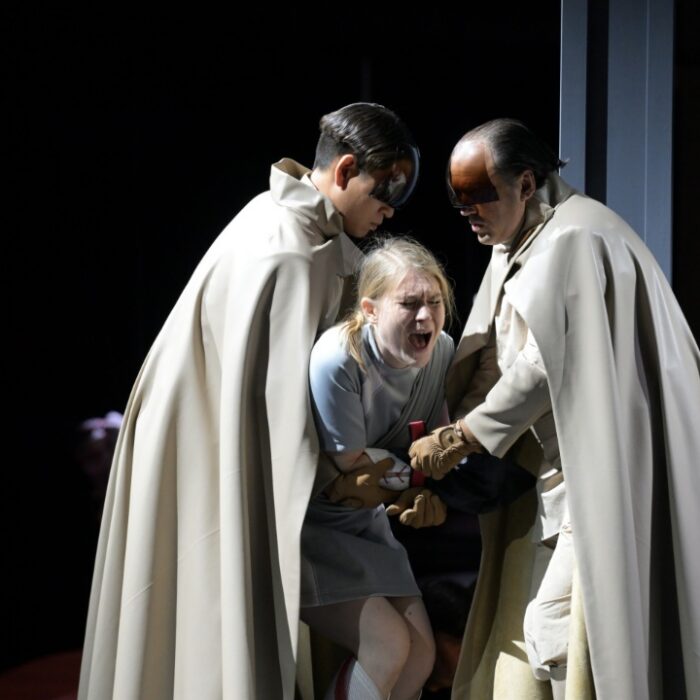
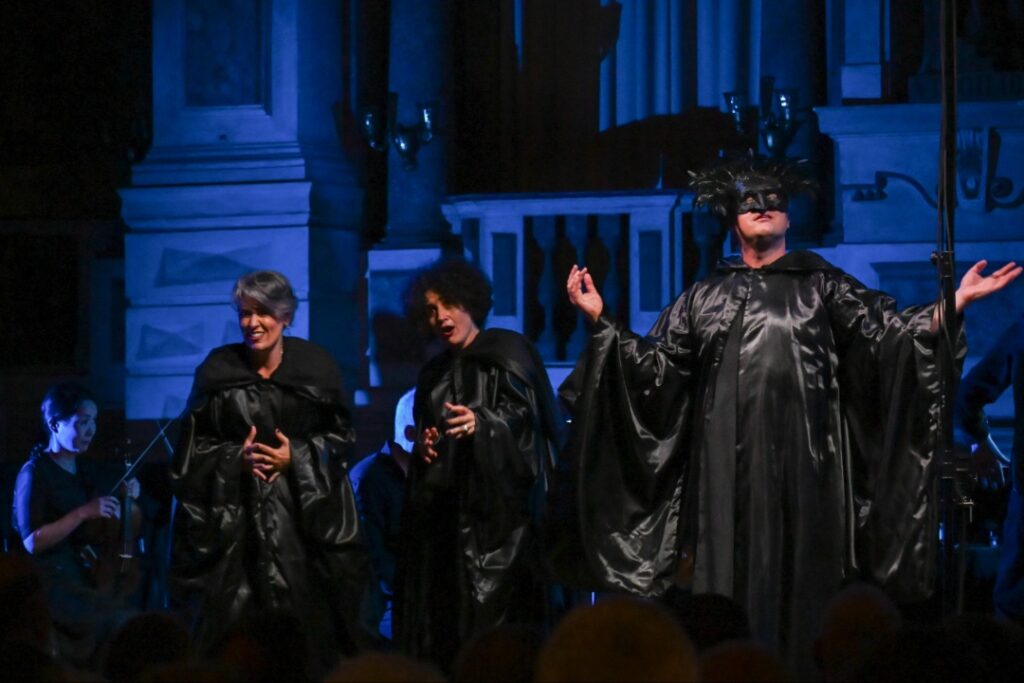
Potter as Sorceress was dressed in a long black cape with a black feathered mask-cum-headdress as he sang his opening aria, “Wayward sisters you that fright.” His vocal trills were precise as he gathered his accomplices around him to sing “Harm’s our delight.” Potter’s “The Queen of Carthage” aria really stirred the drama pot of the night as the witches laughed.
The two witches — Dantcheva as First Witch and Cassinari as Second Witch — sang “But ere we this perform” with a clear sense of vocal agility. Their voices sounded radiant in the hall.
“In our deep vaulted cell” is when the witches really started their mischief, and a part of the chorus was heard offstage singing in response. The choreography made the most out of the theater’s dramatic flare and unique atmosphere, especially when the witches took over the wooden boxes behind the stage. Their long black capes were striking in the dim lights as they sang and rocked back and forth in the shadows. One could sense that there was something special brewing.
Colombo’s voice as she sang Belinda’s aria, “Thanks to these lonesome vales” was stunning. It was her crowning moment.
“Oft she visits this loved mountain” was also a spectacular moment as both Mancini and La Fonte Musica performed together in harmonic bliss. The strings’ section in this aria was sublime.
(Photo: Francesca Faelutti)
Borgioni’s voice as he sang “Behold upon my bending spear” sounded glorious and the chorus followed his lead with aplomb. Fanelli as a Spirit, Altieri as Sailor, and Piroli as Second Woman were excellent in their roles as well. “Come away fellow sailors” was a gentle break from the drama.
“See see the flags” featured Potter, Dantcheva, and Cassinari in witching wonderment, especially leading up to their finale witch dance, “Destruction’s our delight.”
“But death alas I cannot shun” illuminated Mancini’s high notes as Dido commits to death’s embrace. Her final and potentially most famous arias, “Thy hand Belinda when I am laid” and “When I am laid in earth (Dido’s Lament)” were further highlights in this performance.
The final scene featured the chorus in their long black capes holding a single lit candle as they slowly walked onto the platform and sang “With drooping wings Cupids come.” The candlelight flickered as their faces moved in slow motion with their voices. This moment felt suspended in time and will stay in my memory forever. There really is nothing like live singing. La Fonte Musica’s orchestra, candlelight, and the spectacular setting of a theater built for scientific gatherings hosting “Dido and Æneas” made for an unforgettable night. Bravi tutti! I will cherish this forever.