Royal Ballet & Opera 2026-27 Review: Don Giovanni
By Mike Hardy(Photo: Mihaela Bodlovic)
Technically classified as an opera buffo, or a comic opera, both Mozart and his librettist Lorenzo Da Ponte formally assigned it on the printed score as a dramma giocoso, which translates literally to “drama with jokes” or “joking drama.”
Without giving away the entire plot, “Don Giovanni” tells the dramatic tale of an unrepentant, narcissistic nobleman whose insatiable pursuit of women leads to his ultimate downfall. Originally set in 18th-century Spain, (this version opts for the 19th-century Victorian period), the plot kicks off with Giovanni sneaking around, in and out of the bedroom of his latest conquest, Donna Anna, when he is discovered by her father, the Commendatore, who comes to her defense. Giovanni kills the elderly man in a duel and flees the scene with his long-suffering servant, Leporello.
Impervious to the gravity of his wicked deed, Giovanni spends the subsequent day continuing his predatory escapades, attempting to dodge his furious former lover, Donna Elvira, while simultaneously trying to seduce a young peasant bride named Zerlina on her wedding day. As the walls begin to close in, Donna Anna, her fiancé Don Ottavio, and the other victims unite to expose and punish the murderous libertine. The opera reaches its apparent, supernatural climax when the Commendatore reappears from the dead to warn Giovanni of impending retribution, before exacting his revenge; illustrating the traditional moral that earthly crimes and hubris face divine or supernatural reckoning.
I recall, in an interview with the famed soprano Aleksandra Kurzak, where I explained my difficulties in enjoying Mozart as well as some, and she told me that Mozart is perhaps better to sing than to listen to.
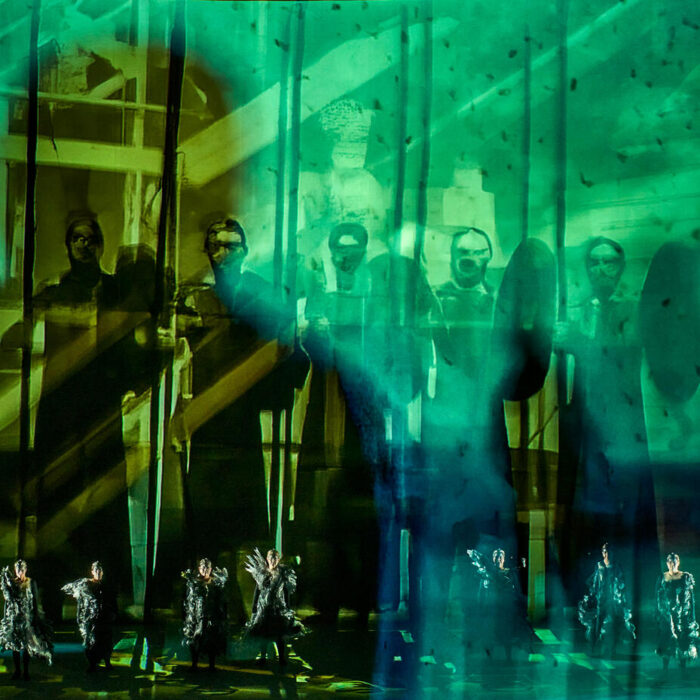
I have to say, on this occasion, that the quality of singing on display was exemplary and actually did make the listening all the more pleasurable for me. Not only that, but courtesy of some funky video graphics, lighting effects and set designs, it was a visual delight also. This is a Greg Eldridge revival of Kasper Holten’s 2014 production and Es Devlin’s rotating set is unquestionably impressive; a large mansion façade displaying levels, balconies and doors, which slowly rotates to reveal the inner workings and central spiral staircase, other interlocking stairways and multiple folding doors that create a veritable Pandora’s box of a set. On to this is frequently projected a smorgasbord of clever video graphics: hand-scribbled names of past and present lovers, (and victims) a la Giovanni’s ‘little black book,’ (which is actually pretty vast); depictions of entwined lovers, swirling corridors and other illusions including huge swathes of extensive blood spattering at key moments. Video designer Luke Halls has created a remarkable, animated backdrop to present the idea of a physical manifestation of Don Giovanni’s chaotic mind and thought process.
Bruno Poet’s clever lighting creates tension with his isolating spots and atmospheric shadow projections.
Anja Vang Kragh’s costumes not only look suitably authentic, but in some instances are cleverly designed to enable the artists to blend virtually invisibly with the projected graphics against the set.
Illuminating Cast
Singing in the titular role is Canadian bass-baritone Gordon Bintner. He possessed great presence in this role and strutted around with suitable authority and haughtiness. He was entirely convincing as the licentious lothario, acting with arrogant fearlessness.
He has a splendid, malt-rich instrument which he amply displays in his keynote “Champagne aria,” “Fin ch’han dal vino,” but adopts a soft, melting tone of much beauty later where he sings the canzonetta “Deh, vieni alla finestra” in his seduction of the maid of his former lover, Donna Elvira.
He was vocally matched by Roberto Tagliavini in the role of Giovanni’s much put-upon servant Leporello. Tagliavini was the more stentorian, displaying wonderful resonance and depth of color. He set the opening scene perfectly with his rendition of “Notte e giorno faticar,” where he detailed his life of woe and misery with Giovanni. His interplays and dialogue with his bullying boss provided much needed comedic relief and his aria “Madamina, il catalogo è questo,” where he details his master’s conquests, is a delight.
I always thought the tenor in this opera, Don Ottavio, somewhat wimpish and far from heroic. His preening pursuit of Donna Anna in her time of despair and emotional turmoil comes across as exploitative and almost predatory. Bogdan Volkov did an admirable job in appearing convincing as a moral nobleman with quiet restraint and resolute strength, remarkable given his boyish appearance. His second Act aria, “Il mio tesoro” was sung with tangible passion and it received the warmest applause of the evening.
It was by listening to a recording of Mozart arias by soprano Rachel Willis-Sørensen that actually convinced me that there may be more to the composer than I had given him credit for, and so I was more than eager to see her sing the role of Donna Anna in the flesh. I am delighted to report that she sang with wonderful power and control; secure in the lower registers and resplendent in the upper with a nuanced top. Her first Act aria, “Or sai chi l’onore,” was adept, when she realized that Giovanni had murdered her father and she sang of her desire for vengeance. She was wonderfully beguiling in her final Act “Non mi dir, bell’idol mio” where she sang to her devoted would-be-lover that she shall be his when her heart has healed. Both arias require vocal skills to perform the trills, high notes and, particularly in the latter, virtuosic coloratura passages.
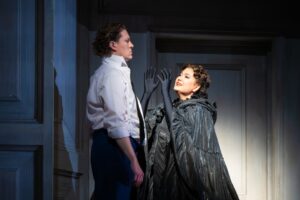
It was unfortunate that the director required her to sneak off and interlope with Giovanni further, upstairs; during Don Ottavio’s aria “Dalla sua pace,” where her fiancé pours out his devotion for her downstairs. Her obvious willingness to be a complicit partner hugely detracts from the driving force of the tale and particularly her part in it, not least making impotent her initial protestations of hatred and rage, levied at the Don. Presumably, Holten rewrote the dynamic between Donna Anna and Don Giovanni to explore the psychological grey areas of desire, perhaps obsession, and social hypocrisy; but I feel the hugely incongruous act of engaging in intimacy with her father’s murderer to be wholly detrimental to the plot.
There are further, (but infinitely less severe), contrasting character traits for another of Giovanni’s conquests, Donna Elvira, performed here by Aigul Akhmetshina. She was equally enraged and, by turn, infatuated with him throughout. Her arias perfectly mirrored her emotional instability, shifting between furious rage and deep, lingering affection. Making her debut in this role, this is entirely new territory for Akhmetshina. She started off with a measured degree of caution, but it wasn’t long before that glorious, unique vocal beauty flowed that marks her out as the mezzo of our time. Her establishing aria, “Ah, chi mi dice mai,” where she vengefully sings of her abandonment, was accomplished. She later performed “Ah, fuggi il traditor” warning the peasant girl Zerlina to reject his advances.
Her final aria, “Mi tradì quell’alma ingrata,” where she sings of her internal conflict, was sublime; receiving warmly deserved applause from the audience. This was the highlight of the evening.
Furthermore, Akhmetshina possessed superb charisma and natural stage presence that intensifies with every role I see her in. She carries herself with an air of absolute conviction and authority. It will be interesting to see if this digression from her usual roles leads her to further engagements in this repertoire.
More Musical Highlights
Giulia Semenzato performed the role of Zerlina, the peasant girl almost seduced by Giovanni on her wedding night! Her “Batti, batti, o bel Masetto” in the first Act, where she tries to appease her almost cuckolded husband, Masetto, was sung with a sweet soprano instrument. Her second Act “Vedrai, carino” was both stylish and sassy and even, at times, genuinely tender.
Dingle Yandell portrayed the role of Matteo with aplomb. He delivered a fine, put upon, hot-headed fiancé to Zerlina. Distinctly tall, he played the working-class gawk to perfection. Not only that, he also sang with a wonderful, clarion bass-baritone voice that was commanding. He had tremendous stage presence, and I would love to see more of him in future roles.
Equally vocally replete was Andreas Bauer Kanabas in the role of the Commendatore. His vibrant bass was particularly effective when playing his phantasmic self where he returned to deliver retribution to the errant Don Giovanni.
The Orchestra of the Royal Opera House were naturally faultless under the baton of Stefano Montanari, although his conducting appeared a tad pacy at times and I did note what, to my ear at least, appeared to be slight tempo and timing irregularities between the orchestra and the singers.