Royal Ballet & Opera 2025-26 Review: Royal Ballet and Opera Jette Parker Summer Performance
By Mike Hardy“I often go for the underdog”, commented David Gowland, Artistic Director of the Royal Ballet and Opera’s Jette Parker Artists Programme, musing on how he selects participants for the highly competitive training scheme, in an interview with Sophie Rashbrook to commemorate 25 years and working with over 150 artists since the programme’s inception in 2001.
On Sunday, July 26th, the current batch of “underdogs” took to the stage at Covent Garden to participate in the Jette Parker summer performance. I have reviewed several of the artists performing previously, in their small roles in Royal Opera productions, often opining that I would love to hear more of them, so this occasion afforded me the opportunity to do just that.
Directed by Talia Stern, the performance was a pastiche; a sequence of dreams, induced by a sleeping potion, surreptitiously introduced in a first act portrayal of a dinner party, to the accompaniment of Tchaikovsky’s “Sleeping Beauty” Overture.
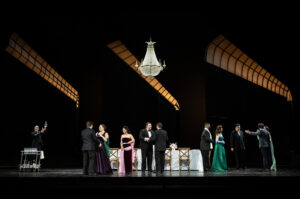
Here, the “guests” were the entire Jette Parker ensemble, playing the characters of “Die lustige Witwe,” where they were hosted by “Puppet Master” Spike King, who performed a wonderful comedic sequence of dance and mime, before introducing the sleeping potion into his charges champagne.
The gathering then transposed to the third Act, Scene two, of Igor Stravinsky’s “The Rake’s Progress” where Nick Shadow, (the Devil), portrayed by bass-baritone Ossian Huskinson, torments Tom Rakewell, played by tenor Emyr Lloyd Jones in a cruel game for his soul. Shadow has come to collect what he is due and informs Tom that he must end his life by any means he chooses before the stroke of midnight. Suddenly, Shadow offers an alternative: they will gamble for Tom’s soul in a card-guessing game.
The sequence is sung in English and acted a little too overly melodramatic for my tastes, although Richard Fu’s persistent harpsicord built the tension nicely. Lloyd-Jones sings with a wonderful, bright instrument with a clean, clarion upper register which positively pings at the top. I have reviewed Huskinson in a number of performances, notably more than once as a splendid Angelotti in more than one “Tosca” performance. Here he gets to show off his rich, treacle thick timbre with abandonment, as he casts Rakewell to eternal damnation by way of insanity.
This dream then progressed to the Café Momus as envisaged by Ruggero Leoncavallo for his final Act in “La Boheme.”
Historically, famously locked into a bitter rivalry with Giacomo Puccini, they had a very public argument in a Milan café where Leoncavallo accused Puccini of stealing his idea for the opera. Both composers’ librettos are based on the novel “Scènes de la vie de bohème,” originally published in serial form by Henri Murger in 1851. Of course, Puccini’s “La Boheme” is one of the most beloved and frequently performed operas in the world, whereas Leoncavallo’s version largely faded into obscurity.
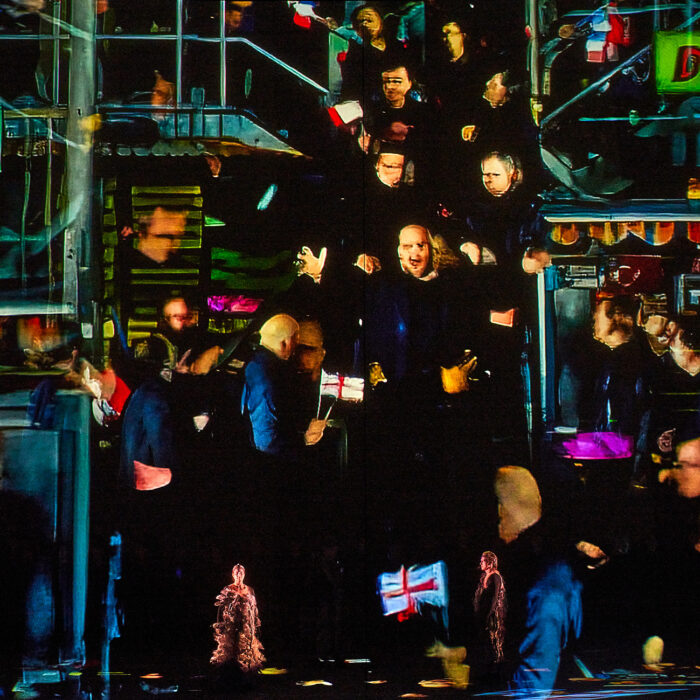
That is not to detract from the quite wonderful score that Leoncavallo wrote, sung beautifully here to the degree that left me wishing to see the whole opera. Here, in a reversal to Puccini’s format, Rodolfo is a Baritone and Marcello is the tenor. Siphe Kwani sang with authority and confidence here as Rodolfo, expressing his adulation for the ailing Mimi in commanding, resonant, velvety utterances whilst Giorgi Guliashvili sang Marcello with a polished, shiny tenor voice that pings nicely and solidly in the upper register. Soprano Hannah Edmunds was outstanding as Mimi, creamy and silver pure who packed huge amounts of evocativeness in such a short performance here. Jingwen Cai portrayed an impish Musetta, producing a big, mezzo voice from a relatively small frame. Baritone Sam Hird completed the group here, who sung with a mature but mellow tone, and acted out his part with aplomb.
It’s difficult, if not impossible to NOT make comparisons with Puccini’s far more famous work but it is testament to the artists skills that I was surely not alone in wishing that this version was more widely staged.
©2026 Clive Barda
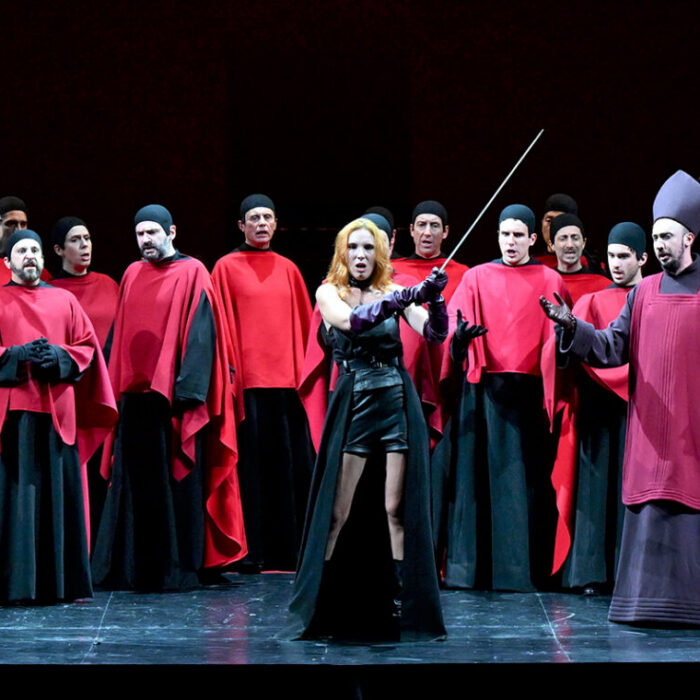
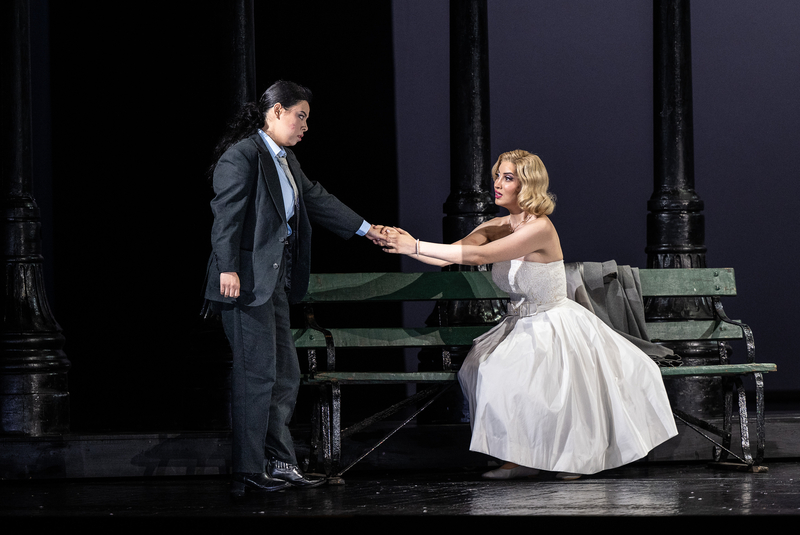
Jingwen Cai is another artist whom I have reviewed previously, and whose performances most definitely left me wanting to hear more. Moving into the fourth dream incarnation, she partook in the unquestioned highlight of the performance, as Romeo, opposite Marianna Hovanisyan’s Giulietta in Bellini’s “I Capuleti e i Montecchi.” Both singers sung with such exquisiteness and consummate skill, performing impossibly beautiful phrases, each seemingly determined to outdo and outshine the other. Cai possesses an astonishingly agile instrument, remarkably clear and distinct in the lower registers yet beautifully expansive and glimmering at the top. She is also voluminous, her mezzo penetrating all corners of the auditorium. She is quite simply, one of the most astonishing mezzo sopranos I have ever heard.
Soprano Hovanisyan almost matched Cai in impactfulness, singing with a palette of divine colour, an enveloping, warm resonance that dripped with heart-rending emotion. The performance brought sustained, tumultuous applause from the audience at its cessation and as well as being the absolute apex of the show, was one of the most glorious sequences I have heard at the opera house, period. It really was that special.
The penultimate dream was another rarity, Georges Bizet’s opéra comique in one act, “Djamileh.” This excerpt was a wonderful slice of frivolity, the role of Djamileh sung by Ellen Pearson, displaying wonderful comedic timing as well as a rich, effusive mezzo soprano voice. Her lover, the wealthy Count Haroun was portrayed by tenor Emmanuel Fonoti Fuimaono, who sang with measured power and beauty in equal measure. A wonderfully opulent lyric tenor voice, he was equally humorous in his role. Baritone Sam Hird completed this wonderful trio, as the scheming, (and delightfully named), Splendiano who, along with Djamileh was planning to avail the Count of his jewels and abscond.
The final act of the performance sees the entire group awakening at the dinner parter where the production begun, where the guests rejoiced in their new-found freedom with much exuberance, performing the Act two finale of Franz Lehár’s operetta “Die lustige Witwe” which brought a triumphant close to a stunning show.
The baton was shared between conductors Giovanni Fanizza, Richard Farnes and Peggy Wu; themselves Jette Parker members. Playing on this occasion was the Orchestra of the Welsh National Opera who were flawless in their execution.
The curtain call was supplemented with effusive plaudits for David Gowland, praising his twenty-five years of service to the Jette Parker programme, including heartfelt testimonies from Sir Antonio Pappano and current Royal Opera Music Director Jakub Hrůša. It was also announced that in recognition of Gowland’s service, a special plaque would be unveiled and placed in a special room within the Royal Opera House to commemorate his creating a most astonishingly successful programme.
Gowland’s notable absence from the event was explained as a result of sudden unforeseen circumstances, and I was left feeling that they must have been somewhat serious to have prevented his appearance at such a celebratory occasion at which his presence was surely obligatory.
The Jette Parker Performances are invariably heralded as a means of showing off the next big stars of the opera stage. On this showing, some of them are already there. They just haven’t yet been afforded the adulation, credibility and prizes that they richly deserve.
“You can fix technique…….” Howland stated in his aforementioned interview, “You can fix language skills. You can teach style. But it’s that thing you can’t teach, which comes from here” ……… (bringing a hand to his heart) ………” that’s what I’m looking for. Someone who’s a rough diamond-that intrigues me”.
I have no doubt that he would have been mightily impressed with the, rather than “rough diamonds,” the supremely polished precious gems on display.