(Photo: Roberto Ricci – Festival Verdi)
Giuseppe Verdi’s “Nabucco,” the opera that established his reputation in 1842, occupies a pivotal position in his development. At a time when Italian opera remained largely governed by bel canto conventions, Verdi made the love story subordinate to a broader conflict involving political power, religious faith and collective suffering. The chorus, meanwhile, assumed an unprecedented dramatic importance, becoming a protagonist in its own right rather than a mere ornament to the action.
At the Teatro Regio di Parma, Pier Luigi Pizzi’s new production (seen October 18) favored visual restraint over the monumental spectacle traditionally associated with this opera. The results were mixed dramatically but often effective visually, while Francesco Lanzillotta’s conducting and, above all, Lidia Fridman’s extraordinary Abigaille provided compelling reasons to return to this early Verdi masterpiece.
A Spare But Meaningful Staging
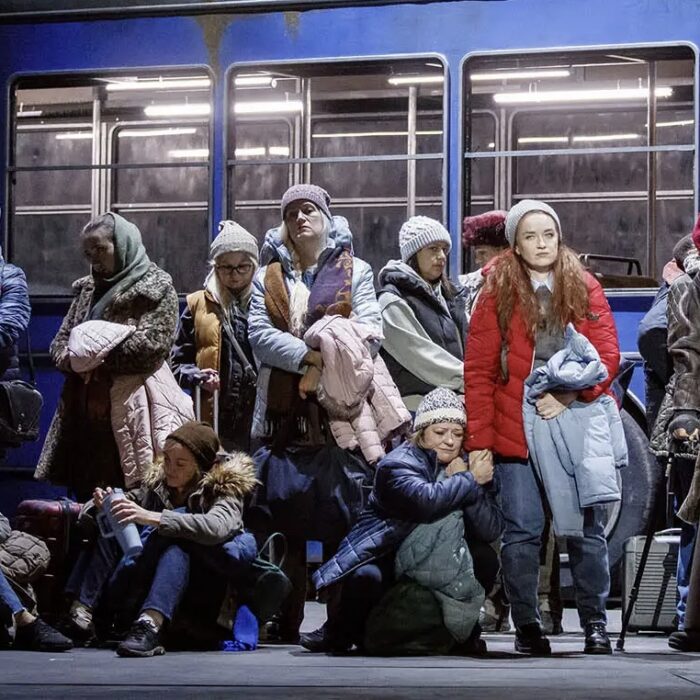
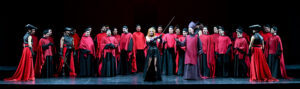
Pizzi, who also designed the sets and costumes, created an austere environment dominated by black and white, with red distinguishing the Assyrians from the Hebrews. The restricted palette gave the opposing peoples an immediate visual identity, while the Assyrians’ red costumes suggested their violence and appetite for conquest.
Rather than filling the stage with imposing architectural reproductions of ancient Babylon or Jerusalem, Pizzi relied on a few significant objects. A monumental menorah, representing the religious and cultural identity of the Hebrews, became a particularly effective image when the invading Assyrians toppled it. The gesture conveyed the humiliation of a conquered people more eloquently than the exaggerated expressions of collective grief often encountered in productions of this opera.
A golden statue erected in Nabucco’s honor made his eventual pretension to divinity tangible. Pizzi wisely resisted the temptation to turn the king’s blasphemy and subsequent punishment into an exercise in theatrical special effects. Nabucco simply collapsed when divine retribution struck, leaving the music and the sudden reversal of his fortunes to convey the magnitude of his downfall.
His costume also marked his transformation, the change of color underscoring the transition from conqueror to chastened, vulnerable man. This economy of means was consistent with Pizzi’s stated preference for removing the superfluous to reveal the essential. At its best, the production allowed the characters and their conflicts to occupy the foreground. At other moments, however, the visual austerity risked becoming emotionally remote, and the stage pictures did not always generate the dramatic urgency the score demanded.
The contrast was particularly evident in the chorus scenes, where the visual organization of the opposing communities helped clarify the action. Yet the production’s formal elegance did not invariably translate into psychological depth.
Lidia Fridman’s Powerful Abigaille
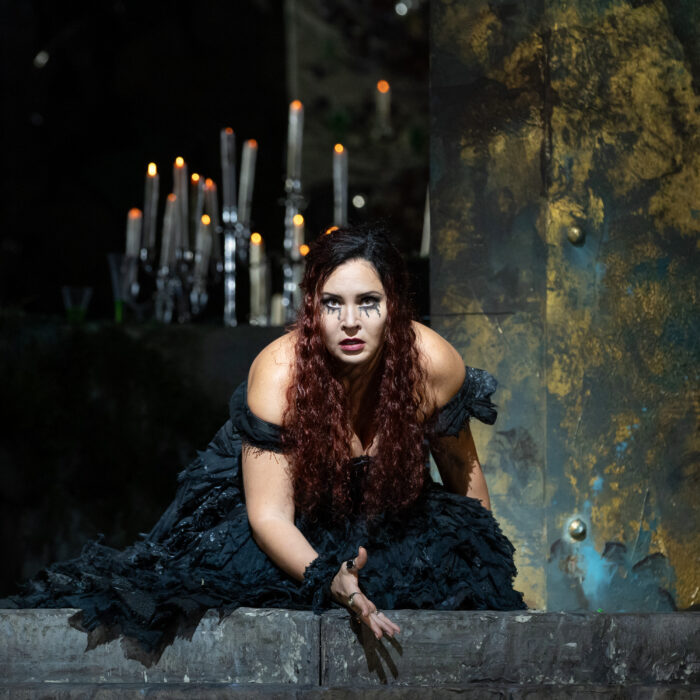
The evening belonged unmistakably to 30-year old Russian soprano Lidia Fridman, whose Abigaille combined formidable vocal resources with a commanding theatrical presence. Having impressed as Lady Macbeth in Parma and as Lina in “Stiffelio” in Piacenza, she confronted another of Verdi’s most punishing soprano roles with remarkable stamina and determination.
Abigaille demands an exceptional combination of vocal power, agility, extended range and sustained intensity. The part moves between explosive coloratura, brilliant high notes, potent lower-register writing and passages requiring an entirely different kind of lyrical concentration. Fridman negotiated these contrasting demands with impressive assurance, making the character’s vocal extremities part of her dramatic vocabulary.
Her distinctive timbre, incisive phrasing and physical authority made her a convincing embodiment of a woman accustomed to wielding power. Dressed in martial attire, with an almost Amazonian silhouette, she projected both seductiveness and menace. Her Abigaille was not simply a villain who happened to possess a spectacular voice: she was a force of nature, driven by ambition, resentment and an increasingly desperate struggle to secure her place in the world.
The Act three confrontation with Nabucco was particularly enthralling. Fridman conveyed Abigaille’s ruthless determination as she forced her adoptive father into submission and secured his signature on the decree condemning the Hebrews. The scene demonstrated her capacity to sustain dramatic tension without relying exclusively on vocal volume or emphatic gestures.
More revealing still was “Anch’io dischiuso un giorno.” Here, the singer exposed the wounded woman beneath the imperious exterior. Abigaille’s longing for love, her rejection and the discovery that she was not Nabucco’s daughter but the child of slaves complicated her apparently unbridled ambition. Fridman’s controlled legato, carefully shaded phrases and moments of vocal delicacy gave these revelations genuine poignancy. For once, the character’s cruelty did not preclude sympathy.
The final scene, particularly “Su me… morente, esanime,” similarly benefited from Fridman’s willingness to relinquish some of the role’s vocal opulence in favor of expressive concentration. Her achievement lay not merely in surviving the music’s indomitable technical obstacles, but in making Abigaille’s eventual collapse feel like the consequence of a damaged and increasingly isolated humanity.
There were moments when the voice’s registers did not blend with complete evenness, and the dramatic phrasing could occasionally favor force over nuance. Such reservations, however, did not diminish the overall impact of a performance in which vocal command, physical presence and psychological engagement combined to make Abigaille the production’s most complex character.
A Noble Nabucco & An Authoritative Zaccaria
Mongolian baritone Ariunbaatar Ganbaatar brought a substantial, resonant baritone to the title role. His ample voice, noble phrasing and capacity to alternate between declamatory authority and lyrical introspection confirmed his considerable promise in Verdi repertory. “Dio di Giuda!” was movingly delivered, while “Deh, perdona ad un padre che delira” revealed the tenderness of a father who had discovered the limits of his own power.
Nevertheless, Ganbaatar’s characterization remained less persuasive than his vocal accomplishment. Nabucco’s journey from arrogant conqueror to broken, repentant father constitutes the opera’s principal psychological counterweight to Abigaille. The king must initially convey overwhelming authority before the collapse of that authority becomes dramatically meaningful. Ganbaatar could have projected greater regality and menace in the opening acts, making the subsequent transformation more startling. His interpretation nevertheless offered a solid foundation on which greater psychological complexity may develop.
Michele Pertusi, by contrast, brought the authority of an experienced artist to Zaccaria. His beautiful, velvety bass, elegant phrasing and mastery of legato and mezza voce lent the Hebrew high priest both prophetic gravity and human vulnerability. “Tu sul labbro de’ veggenti” was distinguished by its refinement, while his religious pronouncements carried conviction without becoming ponderous. Pertusi’s performance was particularly effective in the passages where Zaccaria’s authority could not protect those he loved, and where faith had to sustain him in the face of political and personal catastrophe.
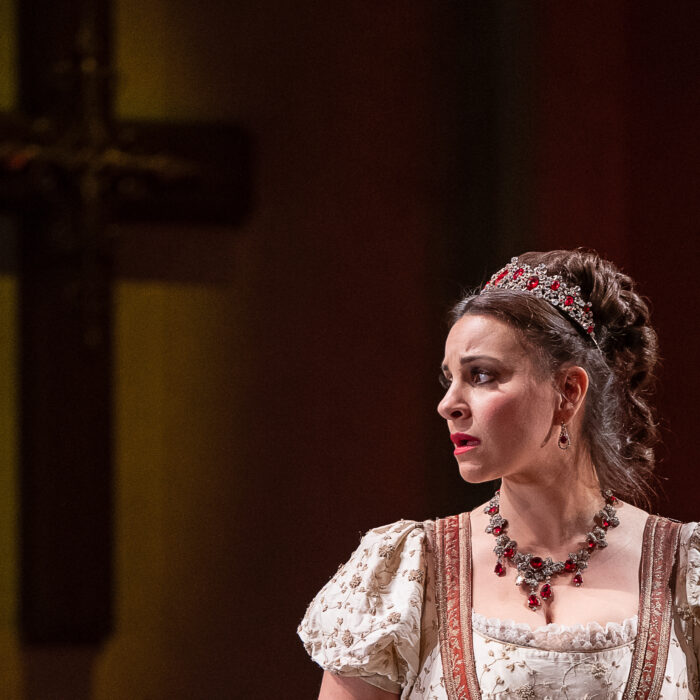
Laura Verrecchia’s Fenena benefited from a warm, substantial mezzo-soprano and a sympathetic stage presence. She made a favorable impression in her exchanges with Abigaille, although a lighter vocal profile might have better conveyed Fenena’s vulnerability and provided a more pronounced contrast with Fridman’s dramatic soprano.
Andrés Moreno García’s Ismaele was musically respectable, but the character lacked sufficient charisma. His relationships with Fenena and Abigaille did not generate the tension required to make the love triangle fully convincing. The supporting cast performed competently, with Adriano Gramigni an appropriately stern High Priest of Belo, Simone Fenotti a promising Abdallo and Maria Cristina Bellantuono an effective Anna.
Lanzillotta & The Chorus
Francesco Lanzillotta conducted with a commendable sense of proportion, balancing the score’s martial energy with attention to its lyrical contours and instrumental detail. Rather than treating early Verdi as a succession of bombastic climaxes, he allowed the music’s contrasting textures and dramatic rhythms to emerge. The orchestral tuttis possessed weight without degenerating into noise, and the forward momentum was generally well sustained.
The Orchestra del Teatro Comunale di Bologna responded with cohesion and energy. Lanzillotta’s handling of the score was especially valuable in the more reflective passages, where the instrumental writing helped reveal the emotional complexity beneath the opera’s imposing public gestures.
The Coro del Teatro Regio di Parma, prepared by Martino Faggiani, was among the evening’s greatest strengths. “Va, pensiero” unfolded with sonorous concentration, a moving sense of longing and admirable textual clarity. The delicate diminuendo at the conclusion was particularly affecting, avoiding the excessive pomp that can turn this celebrated chorus into a self-conscious patriotic pageant. The final prayer, “Immenso Jehovah,” was equally impressive, its solemnity and tenderness arguably making an even deeper impression.
Marco Berriel’s stage movement gave the chorus a coherent collective identity, while Pizzi’s color scheme ensured that the distinction between Hebrews and Assyrians remained clear. The chorus functioned not merely as a massed vocal ensemble but as the voice of a people whose fate supplied the opera with much of its emotional substance.
This “Nabucco” was not without shortcomings. Pizzi’s formal restraint sometimes came at the expense of dramatic warmth, and the title character did not always achieve the psychological stature the role requires. Yet Lanzillotta’s intelligent musical direction, the excellence of the Parma chorus and, above all, Fridman’s compelling Abigaille made the production a worthwhile encounter with one of Verdi’s defining early works.
Ossama el Naggar
Categories
Stage Reviews