Royal Ballet & Opera 2025-26 Review: Tosca (Cast B)
Aleksandra Kurzak Gives an Urgent Performance in Mears’ New Staging
By Benjamin Poore(The Royal Opera ©2025 Marc Brenner)
By the time I got to the Royal Opera and Ballet’s new production of “Tosca” at the end of September, most of the hubbub had died down. The protests around Netrebko’s performance had withered, and her performance was acclaimed – the diva triumphant in the face of politics. So too had dissolved important questions that had rumbled away at the RBO about the inconsistencies in its relationship to Ukraine and Gaza, all brought to the fore by the pro-Palestinian onstage protest from dancer Daniel Perry during the curtain call of July’s “Il trovatore.”
All this certainly lingered in my mind whilst watching Mears’ new staging of an opera where most productions tend not to explore the knottier questions implied in the piece about the relationship of art and politics. Is the prima donna a kind of collaborator, I’ve often wondered, performing her cantata offstage in Act two to give cover to the regime (wittingly or unwittingly), like Gergiev in Palmyra?
That this repertoire work is mostly about stars, ovations, and box office tends to get in the way of its politics, which are surely more than just thrilling scene-setting: I was delighted to read in Alexandra Wilson’s program note that the premiere of the piece was overshadowed by a bomb scare. It’s a forward-looking piece that anticipates a century of urban insurgencies and partisan struggles. You could quite ingeniously set it among the rubble of Pontecorvo’s “The Battle of Algiers,” or, say, the Hungarian Revolution of 1956.
It is to Mears’ credit that his new production opens up these kinds of contexts and ideas (though it is far from a Regie treatment of the piece) in a smartly designed and playfully inventive treatment of the work. It certainly blows the cobwebs away from Jonathan Kent’s stalwart staging, which put in two decades of glowering, naturalistic service, with a more incisive style and less period clutter, belonging broadly to the second half of the twentieth century. New broom from the outset – house lights off in a flash, plunging the auditorium into darkness, with new RBO Music Director Jakub Hrůša popping up out of nowhere to blast out the first terrifying trombone licks. Quite a coup already – “Ecco un artista!,” as Tosca might say.
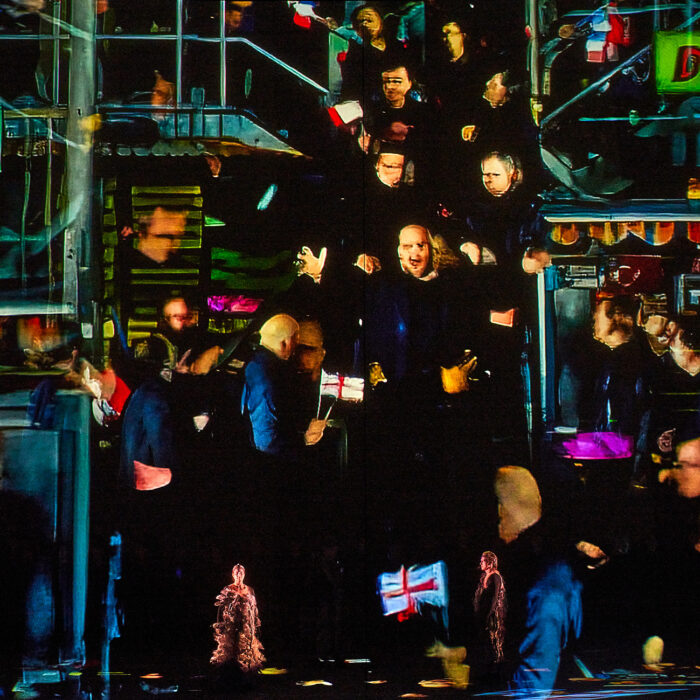
The Act one church is a bombed-out wreck, shattered marble everywhere, with its climactic procession taking place during some kind of barrage, with terrified parents whisking their child choristers away, dust and rubble dropping from the ceiling. Scarpia seems to relish it all, as politics shatters this holy place – a fine metaphor for what happens to Tosca’s faith as the work goes on.
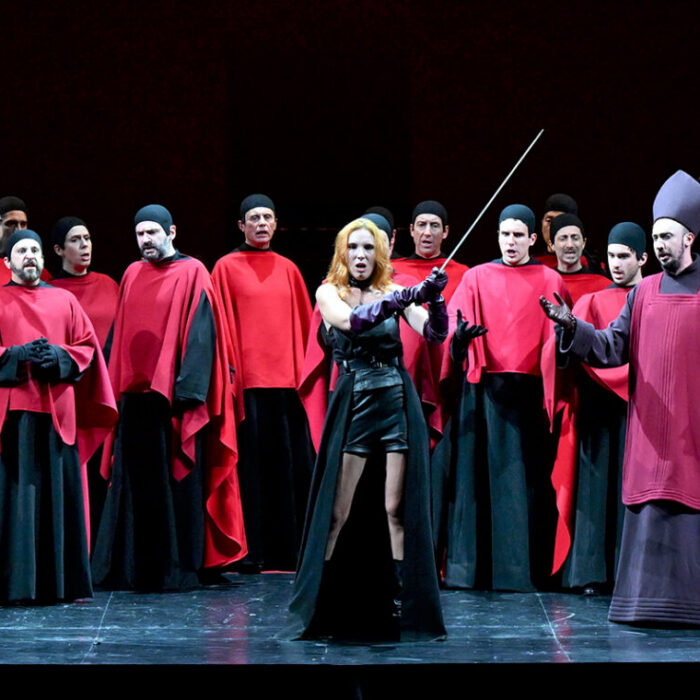
More marble, thanks to designer Simon Lima Holdsworth, in an admirably spare Act two. Out with the aristocratic trappings of the Palazzo – I once saw a production that had Scarpia carving a huge joint of rare roast beef – and in with a single marble slab, a couple of chairs, a takeaway box, and a television that casts an eerie glow; the lighting (Fabiana Piccioli) is big on stark shadows and acute angles, with the cool Mussolini-esque architecture looming with elegant menace over proceedings. Against this neoclassical fascist grandeur, a wheeled office chair allows the Chief of Police to whizz about with an infantile glee, which is absolutely chilling and darkly funny. The setting gives lots of room for their tense exchanges, which proceed otherwise conventionally, but he does get a splendid death – whacked around the head with a freestanding ashtray – a little clumsily done the night I saw it – and then stabbed in the throat with the diva’s hairpin. There’s lots of blood and gurgling, before she dumps his coat and the post-performance bouquet all over him. It’s very nasty and lots of fun – kudos to movement director Anna Morrissey.
For the relative economy of the act, then, the television remains a puzzling prop, which I had plenty of time to ponder. I can’t figure out why, on such a bare stage, it doesn’t play a more decisive role in the drama – it seems like a tremendous opportunity to force Tosca to watch what is happening to Cavaradossi as well as hear it. But the characterization of Scarpia, sung by an oleaginous Gerald Finley, is a real triumph, down to seeing Finley’s impeccable mannerisms go hand in hand with Mears’ vision of the Chief of Police. He’s a bureaucrat – far from the swaggering, burly aristocrat of Kent’s production, which didn’t much suit Finley – who is ultimately a small, grotty man who is made big by his place in the hierarchy, and is thrilled by the exercise of power. It’s the most realistic and historically apt vision of Scarpia I’ve seen, redolent of an Eichmann or any tyrannical middle-manager. One wonders if this portrayal of a greasy manipulator perhaps owed something to Finley’s excellent rendition of Helge Klingenfeldt in Turnage’s “Festen” earlier this year.
Act three – imported wholesale from Mears’ 2017 production of the work at Nevill Holt, though you wouldn’t know it from the program – shrinks the action into another white box – the tiled execution chamber that it turns out Scarpia was watching television in Act two. It’s a great opportunity for more blood-and-guts realism, with Mears’ own brand of naturalism making for uncomfortable, harrowing viewing. We see the first killing of the day – a process is carried out with excruciating bureaucratic formality (paperwork signed, clothes packed into plastic bags, and the whole lot swabbed down afterward). The dawn song of the Shepherd Boy is piped in over the radio, listened to by a chipper functionary who gets ready for another day at the office. A perfectly ordinary thing to do, from the kind of perfectly ordinary person who puts people to death for living; and a skin-crawlingly ironic treatment of the faux-innocence of this music.
A central window with a view of St Peter’s is where Tosca is pinned in her final moments – a wonderfully atmospheric, intense stage picture, those few seconds, before pitching herself out. The whole scene is smart and harrowing, though not without a few difficulties. The window simply feels far too small for the big finish warranted by the music, and makes for some rather awkward clambering, especially as the chair Tosca smashes it with has to be chucked back downstage, and so on. But overall, the staging is sharp and has plenty of glamorous moments – the prima donna’s big green dress in Act two impresses, for a start – and a gritty urgency that feels pretty true to the work’s verismo trappings, which, I would argue, have been all too often obscured by tradition.
Mike Hardy has already set out his impressions of the main cast for this site, so a few words on Aleksandra Kurzak, the second Tosca of the run, whom I was there to see. She’d been replaced a few days earlier by Ailyn Pérez, owing to ill health. I’m not sure, on September 29, she was completely fighting fit. It’s a voice on the lighter end for this role, but despite some uncertain top notes – some of Act two’s zingers went a little wide, with an uncontrolled vibrato – there was plenty of brilliance and dynamism. “Vissi d’arte,” though, was a showstopper, the public lapping it up, the music above the stave delivered with a crystalline fragility and a searing brightness. We felt her vulnerability as well as the character’s inner gleam.
Kurzak is, however, a wonderful actor with a fantastic physicality and rawness that ultimately belied any vocal difficulties. There was a rawness and desperation to her performance in Act two that pays huge dividends in Act two and seems a million miles from the rather more predictable game-playing with Cavaradossi in Act one, which often struggles to land. Gestures are tense and spontaneous – the physical explosion of the final fight feels like a cornered wild animal finally striking back, and her brutal killing of Scarpia is completely electrifying. The details are finely judged – she nearly throws up after the murder – and gives the most guttural, rasping growl of the final lines of the Act that I’ve ever heard. The intensity of her performance recalls a wonderful appearance in “Cavalleria Rusticana” a couple of years back with Pappano in the pit.
Freddie di Tommaso was sturdy and untiring – the second “Vittoria” was held for a death-defying length, and characteristic of the vocal muscularity that pervaded the portrayal, very much in line with our sense of Cavaradossi the freedom fighter. At other times, he felt pushed and tense where something more tender and poetic was required (revolutionaries are Romantics, too, of course), and some of the acting needed to loosen up a bit – he felt rather inhibited during “E lucevan le stelle.” But there’s no doubt his star will continue to ascend. Finley, as previously noted, has found just the right production for smooth and flexible baritone.
Hrůša’s reading of the score wasn’t radical, but rather a show of trust to his colleagues in the pit, who know the piece like the backs of their hands and whose expertise in it was allowed to unfold. Act two, conversely, could’ve seen more orchestral drama, sagging a little as Scarpia piles the pressure more and more on Tosca to reveal Angelotti’s whereabouts, ultimately wanting more surges and swells. A solid opening to the season, though, and I can’t wait to hear what he does in “The Makropulos Case” in November.