Rossini Opera Festival 2026 Review: Rossinimania ‘Rossini à Paris’
By Bernardo Gaitan(Photo: Rossini Opera Festival)
During the first decades of the nineteenth century, demand for music was extremely strong, but there was no way of listening again, through any kind of recording medium, to what audiences had so greatly enjoyed in the theater or concert halls. This gave rise to an entire repertoire of arrangements and transcriptions of larger-scale works, reduced for smaller instrumental ensembles, which we might define as the Spotify of the early 19th century.
Taking advantage of this need, Rossinimania was conceived: the section that allows the Rossini Opera Festival each year to move beyond its usual boundaries and make room for unusual repertoires and musical formats, historical transcriptions, and unconventional instrumental combinations, through which to explore the music of Gioachino Rossini and the cultural universe that surrounded him.
The result was the concert entitled “Rossini à Paris,” which presented a rarely performed program drawn from two collections, both published in the 1820s. This concert was sui generis, since one expects voices to be involved in any activity or concert presented by an opera festival. Yet in “Rossini à Paris,” there was not a single singer. Opera, however, was very much present: and in the most remarkable way!
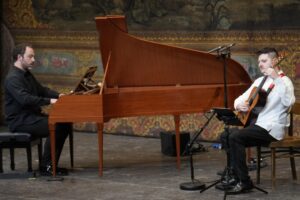
It was an interesting collaboration between guitarist Eugenio Della Chiara, born precisely in Pesaro in 1990 and a recognized expert on his instrument, and Spanish pianist, conductor, and teacher Rubén Sánchez-Vieco.
“Rossini à Paris” offered a way of hearing Rossini’s music again in the same manner in which it would have been heard by Parisians, members of the bourgeoisie, and music lovers in the great European capitals. Della Chiara explained that it was not always possible to attend the theater, but there was almost always an opportunity to perform these arrangements, bringing a great spectacle such as opera into the limited space of the domestic drawing room.
For this reason, the program was devoted to transcriptions of overtures from Gioachino Rossini’s operas made by guitarist and composer Ferdinando Carulli (Naples 1770 – Paris 1841), as well as ballet music from the opera “Moïse et Pharaon,” transcribed by Matteo Carcassi (Florence 1796 – Paris 1853). In this way, the instrumental, harmonic, and melodic dimensions become even more evident and important than in a conventional concert with a singer: here, the instrument is everything.
To make the experience even more authentic, Della Chiara, a Naxos artist since 2024 with a substantial number of recordings to his name, played an antique guitar typical of the period. Sánchez-Vieco, meanwhile, musical preparation coordinator and pianist of the Accademia Rossiniana “Alberto Zedda,” played the fortepiano, the instrument found in 19th century bourgeois homes and the predecessor of the modern piano.
The program included the Sinfonias from “Tancredi,” “Semiramide,” “Armida,” and, to conclude the matinee show, “La gazza ladra.” They were performed with enormous precision, dramatic intent, an assured command of the Rossinian style, and considerable virtuosity. It is no simple task to condense all the energy of Rossini’s finales into just two relatively soft-volume instruments such as the guitar and fortepiano. Between the sinfonias, the “Premier Air de danse” and “Deuxième Air de danse” from “Moïse et Pharaon” were also performed.
Both artists proved thoroughly accomplished on their respective instruments and created a very intimate atmosphere that was, without a doubt, worthwhile. It revealed a facet of Rossini’s music that hardly comes to mind when one thinks of his overtures.
At the end of the concert, a wave of applause prompted three encores. The first was a repeat of one of the dances from “Moïse et Pharaon;” this was followed by the second movement of Franz Schubert’s “Arpeggione Sonata, D.821”, given that the instrument was characteristic of the period when Rossini lived in Paris. The ROF audience would not stop applauding, so they repeated the sinfonia from “Tancredi,” which, in Della Chiara’s words, was performed as a tribute to Alberto Zedda, who had so often played it for him during his lifetime.